Stainless steel surface engineering
Powder Coating Stainless Steel: Pretreatment, Cure Control, and Buyer Specifications
In this guide
TL;DR
Stainless steel can be powder coated, but the alloy’s corrosion resistance does not make surface preparation optional. A durable system depends on a clean, reproducible substrate; a pretreatment qualified for the grade and starting finish; powder chemistry...
1. What powder coating is
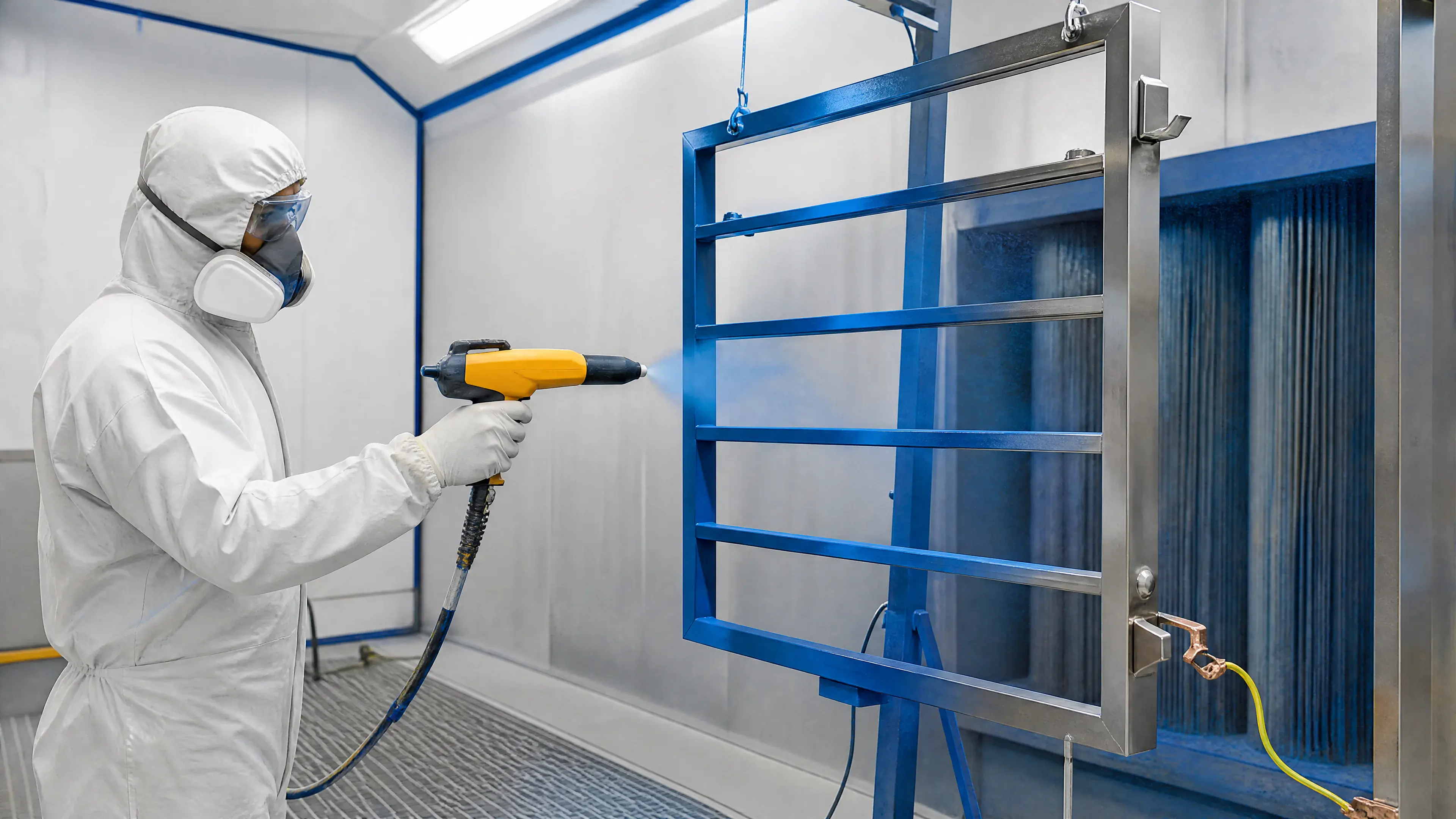
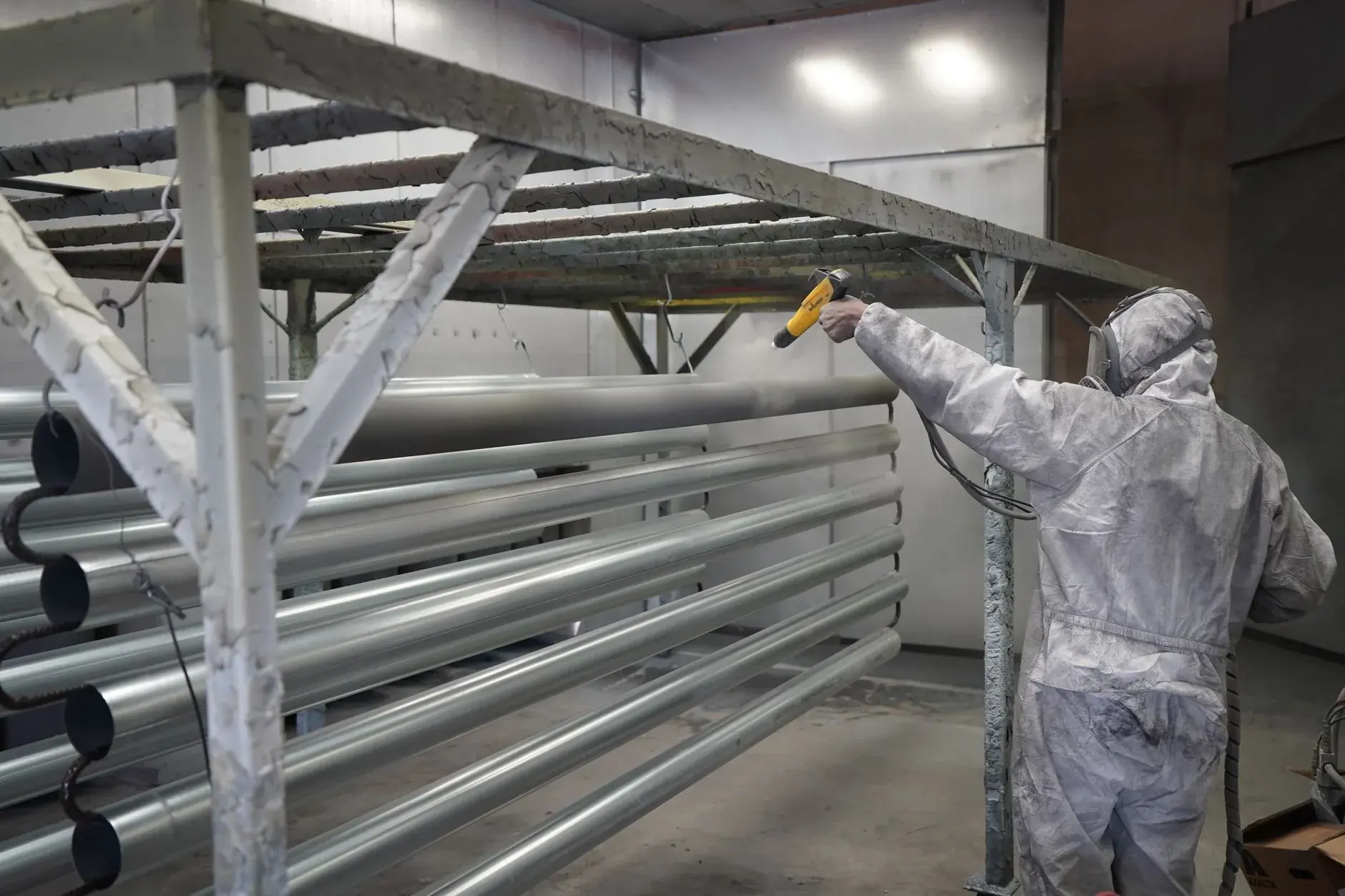
Powder coating applies a dry, finely divided coating material to a prepared part and then forms a continuous film through heat or another qualified curing route. In common electrostatic spray application, charged powder is attracted to an electrically grounded workpiece. The deposited layer flows, gels, and cures or fuses into a film. Thermosetting powders chemically crosslink during cure; thermoplastic powders soften and fuse without the same crosslinking mechanism. The purchase specification must identify which family and formulation are intended [5][8].
The coating is an applied barrier and decorative layer. It is fundamentally different from passivation, which concerns the native stainless surface, and from electropolishing, which removes metal. Powder can add color, gloss, texture, dielectric behavior, or extra environmental separation, but it also hides the substrate from visual inspection and creates interfaces at edges, holes, fasteners, and damaged areas [2][3].
Stainless steel is sometimes coated for color or touch appearance rather than because the bare alloy lacks general corrosion resistance. In other cases the coating helps isolate the metal from a particular exposure. Those purposes lead to different resin, thickness, pretreatment, and testing choices. A cosmetic indoor enclosure should not inherit an expensive severe-service system without reason, and a coastal assembly should not be purchased through color alone.
Lori and co-workers specifically examined stainless steel as a substrate for coil coating [1]. That paper is directly relevant to the substrate/coating interface, although coil coating is not the same production route as electrostatic powder application on a fabricated part. Evidence from a continuous flat strip should therefore inform pretreatment thinking without being treated as proof for welds, sharp edges, recesses, or batch-cured assemblies.
2. How the coating system works
Adhesion at the stainless interface
Organic coating adhesion combines mechanical interlocking, wetting, and interfacial chemical interactions. A stainless surface may be smooth, oily, polished, heat-tinted, contaminated by fabrication, or covered by an intentionally formed oxide. Each condition changes how the pretreatment and molten powder contact the substrate. Cleaning removes shielding soils; controlled roughening can increase effective area and mechanical keying; a qualified conversion or coupling treatment can modify the interface [2][3].
Surface roughness is not automatically beneficial without limit. Amiriafshar and co-workers studied the effect of substrate roughness on coating adhesion for superhydrophobic stainless surfaces [2]. Their coating was not a conventional powder topcoat, so its numerical outcome cannot be transferred. The useful boundary is narrower: stainless surface topography affects adhesion and must be defined as part of a system. An excessively coarse profile can trap contamination, require more film to cover peaks, and leave local thin zones.
Latifi and co-workers studied plasma oxidation of 316L to improve adhesion of a silicone-rubber coating [3]. Again, neither the pretreatment nor coating is automatically equivalent to a powder system. The study does show that altering the stainless oxide/interface can influence adhesion. Any proposed blast, chemical pretreatment, plasma treatment, or primer must be qualified with the actual stainless grade and powder, not selected from an unrelated coating result.
Electrostatic deposition and film formation
During spraying, powder transport and charge determine how much material deposits and where. Broad exposed faces, edges, deep recesses, inside corners, welded pockets, and closely spaced parts do not receive identical electric-field and airflow conditions. Grounding, gun settings, part distance, line speed or dwell, powder flow, reclaim ratio, humidity, and rack loading all affect transfer and thickness distribution [5][7][8].
Recesses can be difficult because field, airflow, and molten-film redistribution differ from exposed flat faces. Gun sequencing, electrostatic settings, touch-up, nozzles, part movement, and racking therefore belong to a qualified geometry-specific route rather than a result inferred from a flat panel [5][7][8].
Particle-size distribution affects powder flow, charging, deposition, packing, and the smoothness of the cured film. Huang and co-workers studied ultrafine powder coating and related fine-particle design to smoother, denser films and corrosion response [7]. That paper supports particle size as a real formulation variable, but it does not establish that simply using the finest available powder will improve every production line; very fine particles can create handling and recovery challenges that the powder manufacturer and coater must manage.
Flow, gel, and cure
Heating causes deposited powder to melt or fuse, flow across the surface, release or trap gases, and, for thermosets, build a crosslinked network. The relevant thermal history is the workpiece’s metal temperature over time, not only the oven-air setpoint. Heavy and thin sections on one assembly heat at different rates, and a thermocouple located away from the slowest region may give misleading cure evidence [6][8].
Mafi and co-workers examined the relationship between cure characterization and corrosion performance for polyester and polyester/epoxy powder coatings [6]. Yuan and co-workers investigated catalytic infrared curing of a polyester powder through experiments and numerical analysis [8]. These studies support control of the full time-temperature history. They do not justify transferring one cure schedule across different powders, colors, film builds, part masses, ovens, or substrate geometries.
Under-cure can leave incomplete network development, weak solvent or mechanical resistance, poor adhesion, or unstable appearance. Excessive thermal exposure can alter color, gloss, flexibility, or polymer properties and may affect the substrate or prior treatment. The approved powder technical specification defines the cure window; production qualification must demonstrate that the coldest relevant metal location reaches it without unacceptable overheating elsewhere [6][8].
3. Variables that control the result
Stainless grade and starting finish
304/304L and 316/316L may both be coated, but grade does not replace surface preparation. A smooth 2B sheet, directional No. 4 finish, bead-blasted panel, cast component, machined surface, and welded assembly present different profiles and soils. Grade, product form, mill finish, fabrication route, and prior chemical treatment should be listed in the RFQ [2].
Heat tint, scale, welding residue, polishing compound, marker, adhesive, coolant, and embedded carbon-steel debris can compromise appearance or adhesion. They need removal through a stainless-compatible, validated route. Pickling or passivation should not be inserted automatically: a passive chemistry optimized for bare corrosion resistance may not be the best immediate interface for a given coating. The pretreatment and coating providers should qualify the complete sequence [2][3].
Cleaning and pretreatment
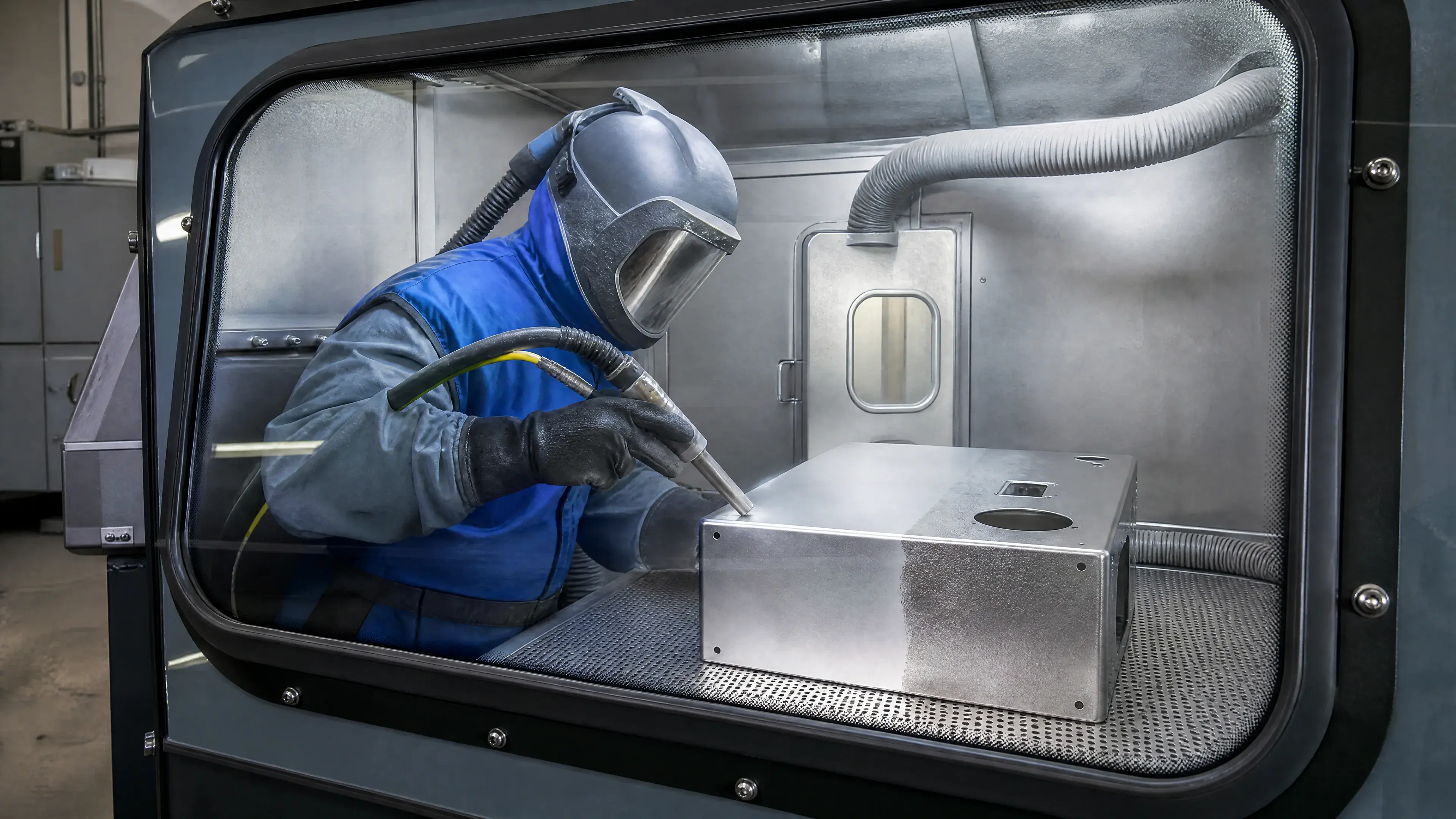
Cleaning must remove oil and particulate without leaving surfactant, salt, or rinse residue. Pretreatment then creates the required surface condition. Options can include controlled abrasion, chemical conversion, plasma treatment, primer, or a combination, but choice depends on powder, service, and environmental constraints. Carbon-steel blasting media should not be assumed acceptable on stainless [2][3][4].
Bajat, Popić, and Mišković-Stanković studied aluminum pretreatment before polyester powder coating [4]. That work is not stainless evidence, and its pretreatment chemistry and corrosion results must not be transferred. It is useful only for the general system principle that pretreatment affects both adhesion and corrosion stability. Stainless qualification must use stainless coupons with the production finish and contamination history.
Rinse quality, drying, and time before coating are also controlled variables. A water-break, flash-rust concept, or appearance check from another substrate is not automatically an acceptance test for stainless. Where residue is critical, specify a validated rinse or surface-cleanliness method. Prepared parts should be protected from dirty gloves, condensation, shop dust, and silicone contamination before spraying [4].
Powder formulation and condition
Resin family influences UV stability, chemical resistance, flexibility, heat response, and appearance. Pigment, filler, crosslinker, flow additive, degassing additive, and texture package also affect the cured film. A color match from one resin family does not prove equivalent outdoor durability or chemical resistance. Powder identification should include the exact product code or an approved performance specification and batch traceability [5][6][8].
Storage temperature and humidity, package opening, shelf life, reclaim ratio, contamination, and particle segregation can change application behavior. Mixed colors or incompatible powders can create specks or cure defects. Reclaimed powder should be controlled to maintain the approved blend and appearance. A production certificate should identify the applied batch or controlled blend when traceability matters [5][7].
Film thickness and geometry
Thickness must be high enough for continuity and performance but within the powder’s validated range. Too little can leave weak coverage at peaks and edges; too much can promote orange peel, poor flow, trapped gas, sag-like behavior, incomplete through-cure, or loss of fit. The actual limits come from the approved system, not a universal powder-coating number [5][7].
Threads, precision bores, earth contacts, sealing faces, bearing fits, weld inspection zones, and identification marks may require masking. Mask edges can build a ridge, and plugs can shadow nearby deposition. The drawing should identify whether dimensions apply before or after coating and whether coating is permitted in holes, on edges, or across joints [5][7].
Cure and part loading
Oven loading changes airflow, radiant view, and thermal mass. A cure profile established on an empty oven or thin panel may not represent a dense rack of mixed-section fabrications. Qualification should place temperature sensors at the slowest-heating and potentially hottest relevant zones, with data tied to the powder’s approved metal-temperature window [6][8].
Fabricated hollow sections can vent oil, water, or trapped air during heating. Weld seams, overlapping sheets, porous castings, and laser-cut edges may release gas into the molten film and form pinholes or craters. Pretreatment drying, vent design, pre-bake, degassing powder, and welding quality can help, but the chosen method must be demonstrated on representative parts [5][6][8].
4. Performance benefits and hard limits
Color, texture, and coverage
Powder coating offers controlled color, gloss, and texture without a liquid solvent carrier in the applied powder. It can cover visual variation in the stainless substrate and create a consistent product identity. Surface appearance still depends on substrate defects, film thickness, cure, and application geometry. A textured coating can conceal minor waviness but does not repair dents, weld undercut, or sharp burrs [5][7].
Color should be specified through an agreed color system or physical standard, with permitted batch and instrument variation. Gloss requires a measurement geometry and target range if important. Texture requires a signed sample because names such as “fine texture” or “wrinkle” are not sufficiently precise across formulations [5][7].
Adhesion and mechanical durability
A qualified system can adhere strongly to prepared stainless, but adhesion is an interface property of substrate, pretreatment, powder, cure, thickness, and conditioning. Tape and pull-off methods measure different responses and are not interchangeable [9][10]. A test result also depends on coating thickness, cut quality, adhesive, fixture, and failure location.
Scratch, abrasion, impact, bend, and wear resistance are separate properties. Barletta and co-workers examined appearance, scratch adhesion, and wear of epoxy thermosetting powder coatings [5], illustrating why “hard coating” is not one complete performance metric. A formulation with high hardness may not provide the flexibility required for a formed panel, and a flexible film may not meet an abrasion requirement.
Corrosion protection
An intact organic film can separate stainless from moisture, salts, and chemicals. System performance depends on permeability, defects, edge coverage, adhesion, pretreatment, and exposure. At a scratch or cut edge, the underlying stainless grade and passive condition again matter. Underfilm migration can occur if contaminants or an unsuitable interface remain [4][6].
Stainless-specific evidence is essential when claiming a service life. Aluminum pretreatment studies, carbon-steel powder panels, and stainless studies using different coating chemistries cannot establish a production stainless powder system [2][3][4]. Use representative coated stainless panels and, where geometry matters, actual-part features such as edges, welds, fasteners, and scribe conditions.
Salt-spray exposure under ASTM B117 operates a controlled fog apparatus; it is not, by itself, a universal predictor of outdoor years or every service environment [12]. If a purchaser requires a test duration or scribe rating, those values must come from the project specification and qualified coating system. This article deliberately supplies no invented exposure-hour claim.
Weathering, chemicals, and temperature
UV radiation, water, heat, cleaning chemicals, solvents, and pollutants affect polymer families differently. Resin and pigment selection must match indoor or outdoor exposure and the required color/gloss retention. A generic “polyester” or “epoxy” label may still be too broad because formulations and cure differ [5][6].
Continuous or cyclic high temperature can soften, embrittle, discolor, or degrade the coating before the stainless loses strength. Chemical immersion can cause swelling, permeation, or loss of adhesion even when bare stainless would resist the fluid. Obtain system-specific data for the actual concentration, temperature, cleaning cycle, and exposure mode; do not infer chemical resistance from powder application alone [5][6].
Damage, repair, and end-of-life
Powder coating can chip or be cut during assembly, transport, or service. Field repair usually creates a different film structure and appearance from factory powder cure. The purchase specification should state allowed repair material, preparation, maximum repair size, color tolerance, and whether repaired zones require separate inspection [5][6].
Coating also changes refinishing routes. A future weld, electrical bond, or repair may require local coating removal and restoration. Design drawings should identify grounding points, weld-after-coat prohibitions, and replaceable coated components where maintenance is expected [5].
5. Substrate and component compatibility
Wrought 304/304L and 316/316L sheet and fabricated parts are reasonable coating candidates when the surface route is qualified. The alloy should still be selected for corrosion at cut edges, fastener interfaces, and damage sites. Coating should not be used to justify a lower grade without service-specific engineering [2][3].
Polished stainless may have inadequate or variable adhesion if coated without suitable preparation. Abrasive roughening can improve mechanical keying but will permanently alter the finish, so masked or future exposed areas need protection. Bead-blasted stainless requires media control and complete removal of dust. A roughness target should include a measurement method rather than only a blast-media name [2].
Welded assemblies need cleaned welds, smooth transitions where required, and freedom from oil-filled crevices. Heat tint beneath an opaque coating should not be ignored merely because it becomes invisible. Enclosed sections need drainage and venting for wet pretreatment and oven heating. Trapped solution can emerge during cure or later service.
Thin sheet may distort during cure, while heavy sections may heat too slowly. Springs, precipitation-hardened parts, adhesives, seals, brazed joints, plated inserts, and heat-sensitive assemblies require temperature compatibility review. Mixed metals can also change pretreatment response and create galvanic interfaces at coating defects [6][8].
Austenitic stainless can complicate some magnetic coating-thickness instruments because its magnetic response differs from carbon steel. Instrument selection and calibration should follow the applicable method on a representative uncoated substrate [11]. Never assume a gauge mode is correct simply because stainless is an iron-based alloy.
6. Inspection and acceptance
Start with lot traceability: stainless grade and finish, powder product and batch, pretreatment procedure, line or booth, reclaim control where relevant, rack configuration, oven load, cure-profile record, coating date, and inspection report. These records connect a failure to the actual system rather than to the color name alone [6][8][11].
Visual inspection should use agreed lighting and distance. Check color, gloss, texture, orange peel, craters, pinholes, inclusions, heavy edges, thin recesses, exposed substrate, mask lines, handling damage, and repair zones. A physical limit sample is more reliable than adjectives for an appearance-critical product [5][7].
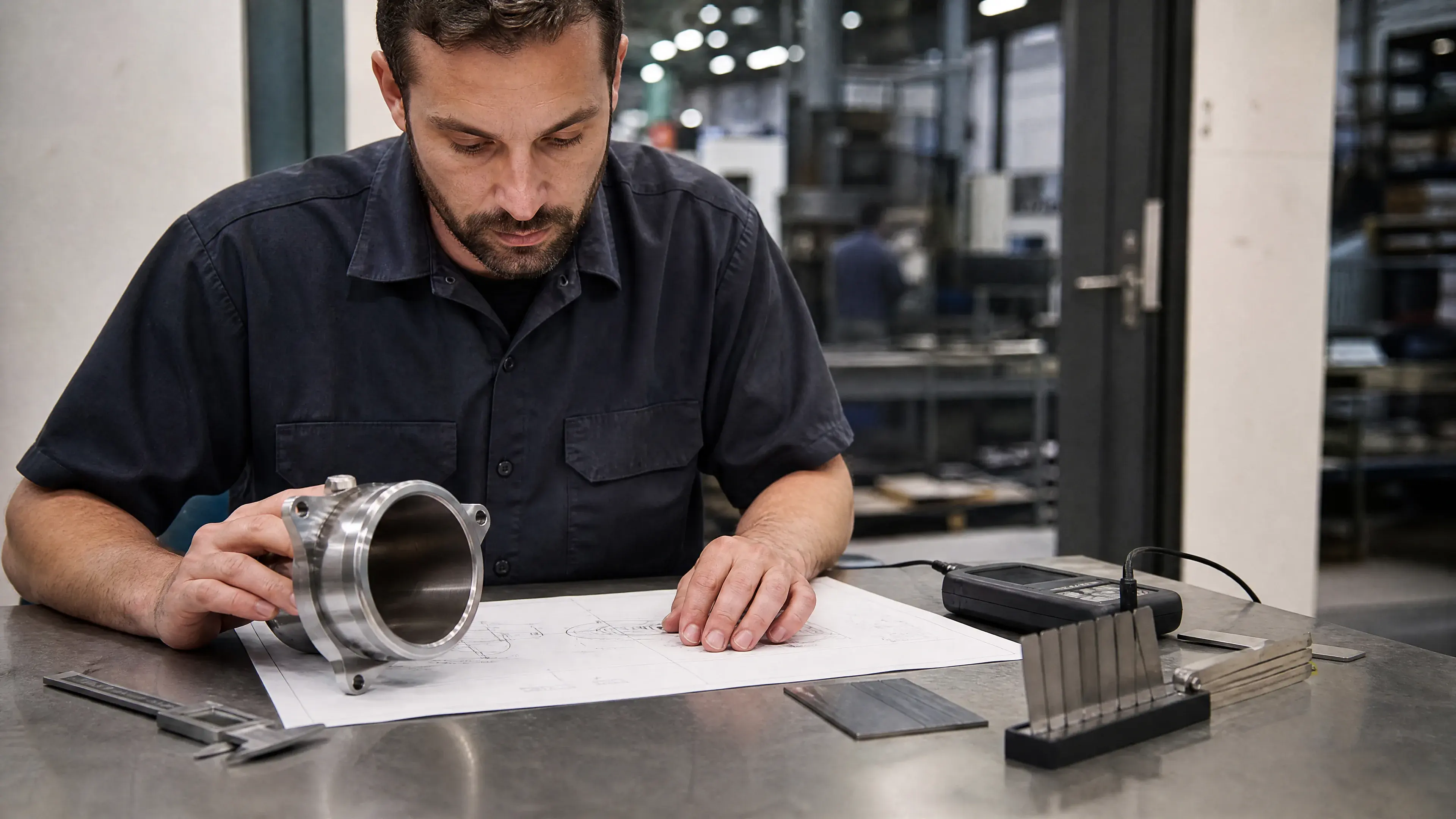
Dry film thickness should be measured with a method appropriate to the nonconductive coating and stainless substrate. ASTM D7091 provides a framework for nondestructive dry-film-thickness measurement on metallic substrates [11]. Calibrate or verify the instrument using the actual bare substrate condition and suitable shims or standards, and define measurement locations, number of readings, edge exclusions, and reporting.
Adhesion can be assessed by tape methods under ASTM D3359 or pull-off strength under ASTM D4541 when appropriate [9][10]. They answer different questions: a cross-cut/tape rating is not a direct tensile stress, and a pull-off result includes dolly adhesive and failure-mode considerations. Specify one method, conditioning, location, acceptance, and whether testing is destructive.
Cure verification may use a production temperature profile, a formulation-specific chemical or mechanical check, or both. A solvent-rub or hardness check is meaningful only when the powder supplier or approved procedure defines its correlation. The core evidence is that the entire relevant part experienced the qualified cure window [6][8].
Corrosion or weathering tests need representative panels and clear scribe, edge, conditioning, evaluation, and acceptance rules. ASTM B117 defines operation of salt-spray apparatus but does not supply a universal service-life conversion [12]. Record exact system build and panel substrate so a passing test on carbon steel or aluminum is not presented as stainless qualification.
7. Practical production workflow
- Contract review. Confirm grade, finish, service, design life basis, color/gloss/texture, powder system, certifications, masked zones, thickness, cure evidence, tests, and records.
- Design and incoming review. Identify sharp edges, recesses, overlap joints, hollow sections, drain and vent paths, mixed materials, heat-sensitive items, and post-coat fit dimensions.
- Surface assessment. Inspect oil, marker, oxide, heat tint, polishing compound, weld residue, rust contamination, scratches, and starting roughness.
- Clean and pretreat. Apply the qualified stainless-compatible sequence; control rinse, drying, prepared-surface protection, and time to coating [2][3].
- Mask and rack. Protect threads, fits, earth points, sealing faces, markings, and specified bare zones; provide reliable grounding and consistent orientation.
- Apply powder. Control product identity, powder condition, reclaim, gun and airflow settings, part distance, touch-up sequence, and coverage in recesses.
- Cure the actual part. Demonstrate required metal-temperature history at representative cold and hot locations for the production load [6][8].
- Cool, unmask, and handle. Avoid imprinting, contamination, chipping, or packaging before the film reaches a suitable handling condition.
- Inspect and release. Complete visual, thickness, adhesion, cure, color/gloss, dimensional, and project-specific corrosion checks; link results to the lot.
For a new part family, first-article approval should use production stainless, pretreatment, powder batch family, rack density, oven load, masks, and measurement locations. A flat laboratory panel remains useful for control, but it does not prove coverage in a deep recess or cure in the heaviest welded section [6][8].
8. Alternatives and neighboring processes
Bare finished and passivated stainless preserves the metallic appearance and avoids coating damage or underfilm interfaces. It may be preferable when the selected grade already meets the environment and color is unnecessary. It still needs a suitable finish, weld cleanup, and contamination control [2][3].
Liquid paint is a different organic-coating route with its own solvent or mixing, edge, cure, repair, and application controls. It should be selected as a complete qualified system rather than as a presumed equivalent color layer [5][6].
Electrophoretic coating is a separate immersion/electrical route that can be evaluated as a primer for compatible conductive parts. Bath access, drainage, pretreatment, bake compatibility, and the exact powder-over-primer stack require direct qualification.
PVD or other thin-film deposition creates a different, much thinner surface system. Substrate finish, deposition access, scratch behavior, adhesion, and corrosion validation cannot be inferred from powder-coating evidence [2][3].
Thermal spray and fused coatings are distinct deposition processes. The word “powder” in their feedstock does not make them equivalent to the organic thermosetting powder systems discussed here; specifications should name the mechanism and material system explicitly [5].
9. Typical applications
Architectural panels and trim
Stainless coil coating is a published research topic [1], but the metadata-only record does not establish an architectural performance result. For architectural panels, success depends on an exterior-rated formulation where required, consistent panel pretreatment, batch color control, edge coverage, joint design, and approved visual samples. Flat-product development does not replace fabricated-panel qualification.
Equipment housings and control enclosures
Coated stainless can combine a colored exterior with exposed stainless interiors or cut edges. Masked earth points, hinges, fasteners, gaskets, ventilation, and post-coat fit deserve explicit drawing notes. Outdoor, washdown, or chemical-cleaning environments each require different system validation [5].
Furniture, fixtures, and consumer-facing parts
Color, touch, low-gloss texture, and fingerprint hiding may be primary requirements. Appearance samples should include welds, bends, and visible edges. Abrasion, scratch, cleaning-chemical, and repair criteria should reflect actual use rather than a generic hardness label [5].
Process and laboratory accessories
Frames, guards, carts, and non-wetted accessory parts may use powder-coated stainless for visibility or identification. Wetted, product-contact, vacuum, or regulated surfaces require separate compatibility and compliance review. A colored powder should never receive a regulated-contact claim without formulation-specific, jurisdiction-specific evidence [5][6].
10. RFQ checklist
- Stainless grade, product form, mill finish, weld condition, prior treatment, and material traceability.
- Drawing revision, quantities, lot definition, critical dimensions, and dimensions before versus after coating.
- Service environment: indoor/outdoor, UV, temperature range, chemicals, washdown, immersion, coastal salts, abrasion, and maintenance.
- Required powder resin family, product code or performance specification, color, gloss, texture, and approved substitutions.
- Required declarations or certifications for restricted substances, contact, smoke/fire, electrical, or regulated use; name the governing jurisdiction and edition.
- Qualified cleaning and pretreatment sequence, permitted abrasives/chemicals, surface profile, rinse, and prepared-part hold controls.
- Coated, masked, and bare zones; permitted rack points; threads, fits, earth contacts, seals, and markings.
- Dry-film-thickness range, method, substrate calibration, measurement sites, sampling, and edge rules [11].
- Cure requirement based on actual part-metal temperature, production load, profile records, and any formulation-specific confirmation [6][8].
- Visual defect, color, gloss, texture, adhesion, impact/abrasion, and corrosion test requirements with conditioning and acceptance [5][9][10][12].
- First-article and representative-panel requirements, including welds, edges, recesses, and heavy sections.
- Repair procedure and limits, packaging, certificate wording, traceability records, and failed-lot disposition.
11. Frequently asked questions
Will powder coating adhere directly to polished stainless steel?
It may initially deposit, but durable adhesion cannot be assumed. Oil, polishing compound, low or inconsistent surface profile, and an unqualified interface can cause failure. Use a cleaning and pretreatment route validated with the actual polished grade and powder, then verify adhesion by the specified method [2][3].
Does stainless steel need blasting before powder coating?
Not always. Controlled abrasion is one pretreatment option, but chemical, plasma, primer, or combined routes may be appropriate. Blasting changes appearance and profile and can contaminate stainless if the media or equipment is unsuitable. The system should be qualified rather than chosen by a universal rule [2][3].
Is oven temperature the same as cure temperature?
No. Oven air may reach its setpoint before a thick or densely loaded part reaches the required metal temperature. Cure evidence should follow actual part-metal temperature over time at representative locations and the approved powder window [6][8].
Does a salt-spray result predict years of outdoor life?
No direct universal conversion exists. ASTM B117 defines a controlled salt-fog apparatus, while outdoor exposure combines UV, wet/dry cycling, temperature, pollutants, design, damage, and maintenance. Use the test as one specified comparison within a qualified system, not as a calendar-life equation [12].
References
- Lori, L., Tamba, A., Deflorian, F., Fedrizzi, L., & Bonora, P. L. “Stainless steel as new substrate for coil coating.” Progress in Organic Coatings (1996). https://doi.org/10.1016/0300-9440(95)00528-5. Access note: DOI metadata verified; no abstract or lawful full text was inspected. The source is used only to identify the stainless coil-coating research topic stated in its title and is not treated as a batch powder-coating trial.
- Amiriafshar, M., Rafieazad, M., Duan, X., & Nasiri, A. “Fabrication and coating adhesion study of superhydrophobic stainless steel surfaces: The effect of substrate surface roughness.” Surfaces and Interfaces (2020). https://doi.org/10.1016/j.surfin.2020.100526. Access note: DOI metadata and indexed abstract verified; the coating is not represented as a conventional powder topcoat, and use is limited to the stainless roughness/adhesion relationship.
- Latifi, A., Imani, M., Khorasani, M. T., & Daliri Joupari, M. “Plasma surface oxidation of 316L stainless steel for improving adhesion strength of silicone rubber coating to metal substrate.” Applied Surface Science (2014). https://doi.org/10.1016/j.apsusc.2014.09.084. Access note: DOI metadata and indexed abstract verified; use is limited to the effect of stainless interface treatment, not powder-system performance.
- Bajat, J. B., Popić, J. P., & Mišković-Stanković, V. B. “The influence of aluminium surface pretreatment on the corrosion stability and adhesion of powder polyester coating.” Progress in Organic Coatings (2010). https://doi.org/10.1016/j.porgcoat.2010.07.004. Access note: DOI metadata and indexed abstract verified; substrate is aluminum, so no numerical result or stainless-specific conclusion is transferred.
- Barletta, M., Lusvarghi, L., Pighetti Mantini, F., & Rubino, G. “Epoxy-based thermosetting powder coatings: Surface appearance, scratch adhesion and wear resistance.” Surface and Coatings Technology (2007). https://doi.org/10.1016/j.surfcoat.2007.02.017. Access note: DOI metadata and indexed record verified; use is limited to powder-film property categories, without transferring substrate-specific values.
- Mafi, R., Mirabedini, S. M., Naderi, R., & Attar, M. M. “Effect of curing characterization on the corrosion performance of polyester and polyester/epoxy powder coatings.” Corrosion Science (2008). https://doi.org/10.1016/j.corsci.2008.08.037. Access note: DOI metadata and indexed abstract verified; no reported cure schedule or corrosion value is generalized to stainless.
- Huang, J., Yang, M. S., Wan, L., Tang, K., Zhang, H., Chen, J., Noël, J. J., Barker, I., Zhang, H., & Zhu, J. “Ultrafine powder coating: Smooth surface, dense structure and enhanced corrosion resistance.” Chemical Engineering Journal (2022). https://doi.org/10.1016/j.cej.2022.140815. Access note: DOI metadata and indexed abstract verified; full text was not available, and use is limited to the studied formulation variables named in the record.
- Yuan, Y., Pan, S., Wang, T., Xia, L., Liu, Y., Wang, T., & Li, L. “Experimental and Numerical Investigations on Curing a Polyester-Based Powder Coating by Catalytic Infrared Radiation.” Applied Sciences, 13 (2023), 2187. https://doi.org/10.3390/app13042187. Access note: open-access full text reviewed; its infrared system and test geometry are not treated as universal production conditions.
- ASTM International. ASTM D3359-23, Standard Test Methods for Rating Adhesion by Tape Test. https://doi.org/10.1520/D3359-23. Access note: official DOI and metadata verified; protected clause text and rating criteria were not accessed or reproduced.
- ASTM International. ASTM D4541-22, Standard Test Method for Pull-Off Strength of Coatings Using Portable Adhesion Testers. https://doi.org/10.1520/D4541-22. Access note: official DOI and metadata verified; protected procedural details and acceptance values were not accessed or reproduced.
- ASTM International. ASTM D7091-22, Standard Practice for Nondestructive Measurement of Dry Film Thickness of Nonmagnetic Coatings Applied to Ferrous Metals and Nonmagnetic, Nonconductive Coatings Applied to Non-Ferrous Metals. https://doi.org/10.1520/D7091-22. Access note: official DOI and metadata verified; protected instrument and calibration clauses were not accessed or reproduced.
- ASTM International. ASTM B117-19, Standard Practice for Operating Salt Spray (Fog) Apparatus. https://doi.org/10.1520/B0117-19. Access note: official DOI and metadata verified; protected apparatus conditions were not accessed or reproduced, and the standard is not presented as a service-life model.
Continue the specification
Related surface-finish guides
Specify before production
Need a finish quoted against a drawing or control sample?
Send the material grade, product form, finish requirement, inspection method and quantity. We will identify the unresolved specification points before quoting.
Discuss the requirement