In short: Type 304L is the preferred austenitic grade for welded fabrications that must resist corrosion in service. Its carbon ceiling of ≤ 0.030% suppresses chromium-carbide precipitation in the weld heat-affected zone — the sensitisation mechanism that robs standard 304 of its corrosion resistance around welds. The result: as-welded 304L assemblies need no post-weld annealing to retain their intergranular corrosion resistance. Strength is slightly lower than 304 — a trade-off almost always worth making for welded corrosion-service applications. For high-temperature pressure service where creep governs, see 304H; for chloride environments, see 316.
What 304L Stainless Steel Is
Type 304L is the extra-low-carbon variant of the world's most widely used stainless steel family. Its composition is identical to standard 304 in every respect but one: carbon is held to ≤ 0.030% — roughly one-third the maximum permitted in standard 304 — and that single change transforms how the material behaves around welds.[1]
Across standards it carries several equivalent designations: in the Unified Numbering System it is UNS S30403; in the European EN system it is 1.4307 (X2CrNi18-9); and in Japanese practice it is SUS 304L. All three refer to the same extra-low-carbon austenitic grade. It is the default specification wherever welded assemblies must retain full corrosion resistance without post-weld heat treatment.[1]
Chemical Composition
The composition of 304L is almost indistinguishable from 304 — the same 18% chromium, the same 8–10% nickel, the same controls on manganese, silicon, phosphorus, and sulphur. The decisive difference is a carbon maximum of 0.030%, and an optional nickel ceiling raised to 12% (giving producers more room to ensure a fully austenitic structure at the lower carbon).[1]
| Element | Symbol | Content (wt%) | Role |
|---|---|---|---|
| Chromium | Cr | 18–20 | Forms the self-healing passive oxide film |
| Nickel | Ni | 8–12 | Stabilises the ductile, non-magnetic austenite phase |
| Carbon | C | ≤ 0.03 | Key limit — held ≤ 0.030% to suppress chromium-carbide precipitation and sensitisation in welds |
| Manganese | Mn | ≤ 2 | Deoxidiser; aids hot working and austenite stability |
| Silicon | Si | ≤ 0.75 | Deoxidiser; assists oxidation resistance |
| Iron | Fe | Balance | Base metal |
Specified composition limits per ASTM A240 / ASME SA-240 for UNS S30403.[1]
Crystal Structure: FCC Austenite
Like all 304-family grades, 304L is a solid solution of several elements in iron — not a compound and not a molecule. Its crystal structure at room temperature is face-centred cubic (FCC) austenite: atoms arranged at every corner and face-centre of a cubic unit cell. The roughly 8–10% nickel stabilises this FCC phase down to cryogenic temperatures, giving the grade its defining characteristics of high ductility, excellent formability, and essentially non-magnetic behaviour in the annealed state.[1]
304L's austenite is metastable — sitting just at the edge of thermodynamic stability. Heavy cold work transforms some austenite into α′-martensite (TRIP effect), raising strength and work-hardening rate. One consequence: a heavily drawn 304L part can become slightly magnetic even though the annealed sheet was not.[7]
Why It Doesn't Rust — and Why Welds Stay Corrosion-Resistant
The passive film mechanism in 304L is identical to 304: chromium above ~11% spontaneously grows a dense, nanometre-thin Cr₂O₃-rich oxide layer that self-repairs when scratched. Surface analysis confirms this film is composed mainly of chromium and iron oxides, with chromium enriched at the surface relative to the bulk — and that chromium enrichment is what governs corrosion resistance.[3] Scratch experiments show the passive film largely reconstructs within approximately 2 hours, with the regrown film showing a markedly higher Cr/Fe ratio.[4]
The critical advantage of 304L is what happens in the weld heat-affected zone (HAZ). Every weld thermally cycles the adjacent metal through 450–850 °C — the sensitisation range. In standard 304, carbon migrates to grain boundaries and combines with chromium to form M₂₃C₆ carbides. Each carbide consumes chromium from the surrounding matrix, creating narrow chromium-depleted zones where the passive film cannot form — the basis of intergranular corrosion. Numerical modelling and electrochemical measurement confirm that the degree of sensitisation (DOS) in the weld decay zone scales directly with the carbon content and heat input.[2] At ≤ 0.030% C, there is simply not enough carbon to drive significant carbide precipitation during a typical weld cycle. The boundaries stay chromium-rich, the passive film stays intact, and the welded joint is as corrosion-resistant as the unwelded plate.
The passive film's one chronic weakness — chloride ions — applies equally to 304L. For environments carrying significant chloride, molybdenum-bearing grades (316, 316L) are required.
Mechanical & Physical Properties
Specified minimum values per ASTM A240 for annealed 304L:[1]
| Tensile strength (MPa) | ≥485 |
| Yield strength (MPa) | ≥170 |
| Elongation (%) | ≥40 |
| Hardness | ≤201 HB |
| Density (g/cm³) | 7.93 |
| Elastic modulus (GPa) | 193 |
| Magnetic response | Non-magnetic (annealed) |
The slight reduction in tensile and yield strength relative to 304 comes from removing carbon's solid-solution strengthening contribution. For the fabricated structures and pressure equipment where 304L is specified, this is rarely the governing constraint — weld corrosion integrity is.
304L's austenite is metastable, and the TRIP (transformation-induced plasticity) effect applies just as in 304. Cold deformation transforms some austenite into α′-martensite, raising the work-hardening rate at higher strains and simultaneously boosting strength and ductility.[7]
Key Characteristics
- As-welded intergranular corrosion resistance. The defining property. Post-weld annealing is not required for 304L assemblies entering aqueous or humid service — the low carbon prevents sensitisation in the HAZ.[2]
- Identical corrosion resistance (unwelded) to 304. Same chromium content, same passive film, same self-healing behaviour. For non-welded parts, the two grades are interchangeable from a corrosion standpoint.
- Excellent formability. The FCC austenite gives the same deep-drawing, bending, spinning and roll-forming behaviour as 304, with the same TRIP-driven work-hardening.
- Weldability. All common methods (TIG, MIG, stick, SAW) work without preheat. Use low-carbon filler (308L or 316L) to maintain the low-carbon integrity of the deposit.
- Slight strength penalty. Tensile and yield minimums are lower than 304. This matters for some structural applications but is inconsequential for most fabricated process equipment.
How 304L Is Made
Production follows the same route as 304, with tighter control on the refining stage. The key step is the argon–oxygen decarburisation (AOD) vessel, where the melt is treated until carbon falls to ≤ 0.030% while chromium is preserved. The extra decarburisation time and tighter chemistry windows add modest cost — which is why 304L carries a small price premium over standard 304.
The AOD step is where the extra-low-carbon target of ≤ 0.030% is achieved, with nitrogen injection and careful slag chemistry to minimise chromium losses while stripping carbon.
304L vs 304 and 304H — Carbon, Sensitisation, and Strength
The 304 family is defined by carbon content. 304L sits at one end (minimum corrosion risk from welding), 304H at the other (maximum high-temperature strength). Standard 304 occupies the middle ground.
Manganese-sulphide (MnS) inclusions are the primary pit-initiation sites in all three grades when exposed to chloride solutions — their dissolution in NaCl drives pitting corrosion along the MnS/matrix boundary.[5] None of the 304-family grades resists serious chloride attack; that requires the molybdenum in 316 or 316L. For food and beverage service — where 304L is widely used — the same chloride sensitivity applies.[6]
Variants & Related Grades
304L sits within a closely related family:
- [304](/en/materials/stainless-steel/304) — the standard grade (C ≤ 0.08%). Slightly higher strength; the default for unwelded or rarely-welded general applications.
- [304H](/en/materials/stainless-steel/304h) — high-carbon version (C 0.04–0.10%). Superior creep and rupture strength above 427 °C for boilers and pressure vessels; not for as-welded aqueous service.
- [316L](/en/materials/stainless-steel/316l) — the molybdenum-bearing low-carbon grade: combines 304L's weld-zone corrosion resistance with 316's superior chloride pitting and crevice resistance. The choice when both welded fabrication and chloride exposure are in play.
In many specifications, 304 and 304L are "dual-certified" — a heat that meets both carbon limits simultaneously satisfies both standards, giving fabricators flexibility.
Applications by Industry
304L's combination of weld compatibility and full corrosion resistance makes it the fabricator's default wherever assemblies must resist aqueous or humid attack.
Chemical & Process Industry
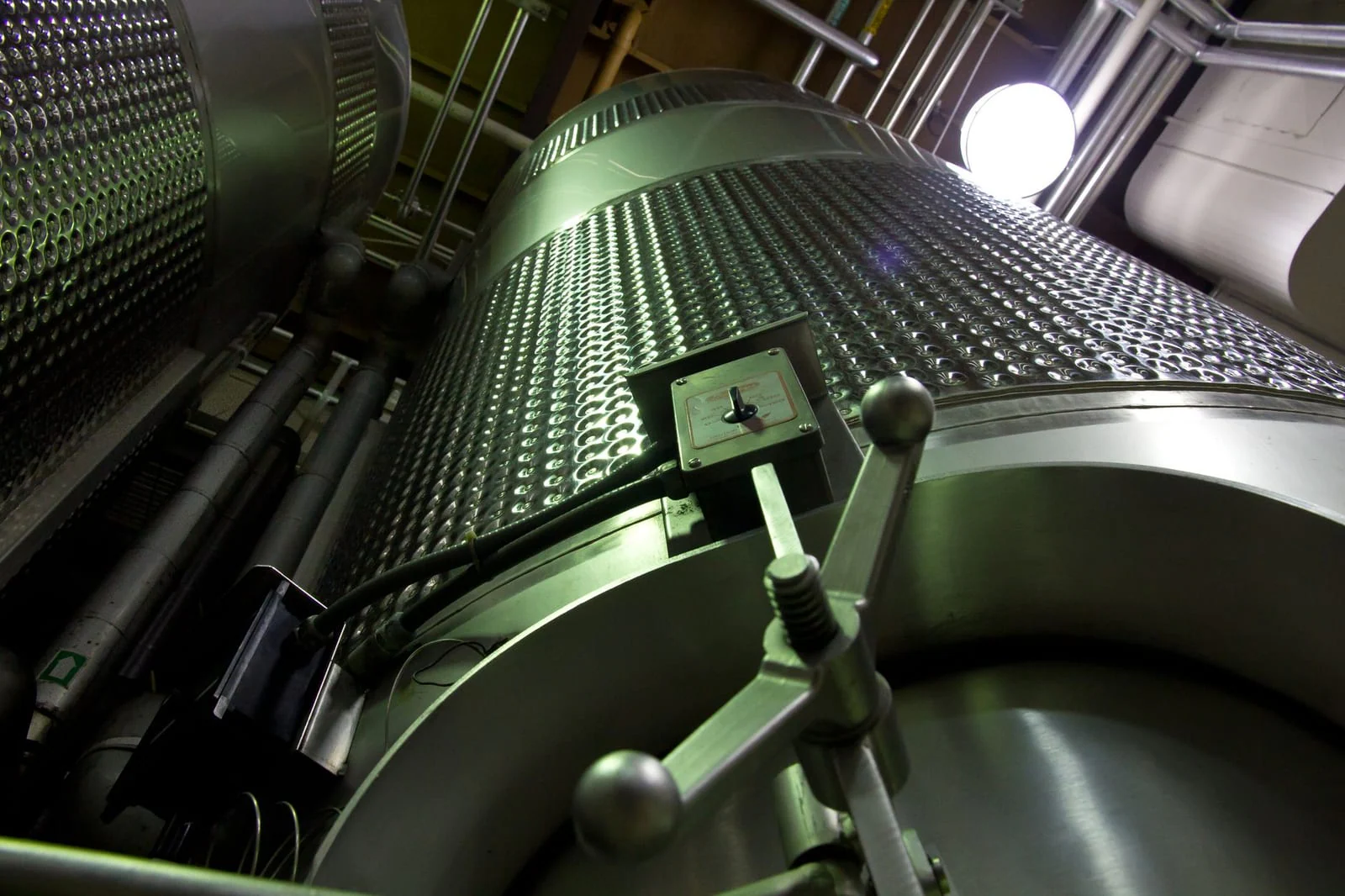
Welded tanks, vessels, and pipework in chemical and petrochemical processing. The ability to weld without post-weld annealing dramatically simplifies construction of large, complex, or site-welded equipment handling acids, caustics, and process streams.[2]
Food & Beverage Processing
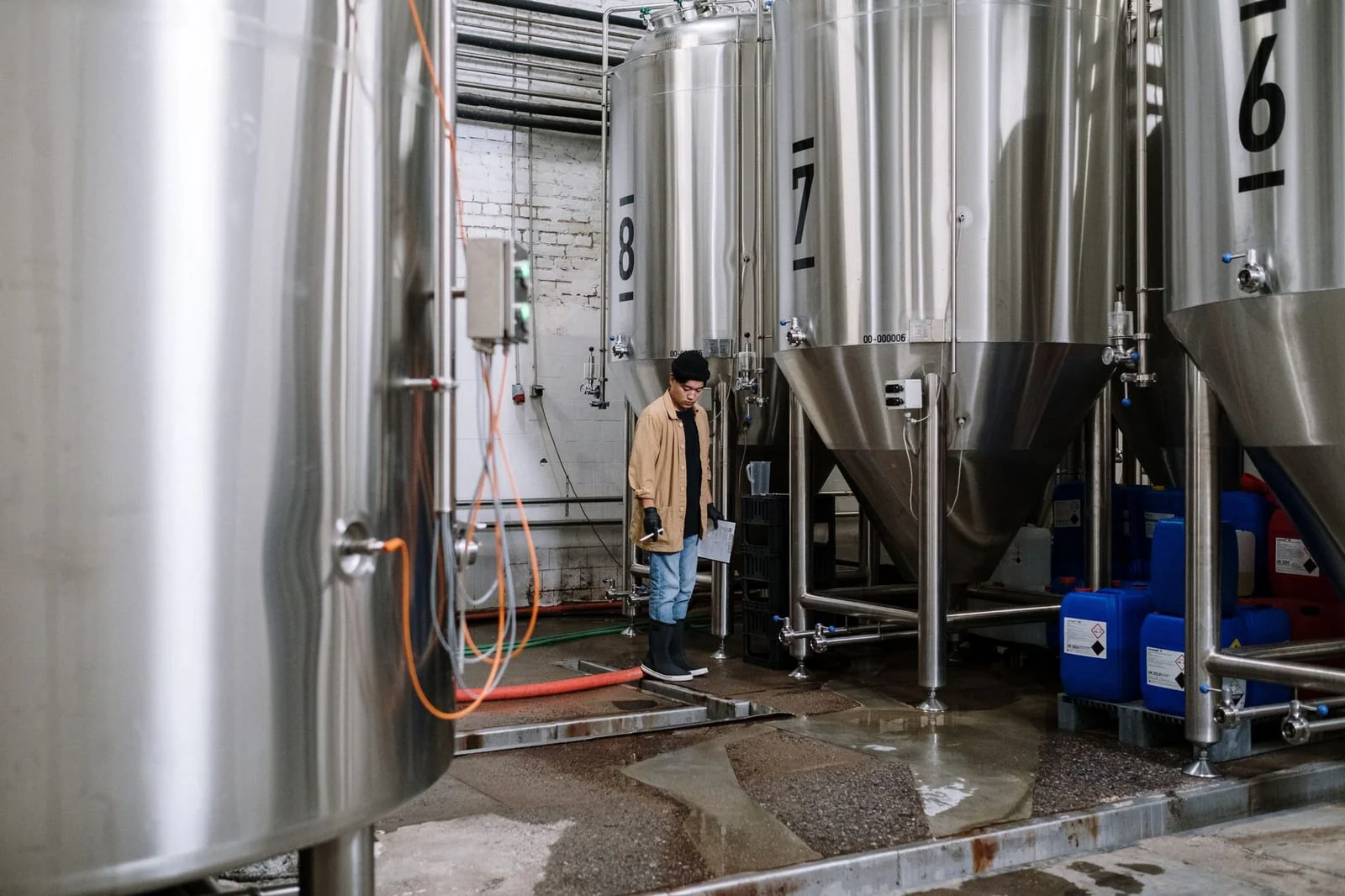
A direct substitute for 304 wherever welded fabrications are specified — tanks, mixers, conveyors, pipework, and dairy equipment. The same corrosion resistance, hygienic cleanability, and cost-effectiveness as 304, with the added confidence that weld zones will not become preferential corrosion sites.[6]
Pharmaceutical & Biotech
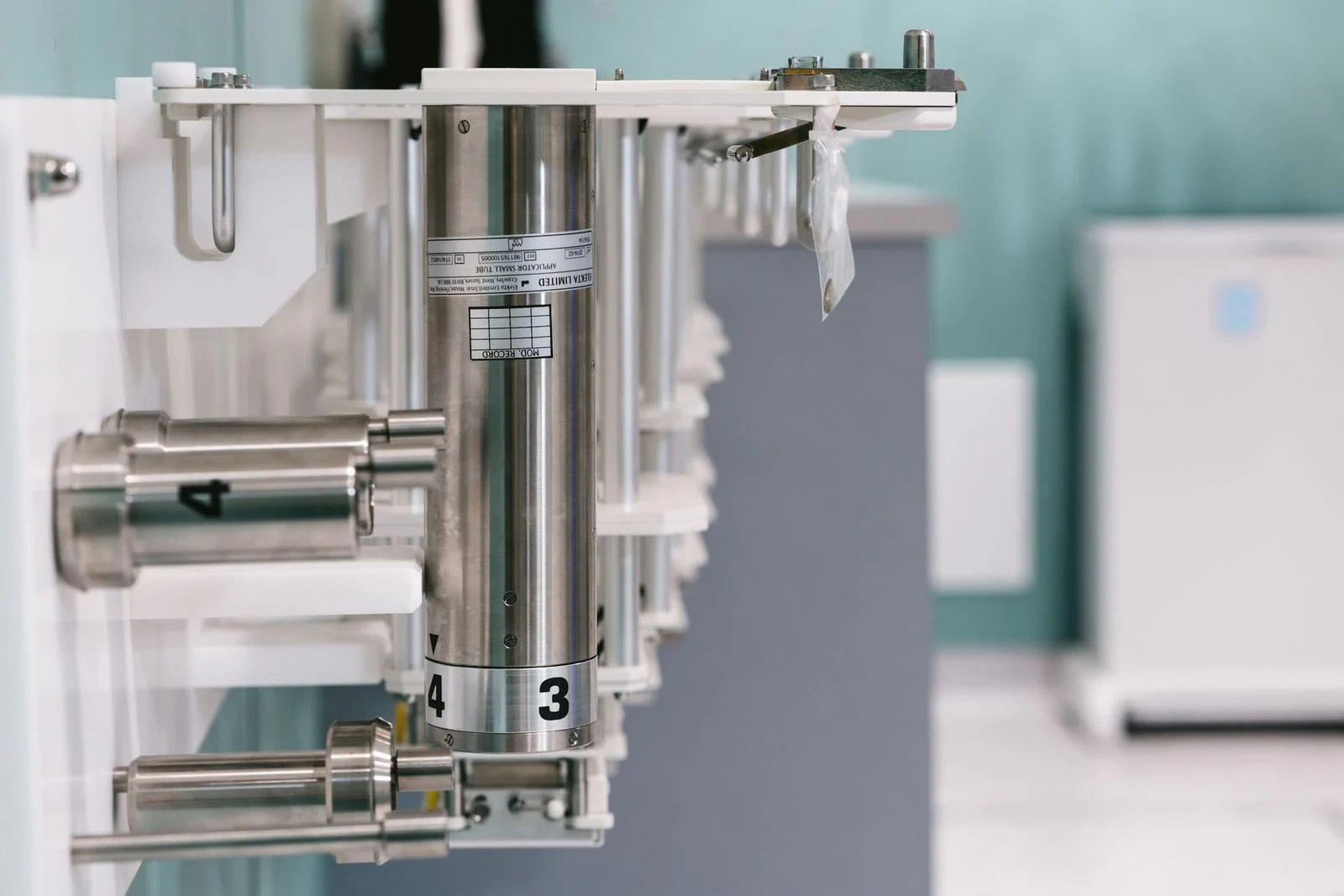
Cleanroom piping, bioreactor vessels, fermenters, and sterile processing equipment. Weld quality and corrosion integrity are critical for CIP (clean-in-place) systems, and post-weld annealing of large installed systems is impractical — 304L solves both requirements simultaneously.
Water Treatment
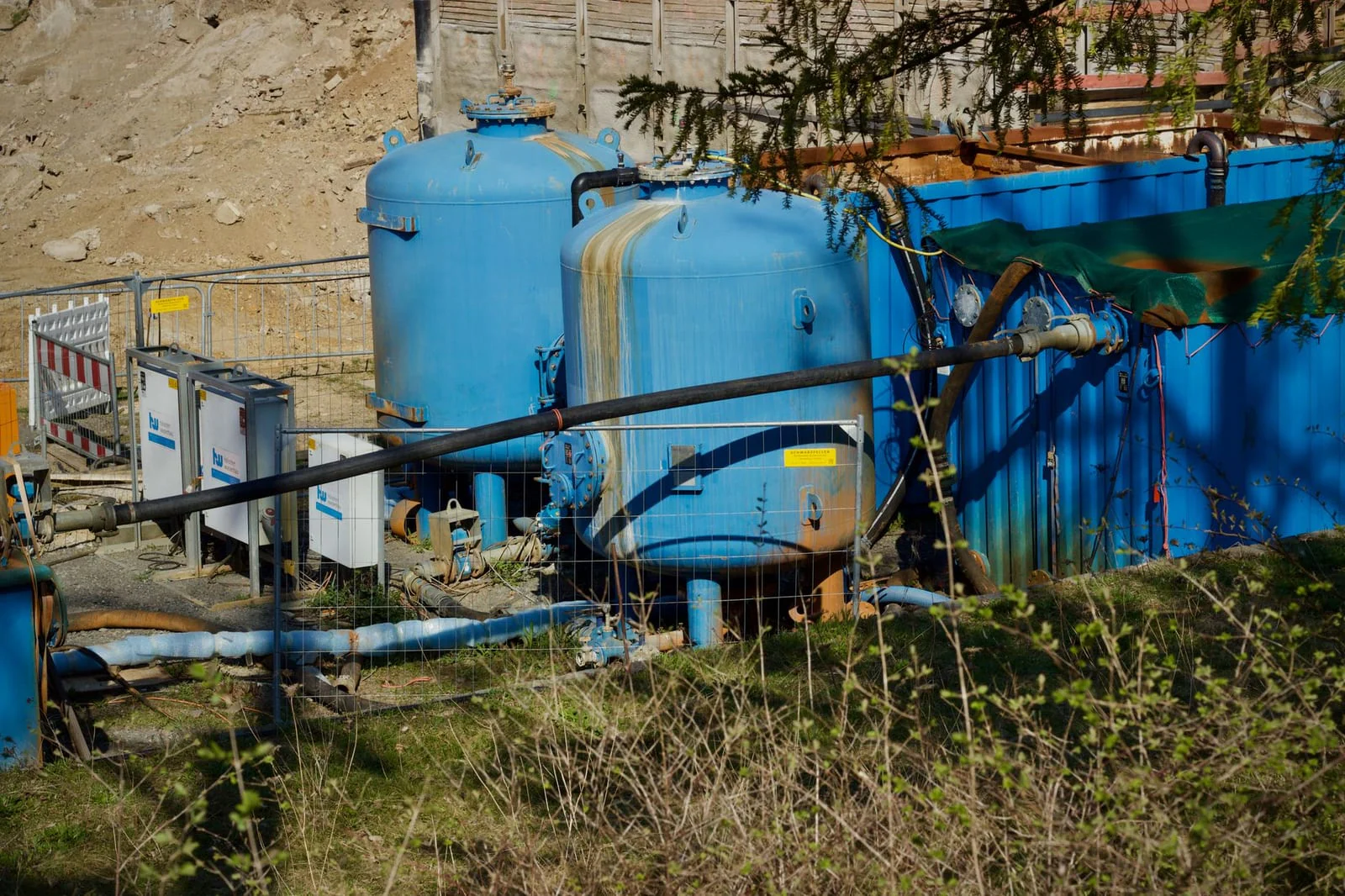
Water and wastewater treatment equipment, desalination pre-treatment trains, and distribution pipework where welded construction is standard and decades of service life are expected without corrosion maintenance.
Forms & Finishes
Common product forms:CoilSheetPlateTubeBar
Surface finishes:2BBANo.4HLMirror
A smoother finish leaves fewer surface crevices for contaminants to lodge in, giving marginally better corrosion performance and easier cleaning — relevant for food and pharmaceutical applications.
References
- Grade 304L Stainless Steel for Severely Corrosive Conditions (UNS S30403). AZoM (materials datasheet, Masteel UK Ltd, based on ASTM/AISI grade system). azom.com/article.aspx?ArticleID=5049
- A new numerical model to predict welding-induced sensitization in SUS304 austenitic stainless steel joint.. Dai P., Li S., Wu L., Wang Y., Feng G., Deng D. Journal of Materials Research and Technology, vol. 17, pp. 234–243 (2022). doi.org/10.1016/j.jmrt.2022.01.015
- Characterization of Passive Films Formed on As-received and Sensitized AISI 304 Stainless Steel.. Zhang Y., Luo H., Zhong Q., Yu H., Lv J. Chinese Journal of Mechanical Engineering, vol. 32 (2019). doi.org/10.1186/s10033-019-0336-8
- Reconstruction of the Passive Layer of AISI 304 and 316 Steel After Scratching.. Charazińska S., Sikora A., Malczewska B., Lochyński P. Materials, vol. 17, 6238 (2024). doi.org/10.3390/ma17246238
- Evolution of the Corrosion Products around MnS Embedded in AISI 304 Stainless Steel in NaCl Solution.. Li D., Hao H., Wang Z., Nyakilla E. E. et al. Materials, vol. 17, 4050 (2024). doi.org/10.3390/ma17164050
- Study of the Corrosion Behavior of Stainless Steel in Food Industry.. Rossi S., Leso S. M., Calovi M. Materials, vol. 17, 1617 (2024). doi.org/10.3390/ma17071617
- Strain induced martensite formation and its effect on strain hardening behavior in the cold drawn 304 austenitic stainless steels.. Choi J. Y., Jin W. Scripta Materialia, vol. 36 (1997). doi.org/10.1016/S1359-6462(96)00338-7