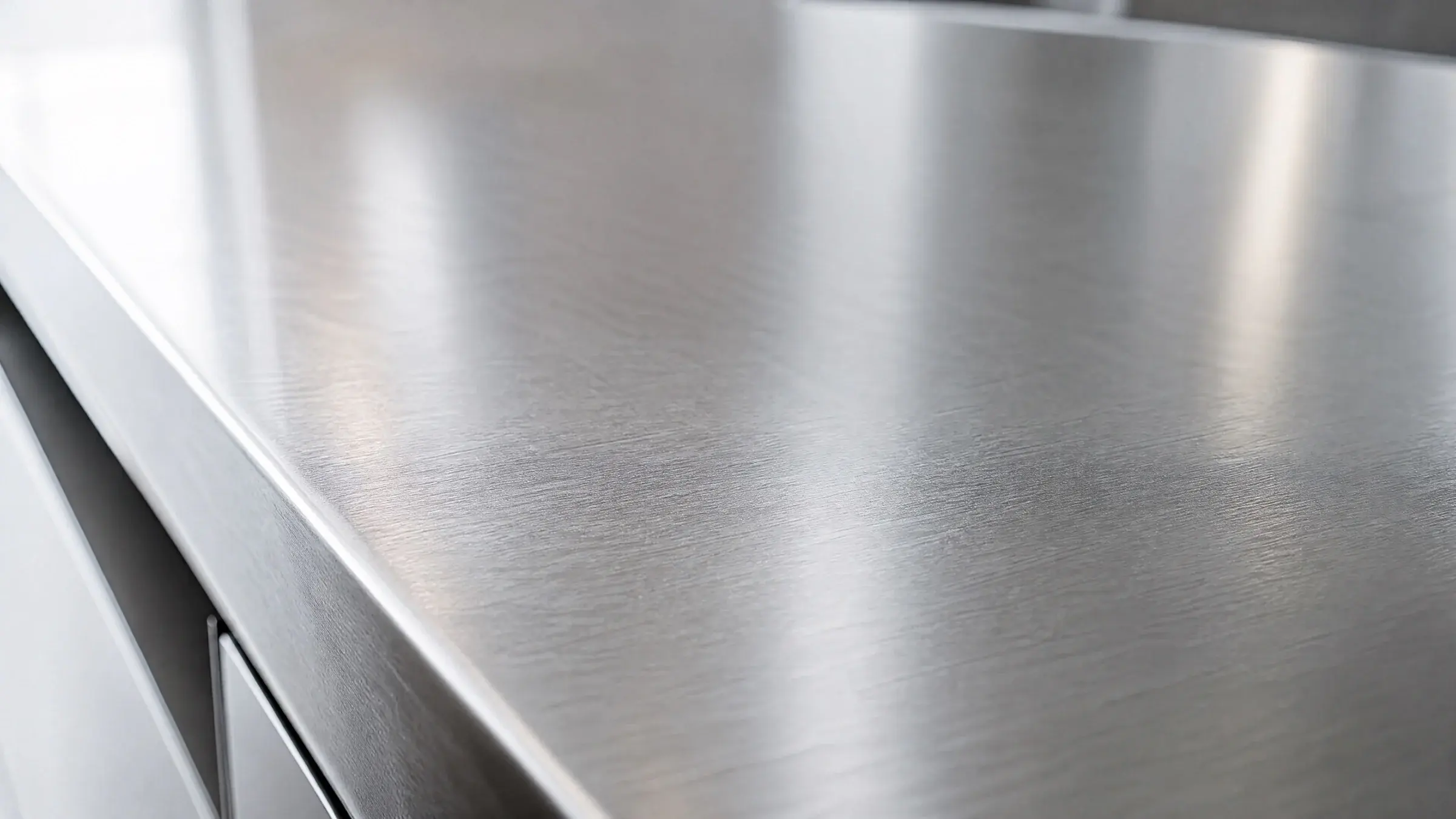
In short: Type 321 is the classic austenitic 18/8 stainless steel upgraded with titanium. That titanium has one job: bind with carbon before chromium can, keeping grain boundaries rich in chromium and free of the carbide films that cause sensitisation. The result is a grade that shrugs off intergranular corrosion in the 425–850 °C range that severely weakens plain 304 — making 321 the preferred choice for exhaust systems, boiler superheater tubes, aerospace heat exchangers, and any welded assembly that must resist corrosion without post-weld annealing. The alternative low-carbon approach of 304L reduces the carbon available for carbides; 321 instead intercepts those carbons with titanium — a fundamentally more robust stabilisation strategy for high-temperature service.
What 321 Stainless Steel Is
Type 321 starts from the same recipe as 304 — roughly 18% chromium and 10% nickel in an iron base — but adds a deliberate amount of titanium. In the Unified Numbering System it is UNS S32100; in Europe it is 1.4541 (X6CrNiTi18-10); in Japan it is SUS 321; and per the AISI system it is simply Grade 321. All refer to the same titanium-stabilised austenitic stainless steel.[1]
The reason titanium is added — and why 321 exists at all — comes down to a failure mode called *sensitisation*. When any austenitic stainless steel is held between roughly 450 and 850 °C (for instance, in the heat-affected zone of a weld, or in high-temperature service), carbon migrates to the grain boundaries and combines with chromium to form chromium carbides. This locally strips chromium from the metal adjacent to those boundaries, leaving a corrosion-vulnerable zone. The alloy is then said to be *sensitised*, and intergranular corrosion can propagate along those depleted boundaries in service.
Titanium solves this by offering carbon a more stable home. TiC is thermodynamically more stable than Cr₂₃C₆, so titanium preferentially seizes the carbon — leaving chromium free to remain in solid solution and maintain the protective passive film right up to the grain boundary. Grade 321 is therefore described as a stabilised grade, as distinct from the low-carbon route taken by 304L (see below).[2][5]
Chemical Composition
The composition of 321 is essentially that of 304 with titanium added and nickel nudged slightly higher to compensate for the extra austenite-destabilising effect of titanium. The chart below shows the balance by weight, and the table lists the ASTM A240 specified ranges.[1]
| Element | Symbol | Content (wt%) | Role |
|---|---|---|---|
| Chromium | Cr | 17–19 | Forms the self-healing passive oxide film; must be kept in solid solution — not depleted at grain boundaries |
| Nickel | Ni | 9–12 | Stabilises the FCC austenite phase; slightly higher than 304 to compensate for Ti's ferritic tendency |
| Titanium | Ti | 5×C min – 0.70 | The defining addition: combines preferentially with C and N to form TiC/TiN, preventing Cr₂₃C₆ precipitation at grain boundaries |
| Carbon | C | ≤ 0.08 | Kept low; excess carbon is captured by Ti rather than depleting Cr at grain boundaries |
| Manganese | Mn | ≤ 2 | Deoxidiser; aids hot working and austenite stability |
| Iron | Fe | Balance | Base metal |
Specified composition limits per ASTM A240 (flat-rolled products). The titanium content rule — minimum five times the sum of carbon and nitrogen — ensures enough Ti to intercept all available carbon and nitrogen before they can form chromium carbides.[1]
Crystal Structure: FCC Austenite
Like all members of the 300 series, 321 is an alloy — a solid solution of elements in iron — so it has no molecular formula. The correct description is its crystal structure: at room temperature it is austenite, a face-centred-cubic (FCC) arrangement of atoms with one atom at every cube corner and one at the centre of every face.[1]
Plain low-alloy steels are body-centred-cubic (BCC) ferrite — magnetic and less ductile. Nickel in 321 stabilises the FCC austenite phase down to room temperature, giving the same excellent ductility and essentially non-magnetic character as 304. When properly annealed, the microstructure of 321 consists principally of austenite and finely dispersed titanium carbides (TiC) — the second-phase particles that are the entire point of the alloy.[1][5]
The Titanium Stabilisation Mechanism
The entire engineering value of 321 rests on a single thermodynamic preference: TiC is more stable than Cr₂₃C₆. In a 304 or 316 steel held between 450 and 850 °C — the sensitisation range — carbon in solid solution diffuses to grain boundaries and reacts with chromium to precipitate chromium carbides. The zone of metal adjacent to each boundary becomes depleted in chromium, losing its passive film locally and becoming vulnerable to intergranular attack.[2]
In 321, the titanium atom gets there first. Because TiC precipitates at temperatures above the carbide precipitation range, the carbon is consumed inside the grains rather than at their boundaries. Grain-boundary chromium stays in solid solution, the passive film remains intact across the entire surface — including at welds — and the alloy resists intergranular corrosion even after prolonged exposure at 425–850 °C.[2][5]
The ASTM rule for how much titanium is required is precisely stated: Ti ≥ 5 × (C + N). The factor of five reflects the stoichiometric ratio of TiC plus TiN formation, with a safety margin. Beyond that minimum, the cap of 0.70 wt% Ti prevents excessive ferrite formation (titanium is a ferrite stabiliser that works against the austenite structure).[1]
One important nuance: for 321 to deliver its full potential, it should receive a *stabilisation anneal* at approximately 950 °C before being put into high-temperature service. This ensures that fine TiC particles are distributed within the grain interiors. Research on 321 shows that optimal stabilisation at 950 °C — not too high, not too low — minimises the risk of residual sensitisation during subsequent service in the carbide-precipitation range.[2]
321 vs 347: Two Stabilisation Strategies
Grade 347 uses niobium (Nb) as its stabilising element rather than titanium. Both TiC and NbC are more stable than Cr₂₃C₆ and serve the same function; the practical differences are subtle. 347 is generally preferred where the service temperature is above 600 °C because NbC is slightly more stable than TiC at extreme heat. For the broad 425–850 °C service range, 321 and 347 are regarded as near equivalents, and choice often comes down to availability and cost.
Corrosion Resistance — Strengths and Limits
In ordinary atmospheric, freshwater, and most aqueous environments, 321 performs at the same level as 304. Both carry the same 17–19 % chromium, and that chromium builds the same self-healing passive oxide film — primarily chromium and iron oxides — that characterises all austenitic stainless steels. Surface analysis of the passive film on 304-type steels confirms that chromium becomes strongly enriched in both the inner and outer layers of the film, and that chromium-to-iron ratio in the film directly governs corrosion resistance.[3]
Where 321 surpasses 304 is in the sensitisation-temperature service zone. Because titanium keeps grain boundaries fully supplied with chromium, 321 retains its full passive-film corrosion resistance even after welding or prolonged exposure at 425–850 °C — conditions under which un-treated 304 would sensitise and become susceptible to intergranular corrosion.[2]
321 shares 304's Achilles heel with respect to chloride pitting. MnS inclusions — present in any austenitic stainless steel, including 321 — act as pit-initiation sites in chloride environments; the manganese sulfide dissolves, chloride concentrates in the cavity, and pitting propagates.[6] For marine, coastal, or chloride-process environments, a molybdenum-bearing grade such as 316 or 316L is the appropriate choice.
At very high temperatures (above 900 °C in oxidising gas), 321 develops a chromium-rich oxide scale. Research on 321 at 800 °C in oxygen-bearing atmospheres shows that standard polycrystalline 321 undergoes breakaway oxidation — scale spallation — after about 100 hours of continuous exposure, though the integrity of the scale is markedly improved by surface treatments that increase chromium diffusion rates.[4] In practice, 321 is rated for intermittent service to 900 °C and continuous service to 925 °C in dry air, and it performs well in the 425–900 °C range where subsequent aqueous corrosion conditions are also present.[1]
Mechanical & Physical Properties
In the annealed condition, 321 has essentially the same mechanical properties as 304. Titanium contributes a small degree of grain-boundary strengthening through TiC particle pinning, but the room-temperature figures are governed by the FCC austenite matrix. The values below are the specified minimums for ASTM A240 flat-rolled products:[1]
| Tensile strength (MPa) | ≥515 |
| Yield strength (MPa) | ≥205 |
| Elongation (%) | ≥40 |
| Hardness | ≤217 HB |
| Density (g/cm³) | 7.90 |
| Elastic modulus (GPa) | 193 |
| Magnetic response | Non-magnetic (annealed) |
The combination of 40% minimum elongation and good yield strength reflects the FCC austenite structure: the steel is readily deep-drawn, bent, spun, and roll-formed without intermediate annealing — the same formability advantage that makes all 300-series grades attractive for fabricated components.[1]
At elevated temperature, 321 has a significant advantage over 304. The dispersed TiC particles pin grain boundaries and dislocations, resisting creep deformation. Research on 321's high-temperature behaviour shows that TiC second-phase particles directly control creep resistance, and that optimised heat-treatment schedules (including the stabilisation anneal) are critical to preserving those particles and the mechanical properties they confer during long-term service.[5]
Key Characteristics
- Sensitisation resistance. The defining feature. Ti preferentially captures C and N before chromium can, keeping grain-boundary chromium levels high. 321 resists intergranular corrosion in the 425–850 °C range without post-weld heat treatment.
- High-temperature service. Rated for continuous service to 925 °C in dry air; performs well where welded or formed structures must resist both high-temperature oxidation and subsequent aqueous corrosion. TiC particles also improve creep resistance.
- Weldability. Excellent — the primary reason many specifiers choose 321 over 304. Welds can be left in the as-welded condition for corrosive service without requiring post-weld solution annealing.
- Formability. Equal to 304; deep drawing, spinning, roll-forming and bending are all straightforward. The FCC austenite matrix provides the same ductility and work-hardening behaviour.
- Passive-film corrosion resistance. In atmospheres, fresh water, food acids, and non-chloride chemistries, performance is equivalent to 304. Chloride pitting and crevice corrosion resistance are also comparable to 304 — i.e., not a marine alloy.
How 321 Is Made
Production follows the same route as standard austenitic stainless steels: electric arc furnace (EAF) melting of scrap and ferroalloys, argon–oxygen decarburisation (AOD) to drive carbon to its specified maximum while preserving chromium, continuous casting, and then hot- and cold-rolling to final gauge. The critical difference is the addition of titanium — typically as ferrotitanium — in the AOD or ladle-metallurgy stage, after the melt chemistry has been adjusted and oxygen activity is low enough to prevent titanium loss to the slag.
After solution annealing at 1050–1100 °C, the steel is rapidly cooled to dissolve any chromium carbides that may have formed and restore a fully austenitic matrix. For components destined for sustained high-temperature service, a subsequent *stabilisation anneal* at approximately 950 °C promotes the precipitation of TiC within grain interiors — reducing the carbon available for chromium carbide formation during service.[2]
321 vs 304 vs 304L — Two Routes to Sensitisation Resistance
The cross-shopping question for 321 is almost always against 304 or 304L. All three share the same austenitic FCC crystal structure and similar mechanical properties, but they approach the sensitisation problem differently:
The key insight: 304L's low-carbon approach reduces the amount of carbon available to form carbides, but it does not eliminate it. In very high-temperature service or long-duration exposure, even low-carbon grades can sensitise. 321's titanium actively *intercepts* the carbon — making the stabilisation strategy fundamentally more robust for sustained high-temperature applications.[2]
Variants & Related Grades
- 321H (UNS S32109) — The high-carbon, high-titanium version of 321 designed specifically for elevated-temperature structural applications (pressure vessels, superheater tubes). A higher carbon content (0.04–0.10 %) combined with higher titanium improves creep strength. It is often specified in ASME Boiler and Pressure Vessel Code applications above 550 °C.
- 347 — The niobium-stabilised equivalent. Niobium serves the same stabilisation function as titanium but is preferred for very high-temperature service above 600 °C. In most other respects 321 and 347 are interchangeable.
- [304L](/en/materials/stainless-steel/304l) — The low-carbon alternative route to weld sensitisation resistance, described above. Better for light fabrications that will not see sustained high-temperature service.
Applications by Industry
321's defining characteristic — that it stays corrosion-resistant even after exposure to the sensitisation range — makes it the default grade wherever steel is welded and then placed in moderately hot or chemically aggressive service.
Aerospace Exhaust Systems
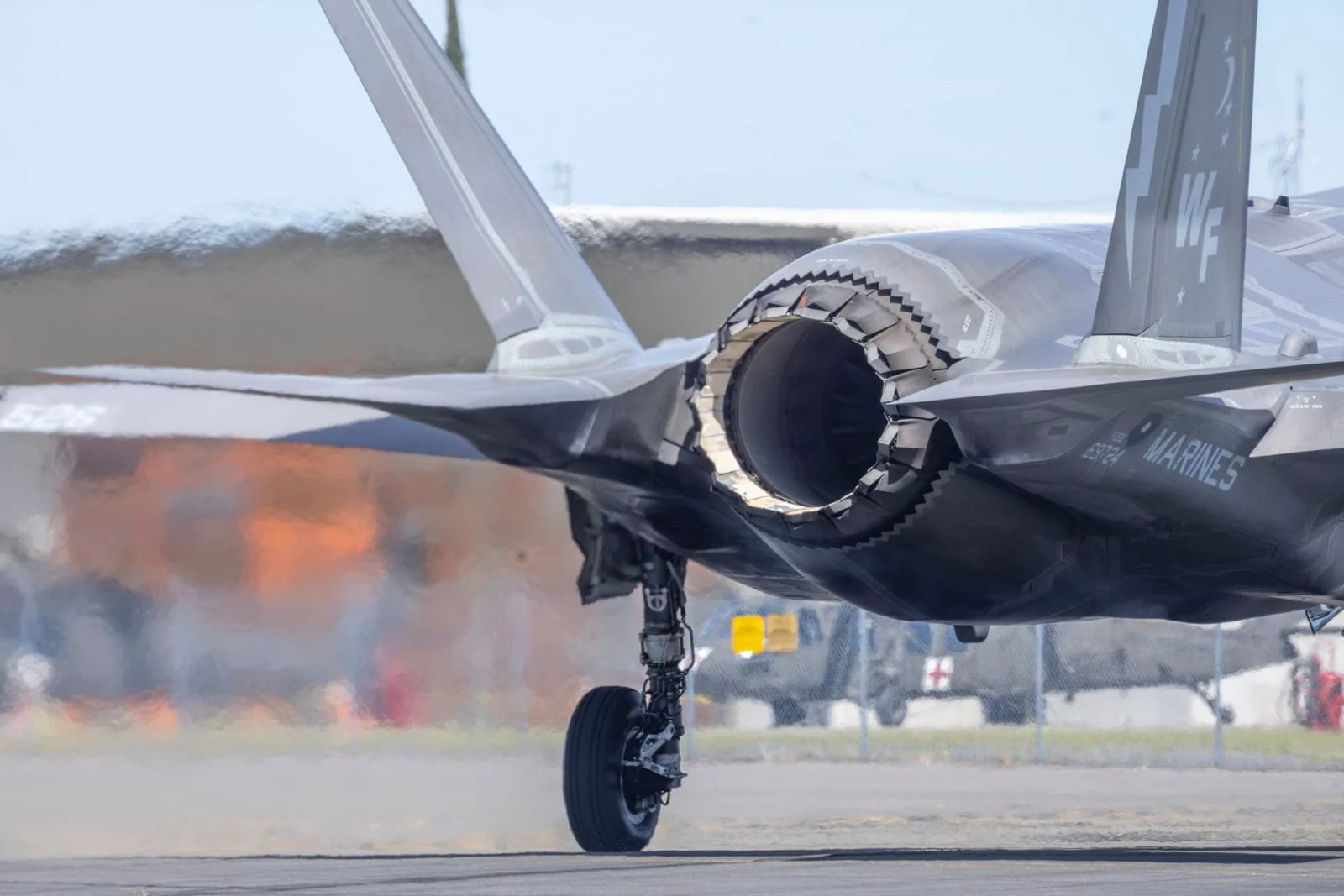
Jet engine exhaust manifolds, tailpipes, and collector rings see sustained temperatures of 500–800 °C combined with repeated thermal cycling. Grade 321 — and especially 321H — handles both the high-temperature oxidation environment and the mechanical demands of thermal expansion and contraction. The titanium stabilisation ensures that weld joints in the exhaust assembly do not become sensitisation-vulnerable over years of service.[5]
High-Temperature Industrial Piping & Expansion Joints
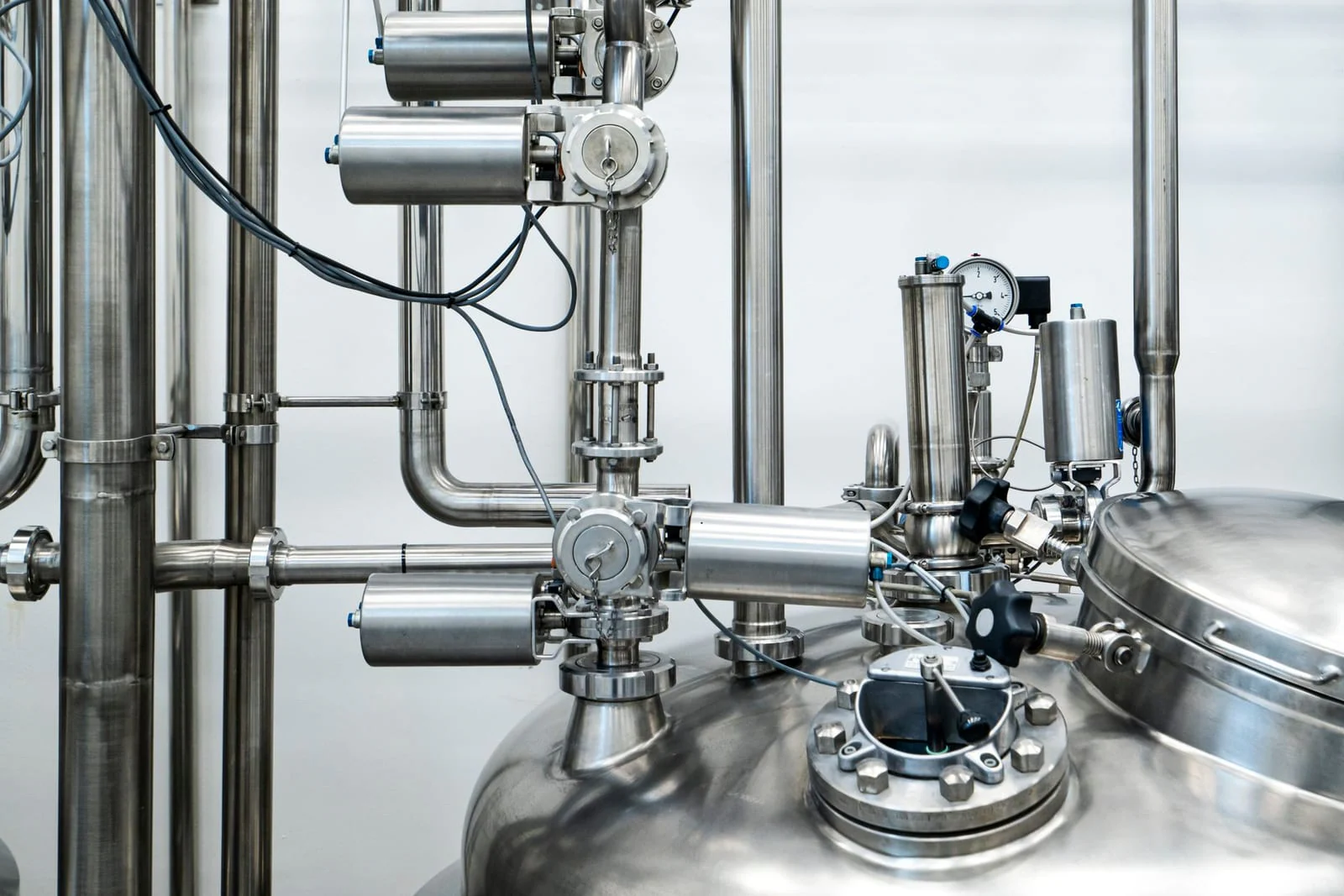
Chemical plant piping carrying hot process streams, and the expansion joints that accommodate thermal movement in those pipelines, are a natural fit for 321. The grade tolerates the operating temperature window, remains corrosion-resistant at weld seams, and handles repeated thermal expansion and contraction without sensitising over time.[5]
Boiler Superheater Tubes & Heat Exchangers
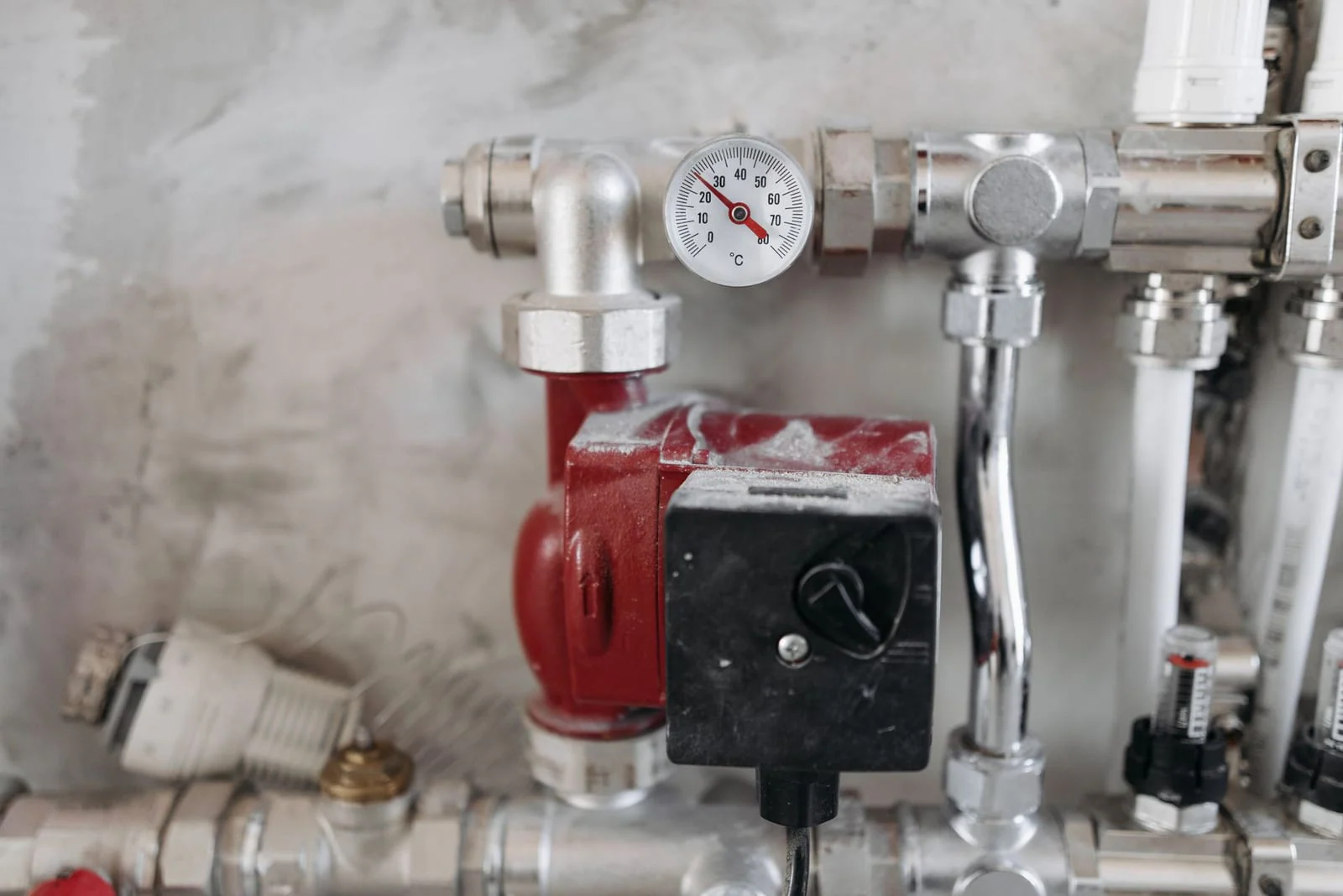
Power-station boiler superheater tubes and heat-exchanger bundles must maintain mechanical strength and corrosion resistance over tens of thousands of hours at temperatures in the 500–700 °C range. 321 and 321H are well-established materials of construction for these applications, where 304 would sensitise and where 316's molybdenum provides no benefit (the environment is not chloride-aggressive).[5][4]
Chemical & Petrochemical Processing
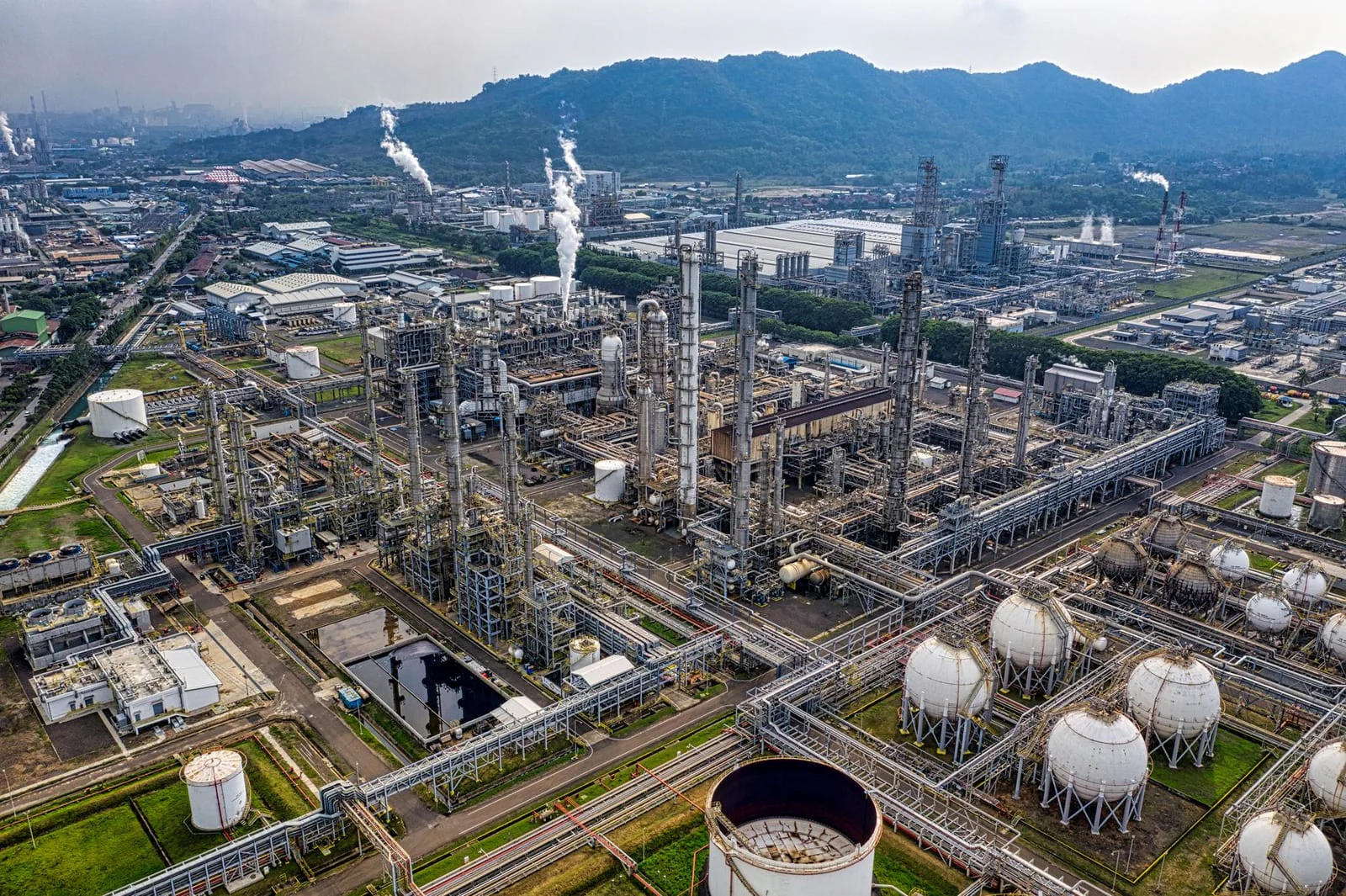
Vessels, piping, and agitators handling non-chloride process chemistries at elevated temperatures — including many acid-recovery and organic-synthesis operations — use 321 for its combination of weld-zone corrosion resistance and high-temperature strength. Wherever a 304-class alloy would sensitise in service and 316 is not warranted by the chloride environment, 321 is typically the correct specification.
Forms & Finishes
Common product forms:CoilSheetPlateTube (welded & seamless)PipeBar
Surface finishes:2BBANo.4HLPickled (hot-rolled)
For high-temperature service, a pickled or mechanically cleaned surface is usually adequate; the finer cosmetic finishes (BA, Mirror) are used when 321 appears in architectural or decorative roles where its sensitisation resistance is also needed.
References
- Stainless Steel – Grade 321 (UNS S32100). AZoM (materials datasheet based on the ASTM/AISI grade system, ArticleID 967). azom.com/article.aspx?ArticleID=967
- Influence of stabilization heat treatments on microstructure, hardness and intergranular corrosion resistance of the AISI 321 stainless steel. Moura V., Kina A.Y., Tavares S.S.M. et al. Journal of Materials Science, vol. 43, pp. 536–540 (2008). doi.org/10.1007/s10853-007-1785-5
- Characterization of Passive Films Formed on As-received and Sensitized AISI 304 Stainless Steel. Zhang Y., Luo H., Zhong Q., Yu H., Lv J. Chinese Journal of Mechanical Engineering, vol. 32 (2019). — Evidence pool P1; passive film mechanism applies to all 18Cr austenitic grades. doi.org/10.1186/s10033-019-0336-8
- High temperature oxidation behaviour of AISI 321 stainless steel with an ultrafine-grained surface at 800 °C in Ar–20 vol.% O₂. Pour-Ali S., Weiser M., Nguyen N.T., Kiani-Rashid A.-R., Babakhani A., Virtanen S. Corrosion Science, vol. 163, art. 108282 (2020). doi.org/10.1016/j.corsci.2019.108282
- Research Progress on the Relationship Between Microstructure and Properties of AISI 321 Stainless Steel. Huang Z., Zhang J., Ma Z., Yuan S., Yang H. Applied Sciences (MDPI), vol. 14, no. 22, art. 10196 (2024). doi.org/10.3390/app142210196
- Evolution of the Corrosion Products around MnS Embedded in AISI 304 Stainless Steel in NaCl Solution. Li D., Hao H., Wang Z., Nyakilla E. E., et al. Materials, vol. 17, 4050 (2024). — Evidence pool P4; MnS pit-initiation mechanism is common to all austenitic grades including 321. doi.org/10.3390/ma17164050