In short: Q235 is China’s standard plain carbon structural steel (GB/T 700) — a low-carbon steel with roughly 0.17–0.22% carbon, internationally close to ASTM A36 and EN S235. Its room-temperature structure is ferrite (BCC α-iron) with a little pearlite, which makes it magnetic, easy to weld, and easy to form, with medium strength adequate for most structural work. Unlike stainless steel, Q235 has no chromium and no passive film — it rusts, and the loose rust offers no protection, so it must be actively protected by paint, hot-dip galvanising, blackening, or phosphating. It is the everyday workhorse for structural framing, hot-rolled sections, and general fabrication. For heavier loads step up to the low-alloy Q345; for clean carburising and cold-heading work use 20 steel; and where shafts and gears must be hardened, the medium-carbon 45 steel is the quench-and-temper grade.
What Q235 Is
Q235 is China’s most common plain carbon structural steel — a low-carbon steel specified to GB/T 700. The designation reads directly: Q stands for *qufu qiangdu* (屈服强度, yield strength) and 235 is the nominal minimum yield in MPa. It is the everyday structural workhorse: cheap, available everywhere, easy to cut, weld, and form, and strong enough for the great majority of building and general-engineering work.
Internationally Q235 corresponds closely to ASTM A36 and to EN S235 — the same family of general-purpose, weldable carbon structural steel that frames buildings worldwide. Buyers searching *Q235*, *A3* (its old GB name), or *碳素结构钢* are looking for this grade.
It belongs to the carbon-steel family — iron alloyed with a modest amount of carbon and very little else. That is the key distinction from the stainless and copper alloys elsewhere on this site: Q235 contains no chromium, so it has no passive film and no inherent corrosion resistance. It rusts in ordinary atmosphere and relies on coatings or galvanising for protection — the price paid for its low cost, easy welding, and easy forming.
Within the carbon-steel range Q235 sits at the low-carbon, low-strength, high-weldability end. Higher strength is bought by moving to the micro-alloyed Q345, and hardenability by moving up in carbon to medium-carbon 45 steel — but neither welds or forms as freely as plain Q235.
Chemical Composition
Composition limits for Q235 per GB/T 700. It is deliberately lean: a controlled low carbon level for weldability, a little manganese for strength and clean steelmaking, and tight ceilings on the residual impurities phosphorus and sulphur. There is no chromium, nickel, or molybdenum — those are what would make a steel *stainless*, and Q235 is plain carbon steel.
| Element | Symbol | Content (wt%) | Role |
|---|---|---|---|
| Carbon | C | 0.12–0.22 | Principal strengthening element — forms pearlite (with Fe₃C) and raises strength; kept low here so the steel stays easy to weld and form |
| Manganese | Mn | 0.3–0.7 | Solid-solution strengthening and grain refinement; also combines with sulphur during steelmaking to prevent hot-shortness (desulphurising role) |
| Silicon | Si | ≤ 0.3 | Deoxidiser from steelmaking; modest solid-solution strengthening |
| Phosphorus | P | ≤ 0.045 | Residual impurity — capped because it embrittles (cold-shortness); kept within the GB/T 700 ceiling |
| Sulfur | S | ≤ 0.05 | Residual impurity — capped because it causes hot-shortness; Mn ties it up as manganese sulphide |
| Iron | Fe | Balance | Base metal — the BCC α-iron matrix that makes Q235 magnetic |
Per GB/T 700 (Q235), ≈ ASTM A36 / EN S235.
Crystal Structure: BCC Ferrite with Pearlite
Q235 is an alloy of iron and carbon, so it has no molecular formula — the right description is by crystal structure and phases. At room temperature it is overwhelmingly ferrite (α-iron), the body-centred cubic (BCC) form of iron, with a small fraction of pearlite. Because iron in the BCC ferrite form is ferromagnetic, Q235 is magnetic — a sticking magnet is the quickest shop-floor test that tells plain carbon steel from austenitic stainless.
Carbon barely dissolves in BCC ferrite (the iron atoms pack too tightly to make room). The carbon that cannot dissolve is held in iron carbide, Fe₃C (cementite), which appears as fine alternating lamellae of ferrite and cementite — pearlite. The fraction of pearlite tracks the carbon content: Q235 is low-carbon, so it carries only a little pearlite in a mostly-ferrite matrix.[3] That is exactly why it is soft, tough, and weldable.
The mechanism is the eutectoid reaction of the iron-carbon system. On slow cooling the high-temperature austenite decomposes into ferrite plus the ferrite-plus-cementite pearlite (γ → α + Fe₃C), the lamellae growing cooperatively as carbon diffuses ahead of the front.[1][2] In a hypoeutectoid steel like Q235, proeutectoid ferrite forms first and the remaining austenite then transforms to pearlite — which is why the final structure is ferrite-rich.[1] There is no chromium and no passive film anywhere in this picture: Q235’s structure is plain BCC iron carrying carbon as carbide, not the FCC austenite of stainless steel.
Microstructure: Ferrite-Rich, Lightly Pearlitic
Under the microscope a hot-rolled Q235 looks like a sea of pale, equiaxed ferrite grains with a scatter of darker pearlite colonies sitting mostly at the grain boundaries. Because the carbon is low, the pearlite is a minority constituent — the soft, ductile ferrite dominates and sets the character of the steel.
This structure is the lever for properties. More carbon means more pearlite, which means higher strength but lower ductility — the trade-off that separates Q235 from medium-carbon 45 steel.[3] Strength and toughness also rise as the ferrite grain size falls, following the Hall-Petch relationship, so the finer-grained the rolled product the better it performs.[4] Q235’s deliberately low carbon keeps the pearlite fraction small, trading peak strength for the easy welding and forming that structural fabrication needs.
Corrosion: Q235 Rusts — and Why Protection Is Mandatory
This is the single most important thing to understand about Q235, and the sharpest contrast with the stainless steels elsewhere on this site: Q235 has no chromium, forms no passive film, and rusts. It does not protect itself. Plan for protection from the start, not as an afterthought.
Why it rusts. A stainless steel carries enough chromium to grow a thin, self-healing chromium-oxide passive film that re-forms the instant it is scratched. Q235 has none of that. In moist air its surface oxidises to ordinary iron-oxide rust, and crucially that rust layer is loose, porous, and non-protective — it flakes and lets moisture and oxygen reach fresh metal underneath, so corrosion simply continues inward instead of stopping.[5] In chloride-rich or marine wet-and-dry conditions the attack is worse still, with aggressive rust products such as akaganeite forming. There is no self-passivation to fall back on.
So Q235 must be actively protected. Because the metal cannot defend itself, every Q235 component in service relies on an applied barrier or a sacrificial system:
- Paint / organic coatings — a barrier film that keeps moisture and oxygen off the steel; the everyday protection for structural frames and fabrications.
- Hot-dip galvanising (zinc coating) — the most robust option. Zinc is more reactive than iron, so it acts as a sacrificial anode: it corrodes preferentially and cathodically protects the steel beneath, continuing to protect even where the coating is scratched.[6]
- Blackening / bluing — a controlled magnetite (Fe₃O₄) conversion layer that gives mild indoor rust resistance and a black finish, usually sealed with oil.
- Phosphating — a phosphate conversion coating, typically as a paint primer to improve adhesion and corrosion life.
The takeaway: treat untreated Q235 as a material that will rust in service. Its low cost and easy fabrication are bought at the price of mandatory surface protection — the opposite of a stainless steel, which is chosen precisely so it can defend itself without a coating.[5]
Mechanical & Physical Properties
Q235 offers a medium, dependable strength with generous ductility — the low carbon keeps it soft and tough, so it stretches and bends rather than cracking. Strength comes mainly from the small pearlite fraction and from grain refinement during hot rolling, not from any heat-treated hardening (the carbon is too low to quench-harden usefully).
| Tensile strength (MPa) | 370–500 |
| Yield strength (MPa) | ≥235 |
| Elongation (%) | ≈26 |
| Density (g/cm³) | 7.85 |
| Elastic modulus (GPa) | 200 |
| Magnetic response | Magnetic |
Being a ferrite-rich low-carbon steel, Q235 is not a hardenable grade: there is no quench-and-temper route to high hardness as there is for medium-carbon 45 steel. Its strength is essentially set by composition and rolling, and its generous ≈26% elongation is what makes it forgiving to bend, roll, and weld. Like all iron-based ferritic steel it is magnetic, with the stiffness (≈200 GPa elastic modulus) and density typical of structural steel.
Weldability & Formability
Easy welding is Q235’s headline practical virtue. Weldability of carbon steel is governed largely by carbon content (and carbon equivalent): the lower the carbon, the lower the risk of a hard, brittle, crack-prone heat-affected zone. Q235’s deliberately low carbon keeps that risk low, so it welds readily by ordinary arc processes — typically with little or no preheat — which is exactly why it dominates welded structural fabrication.
The same low carbon and ferrite-rich structure make Q235 easy to cold-form — to bend, roll, press, and shear — and easy to machine. Its generous ductility is what lets a fabricator cut, form, and weld it into frames and brackets without special procedures. When higher strength is needed without losing weldability, the micro-alloyed Q345 raises strength through grain refinement and micro-alloy additions while keeping carbon low enough to stay weldable.
Key Characteristics
- Excellent weldability. Low carbon means a low-risk heat-affected zone — welds readily by ordinary arc processes, usually without preheat.
- Easy to form and machine. Soft, ductile ferrite-rich structure bends, rolls, presses, and cuts without special procedures.
- Medium, dependable strength. Adequate yield and good elongation for the great majority of structural and general-engineering work.
- Low cost, universally available. Supplied in every hot-rolled form — plate, sheet, coil, bar, section — at the lowest price point in the steel range.
- Magnetic, BCC ferrite. Mostly ferrite with a little pearlite; ferromagnetic, unlike austenitic stainless.
- No inherent corrosion resistance — it rusts. No chromium, no passive film; requires paint, hot-dip galvanising, blackening, or phosphating to survive service.
How Q235 Is Made
Q235 is steelmaking at its most economical: iron is refined to the lean low-carbon C-Mn composition, continuously cast, then hot-rolled into the structural shapes and flat products that are its whole reason for being. Because it will rust, the final — and essential — stage for service is a protective treatment such as galvanising or painting.
Control of carbon and of the sulphur and phosphorus residuals during steelmaking is what guarantees the easy welding and toughness Q235 is bought for. The protective finishing step is not optional cosmetics: it is the corrosion defence the bare carbon steel cannot provide for itself.
Q235 vs Q345 vs 45 — Picking the Right Carbon Steel
All three are iron-carbon steels with a ferrite-and-pearlite ancestry, but each is tuned for a different job. The choice comes down to whether the priority is easy welded fabrication, higher structural strength, or hardenable wear resistance.
Applications by Industry
Q235’s blend of weldability, formability, dependable strength, and low cost makes it the default structural steel wherever metal must be framed, fabricated, and joined without fuss — always with a protective finish, because bare Q235 rusts.
Structural Steel Framing
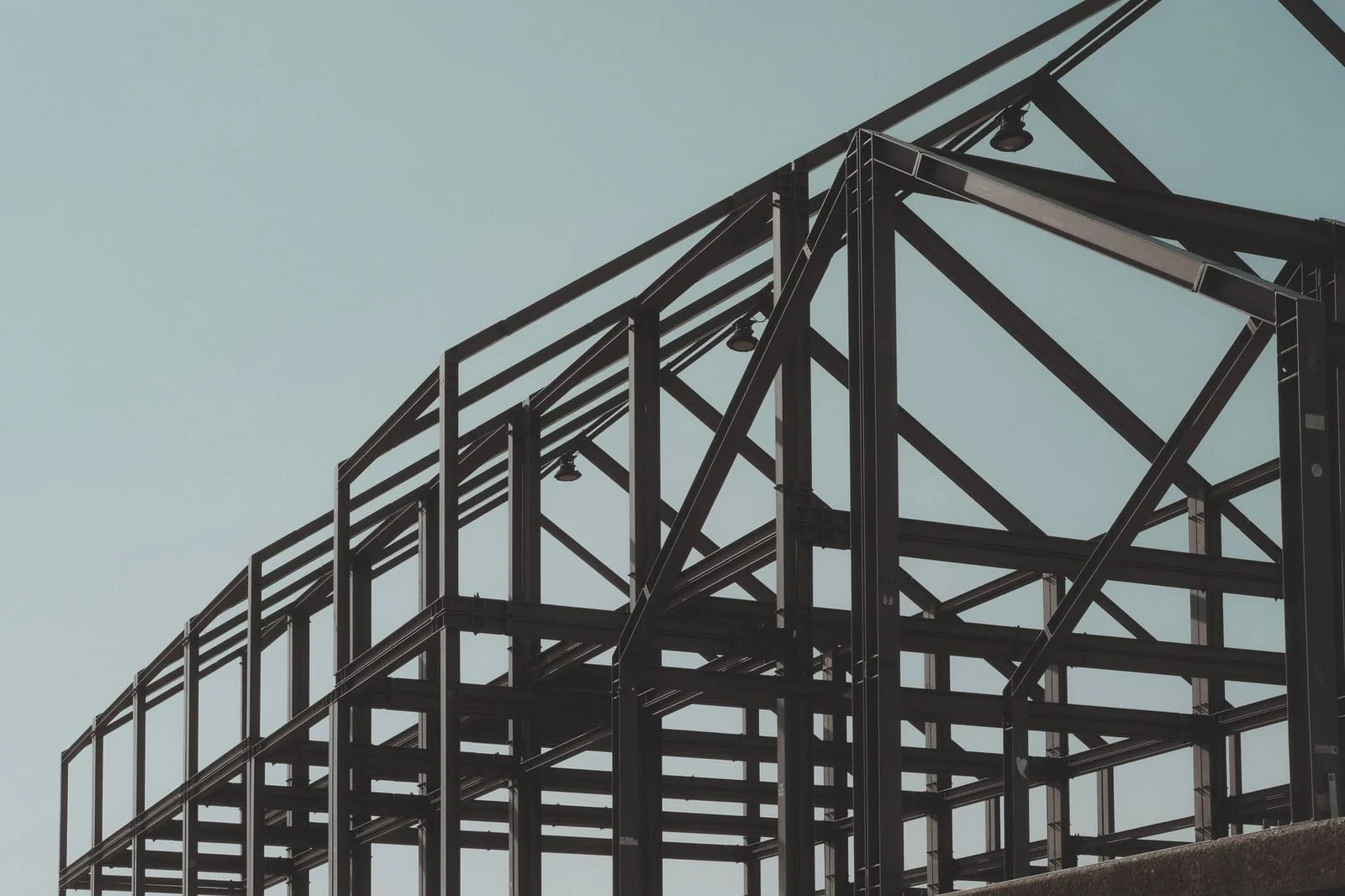
Building frames, columns, beams, purlins, and trusses in hot-rolled steel construction — the primary use. Q235 welds and bolts readily into frameworks, and is hot-dip galvanised or painted for corrosion protection in the structure.
Hot-Rolled Sections & Plate
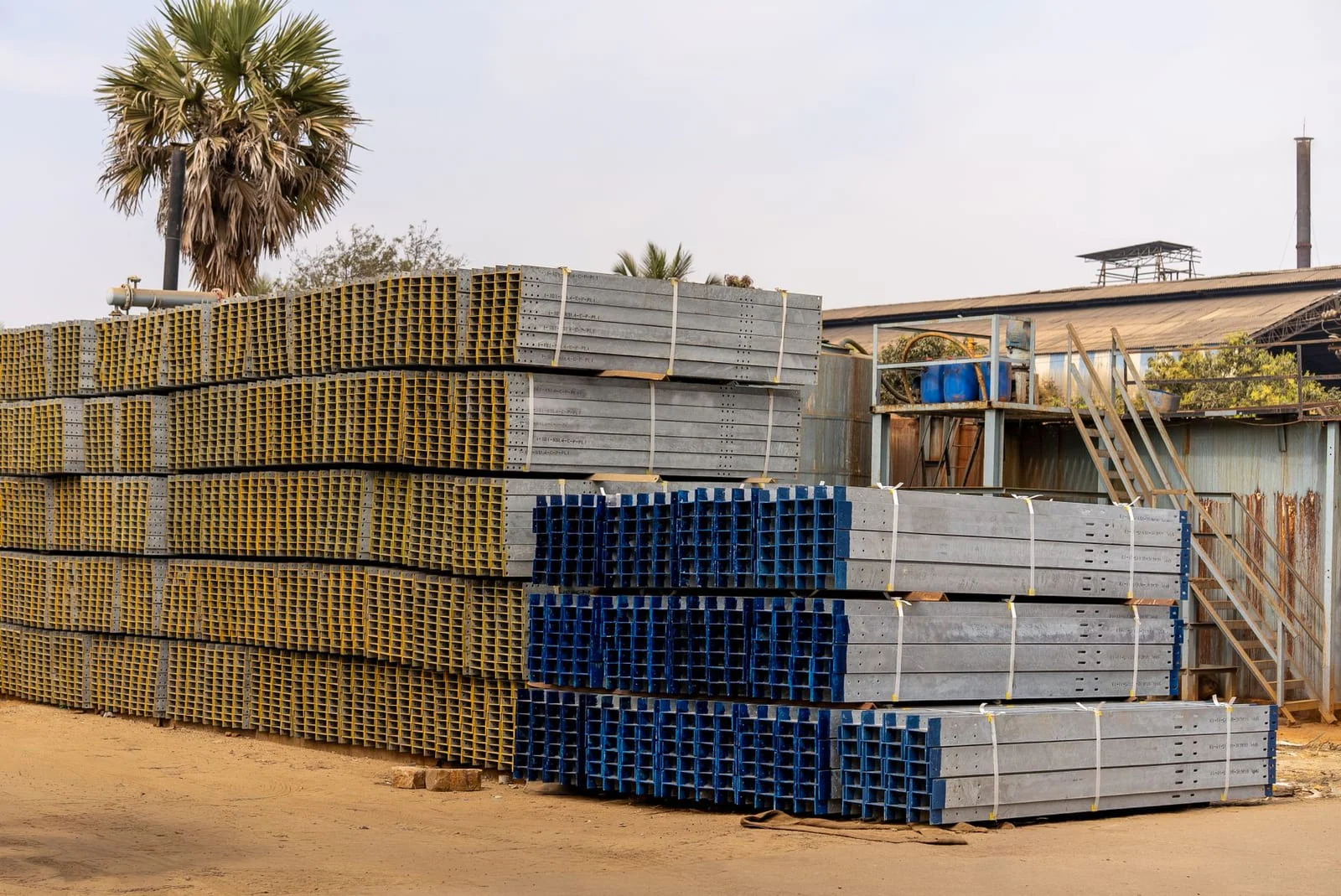
Angles, channels, I-beams, flats, plate, and sheet for general construction and engineering. Q235 is the standard grade these mill products are rolled in, supplied across the full size range.
General Fabrication & Brackets
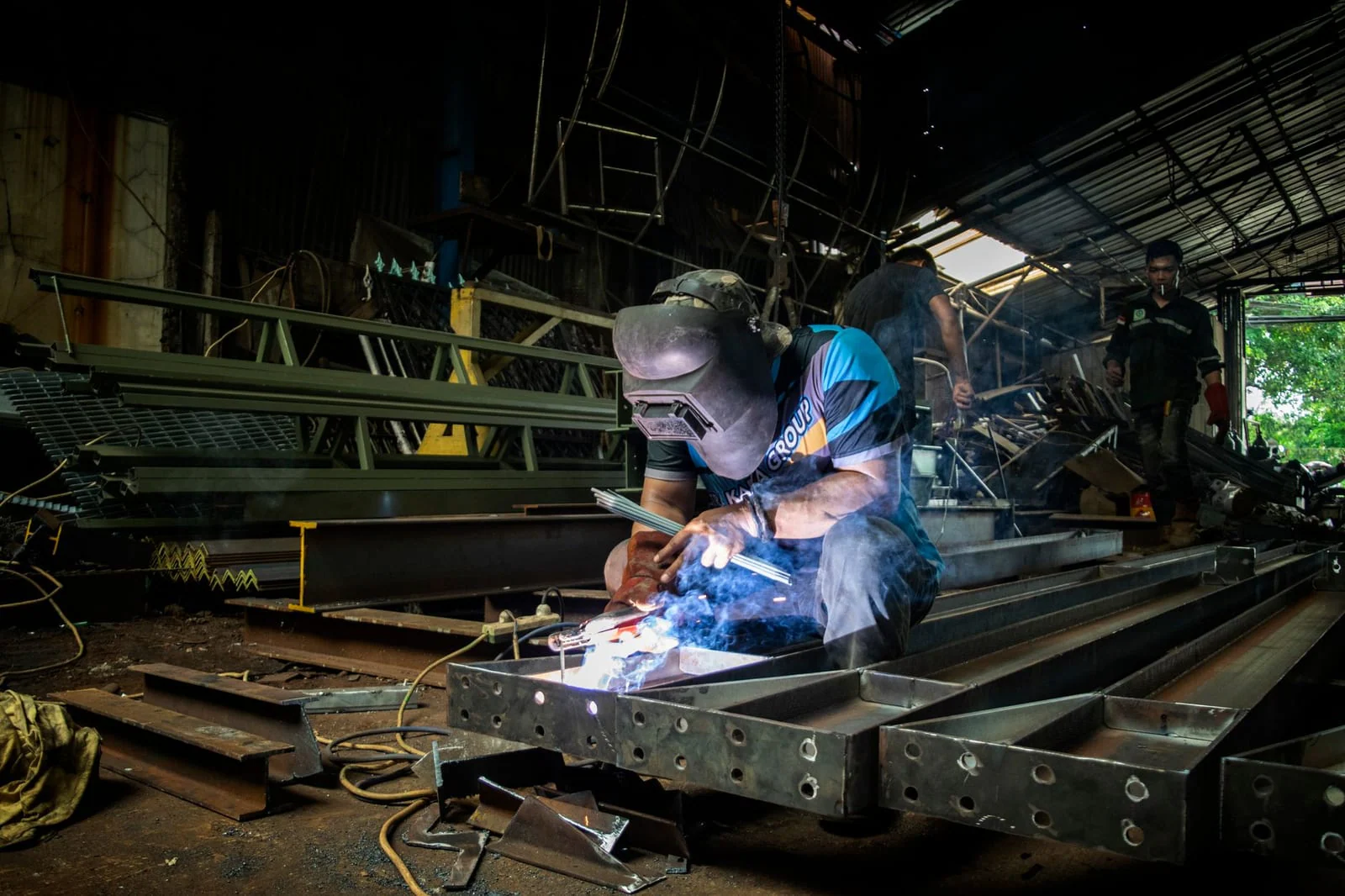
Everyday fabricated steelwork — brackets, supports, baseplates, frames, and weldments — where easy cutting, forming, and welding matter more than high strength or corrosion resistance.
Bridges & Building Components
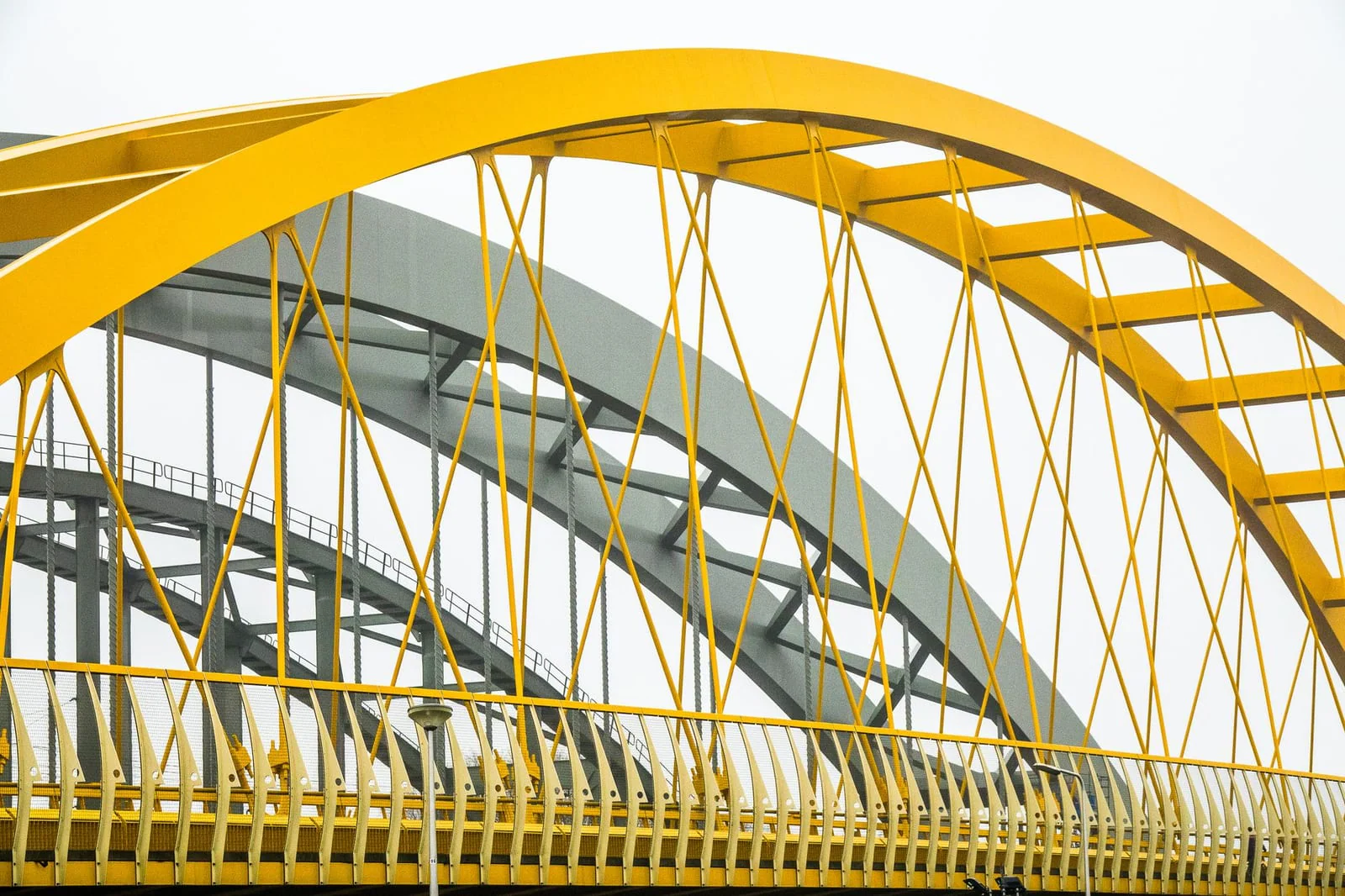
Bridge members, machine bases, and general building components, typically galvanised or painted for outdoor service. For the heaviest loads designers step up to the higher-strength low-alloy Q345.
Forms & Finishes
Common product forms:PlateSheetCoilBarSection
Surface finishes:Hot-rolledPickledGalvanized
Hot-rolled plate, sheet, coil, bar, and section are the workhorse forms for Q235, covering structural framing and general fabrication. Pickled stock offers a cleaner descaled surface, while galvanized stock arrives already protected with a sacrificial zinc coating — the practical default wherever the steelwork will see weather.
References
- Effect of Carbon Concentration in Austenite on Cementite Morphology in Pearlite. ISIJ International 61(1), 2021. Hypoeutectoid C-Mn steel: proeutectoid ferrite plus pearlite; cooperative ferrite/cementite growth in the eutectoid reaction, controlled by carbon diffusion. jstage.jst.go.jp/.../isijinternational/61/1
- Austenite-to-ferrite-plus-pearlite transformation on continuous cooling. PMC9267234. Continuous-cooling transformation (CCT) of austenite → ferrite + pearlite (A→F+P). pmc.ncbi.nlm.nih.gov/articles/PMC9267234
- Carbon content effect on pearlite fraction in ferrite-pearlite steels. PMC8838105. Pearlite fraction vs carbon content — more carbon means more pearlite, higher strength, lower ductility; low-carbon steels have little pearlite and much ferrite. pmc.ncbi.nlm.nih.gov/articles/PMC8838105
- Ferrite grain size and Hall-Petch in ferrite-pearlite steels. Frontiers in Materials, 2020. Tensile data for F+P microstructures + Hall-Petch (σy = σ0 + k·d^-1/2); finer ferrite grains give higher strength and toughness together. frontiersin.org/.../fmats.2020.604792
- Non-protective rust layer on carbon steel. PMC5506973. Carbon-steel rust is porous and non-protective, in contrast to stainless self-passivation — carbon steel keeps rusting and never self-passivates. pmc.ncbi.nlm.nih.gov/articles/PMC5506973
- Zinc coating as sacrificial anode for steel protection. Frontiers in Materials, 2020. The zinc layer acts as a sacrificial anode, cathodically protecting the steel substrate — the protection mechanism of galvanizing. frontiersin.org/.../fmats.2020.00074