In short: Type 201 is an austenitic stainless steel engineered to reduce nickel cost by substituting manganese (5.5–7.5%) and nitrogen (≤ 0.25%) as austenite stabilisers. This keeps the FCC crystal structure, lifts yield strength to ≥ 260 MPa (versus 304's 205 MPa), and cuts alloy cost — but results in higher MnS inclusion density and meaningfully lower chloride-pitting resistance than 304. Grade 201 belongs indoors: decorative tube, appliance panels, elevator cladding, and dry-environment kitchen hardware.
What 201 Stainless Steel Is
Type 201 occupies a specific economic niche in the austenitic stainless steel family. It was developed in the mid-20th century, during periods of nickel scarcity, as a deliberate strategy: replace roughly half the nickel with cheaper manganese and nitrogen, keep the austenite stable, and capture a cost advantage. The formula works — as long as the service environment stays away from chlorides.[1]
It goes by several standard designations: AISI/SAE 201, UNS S20100, European 1.4372 (X12CrMnNiN17-7-5), and Japanese SUS 201. Industry sometimes calls it an 18/6 Mn grade, loosely indicating its chromium and manganese levels. All refer to the same austenitic chromium–manganese–nitrogen alloy, produced worldwide primarily for decorative, appliance, and indoor structural uses.[1]
Chemical Composition
The defining feature of 201's composition is the high manganese band and the elevated nitrogen ceiling — both in service of replacing nickel. The ring chart below highlights the Mn segment that distinguishes 201 from 304, and the table lists the ASTM A240 specified ranges.[1]
| Element | Symbol | Content (wt%) | Role |
|---|---|---|---|
| Chromium | Cr | 16–18 | Builds the self-healing passive oxide film |
| Nickel | Ni | 3.5–5.5 | Co-stabiliser of austenite (reduced vs 304) |
| Manganese | Mn | 5.5–7.5 | Primary Ni substitute; austenite former; enables higher N solubility |
| Nitrogen | N | ≤ 0.25 | Potent austenite stabiliser + solid-solution strengthener |
| Carbon | C | ≤ 0.15 | Higher ceiling than 304; strengthens but raises sensitisation risk |
| Iron | Fe | Balance | Base metal |
Specified composition limits per ASTM A240 / UNS S20100. Mn and N are the core 201 strategy: replace costly Ni with cheaper Mn and N.[1]
Crystal Structure: FCC Austenite, Stabilised by Mn and N
Stainless steel is an alloy — a solid solution of several elements in iron — so it has no molecular formula. The correct description is by crystal structure: 201 is, like 304, fully austenitic — a face-centred-cubic (FCC) arrangement of atoms at room temperature, with the unit cell occupying every corner and every face centre.[1]
In grade 304, ~8% nickel is what stabilises the FCC austenite phase down to room temperature. In 201, nickel is cut to 3.5–5.5% — far below what would normally sustain austenite. The gap is filled by manganese (5.5–7.5%) and nitrogen (≤ 0.25%). Research on Mn-N austenitic stainless steels confirms that these two elements together function as effective substitutes for Ni in stabilising the FCC structure, enabling cost-competitive alloys with retained austenite and improved strength.[3] The resulting austenite is non-magnetic in the annealed state — indistinguishable to the touch from 304.
With less nickel stabilisation, 201's austenite is *more* metastable than 304's. Cold working therefore triggers strain-induced α′-martensite (the TRIP effect) more readily and at lower strains. A heavily drawn 201 cup or bent 201 sheet will typically show a stronger magnetic response than equivalent 304 cold work.[7]
Corrosion Resistance — Strengths and Real Limits
In still air, mild humidity, and non-chloride contact, 201's passive film performs adequately. The same chromium-oxide self-healing mechanism that makes 304 stainless is present in 201: the film is composed mainly of Cr and Fe oxides, and chromium enrichment in the film governs corrosion resistance.[2]
However, 201's chloride resistance is noticeably inferior to 304's — for two compounding reasons. First, at 16–18% Cr versus 304's 18–20%, the passive film has slightly less chromium margin. Second — and more important — the high manganese content (5.5–7.5% versus 304's ≤ 2%) means many more MnS inclusions per unit volume. In chloride solutions, MnS inclusions are well-established pit-initiation sites: they dissolve preferentially, chloride ions concentrate in the micro-cavity, and pitting propagates from there.[4][5]
Electrochemical studies of nickel-reduced, high-Mn-N austenitic steels directly observe this mechanism: pitting initiates at MnS inclusions — particularly where they sit adjacent to Al₂O₃ clusters — and while increasing nitrogen content improves the passive film somewhat, it cannot fully overcome the MnS vulnerability when chlorides are present.[8] Separate work combining Mn and Mo additions in austenitic steels confirms the same pattern: Mn additions exert a detrimental effect on pitting via MnS, while Mo additions improve it — explaining why Mo-bearing 316 outperforms both 201 and 304 in chloride service.[6]
Practical rule: Deploy 201 only in dry, indoor, low-chloride environments. Coastal atmospheres, seawater, swimming pools, brine contact, and de-icing salts are all out of scope for 201. Step to 304 for general outdoor/food service; step to 316 when chlorides are assured.
Mechanical & Physical Properties
ASTM A240 specified minimums for annealed Type 201 sheet and plate:[1]
| Tensile strength (MPa) | ≥515 |
| Yield strength (MPa) | ≥260 |
| Elongation (%) | ≥40 |
| Hardness | ≤241 HB |
| Density (g/cm³) | 7.80 |
| Elastic modulus (GPa) | 197 |
| Magnetic response | Non-magnetic (annealed); work-hardens |
The headline mechanical advantage of 201 is its yield strength: ≥ 260 MPa versus 304's ≥ 205 MPa — a 27% uplift in the annealed condition, delivered by nitrogen's solid-solution strengthening effect. For spring-tempered strip, fasteners, clamps, and structural sections where load-bearing capacity matters more than corrosion resistance, this is a genuine benefit at lower alloy cost.
TRIP Effect — More Pronounced Than in 304
Because 201's austenite contains even less nickel than 304's already-metastable structure, it is more susceptible to strain-induced martensite (α′-martensite) during cold deformation. Research on cold-drawn austenitic stainless steels documents the sequence: mechanical twinning at small strains, then nucleation and growth of α′-martensite at twin intersections at intermediate strains, producing strong work-hardening and elevated post-cold-work strength.[7] In 201, with lower Ni stabilisation, this TRIP transformation is initiated more readily — which is useful for spring temper applications, but means that cold-worked 201 also picks up a more noticeable magnetic response than cold-worked 304.
Key Characteristics
- Cost advantage. Manganese costs a fraction of nickel's price per kilogram. 201 typically trades at a meaningful discount to 304, making it the economic choice for high-volume decorative and indoor structural applications.
- Higher yield strength. The ≥ 260 MPa yield minimum is ~27% above 304's — useful for springs, fasteners, clamps, and structural tube where strength efficiency matters.
- Good formability. FCC austenite gives deep-drawing, bending, and roll-forming performance comparable to 304; the stronger TRIP effect raises work-hardening rate at higher strains.
- Non-magnetic (annealed). Passes standard magnet tests in the annealed condition. More strongly magnetised than 304 after equivalent cold work.
- Indoor / low-chloride service only. Not suitable for marine, coastal, pool, or any chloride-bearing environment. The higher MnS density is the primary limitation.
- Weldable, but watch the carbon. The higher carbon ceiling (≤ 0.15% vs 304's ≤ 0.08%) creates greater sensitisation risk; post-weld annealing or the 201L variant should be specified for corrosive service after welding.
How 201 Is Made
Production follows the same route as all austenitic stainless steels. Scrap and ferroalloys are melted in an electric arc furnace (EAF), then refined in an argon-oxygen decarburisation (AOD) vessel to reduce carbon while retaining chromium. The higher Mn and N targets are managed at the AOD and ladle-metallurgy stages — nitrogen is typically introduced by bubbling nitrogen gas through the melt or adding nitrogen-bearing ferroalloys. The steel is then cast, hot- and cold-rolled to gauge, annealed to restore the soft austenitic microstructure, and finally pickled and passivated to re-establish a uniform passive film.
201 vs 304 — The Ni / Mn / Corrosion Trade-off
The 201-vs-304 choice is fundamentally a cost-vs-corrosion decision. The structural chemistry difference is decisive:
The corrosion gap comes down to two chemistry effects working together. First, the MnS inclusion density: with Mn at 5.5–7.5%, 201 generates far more MnS inclusions than 304's ≤ 2% Mn. In chloride solutions, MnS sites are where pitting begins — the inclusions dissolve, chloride concentrates in the micro-cavity, and the pit self-accelerates.[4][5] Second, the Mn effect on the passive film itself: studies of austenitic steels with varying Mn and Mo combinations confirm that Mn additions worsen pitting resistance, while Mo additions improve it.[6] The result is that 201, with high Mn and zero Mo, sits well below 304 (high Ni, low Mn, zero Mo) and far below 316 (high Ni, low Mn, 2–3% Mo) in chloride pitting resistance.
For indoor, dry, non-chloride service, 201's cost advantage is real and defensible. The moment the environment introduces humidity with chlorides, 304 is the responsible minimum; for genuine marine or chemical-process service, see 316.
Variants & Related Grades
201 anchors a small sub-family within the 200-series austenitic steels:
- 201L (UNS S20103) — the low-carbon version (C ≤ 0.030%). Reduced carbon suppresses chromium-carbide precipitation in the heat-affected zone during welding, making it the correct choice for 201-class material in welded assemblies that will face any corrosive service after fabrication.
- 201LN (UNS S20153) — further nitrogen-optimised variant balancing austenite stability, strength and weldability for demanding forming applications.
- 202 (UNS S20200) — similar Mn-N-Cr-Ni philosophy with a slightly different composition balance; widely produced in Asia for similar decorative and appliance markets.
For readers stepping up in corrosion resistance: 304 is the next grade in the austenitic family, and 316 adds molybdenum for chloride environments.
Applications by Industry
201's combination of good looks, formability, higher yield strength, and lower cost makes it the go-to for indoor, dry, non-chloride applications at volume.
Decorative Tube & Pipe
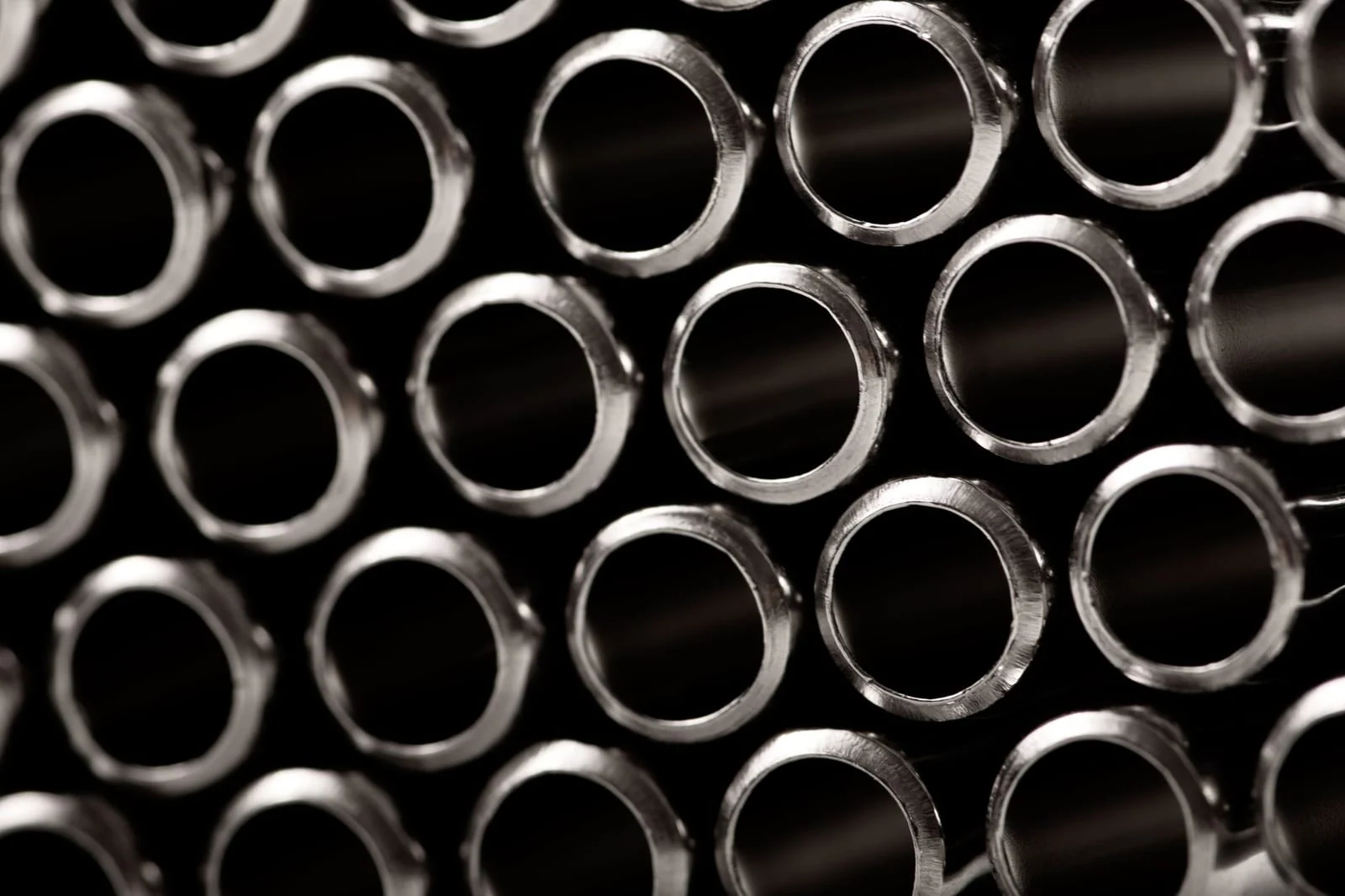
Interior handrails, furniture frames, display racks, shelving uprights, and architectural tube in lobbies and shopping malls are classic 201 applications. The bright or brushed finish holds its appearance well in air-conditioned, climate-controlled environments — and the higher yield strength suits tube that carries load without being oversized.
Appliance Panels & Enclosures
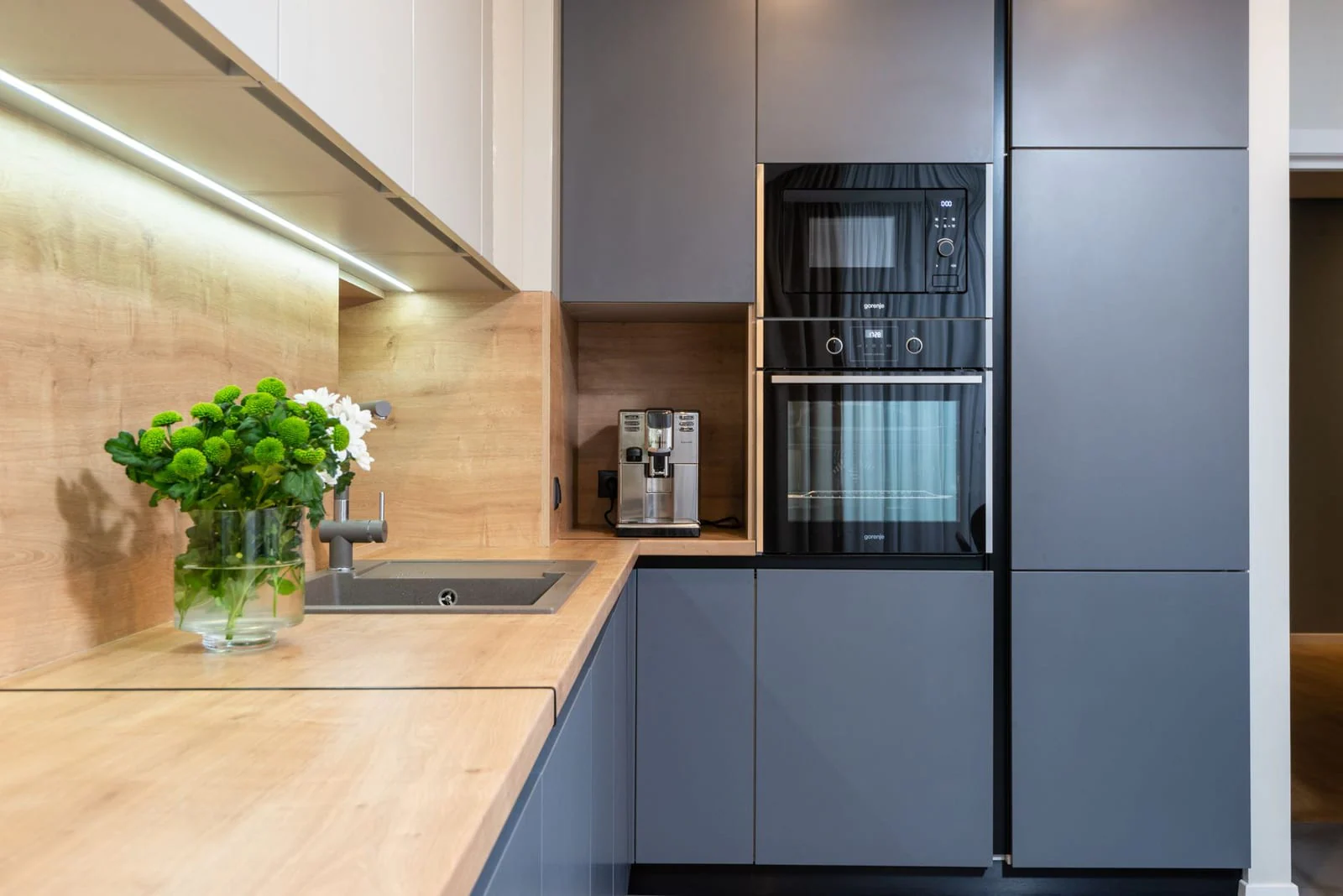
Refrigerator door liners, washing-machine drums, microwave housings, dishwasher interiors, and consumer-electronics enclosures frequently use 201 to deliver the stainless-steel look and feel at an alloy cost below 304. The surfaces see mild detergents in household air, not salt or brine.
Kitchen Hardware & Cookware

Domestic sinks, countertops, cookware, cutlery, and kitchen hardware in residential kitchens are reasonable 201 territory — as long as the application does not involve prolonged contact with salty brines or high-chloride cleaning agents. High-salt commercial food processing should specify 304 or 316 instead.
Elevator Cladding & Interior Panels

Elevator cab interiors, lift-lobby wall panels, and decorative cladding in buildings away from the coast are one of the most common high-volume uses for 201 sheet. The controlled indoor environment — no salt, no direct rain — suits 201's corrosion envelope, while the improved yield strength and surface-finish versatility (2B, HL, mirror) meet the specification requirements.
Forms & Finishes
Common product forms:CoilSheetPlateTubeBar
Surface finishes:2BBANo.4HLMirror
A smoother finish leaves fewer surface crevices for contaminants to accumulate — particularly important for 201, since its lower intrinsic pitting resistance means that surface preparation has a more noticeable protective effect. In practice, HL (hairline) and Mirror finishes are popular for elevator and decorative applications precisely because they combine aesthetics with reduced crevice surface area.
References
- AISI Type 201 Stainless Steel — Product Data Sheet (per ASTM A240/A240M, UNS S20100). AK Steel; cross-verified against North American Stainless Grade 201/201LN data sheet and Trinox Metal DC_201 specification. Multiple industry datasheets (spacematdb.com, trinoxmetal.com). spacematdb.com — AISI Type 201
- Characterization of Passive Films Formed on As-received and Sensitized AISI 304 Stainless Steel. Zhang Y., Luo H., Zhong Q., Yu H., Lv J. Chinese Journal of Mechanical Engineering, vol. 32 (2019). doi.org/10.1186/s10033-019-0336-8
- Effect of nitrogen content on corrosion behavior of high-nitrogen austenitic stainless steel. Gao F., Qiao Y., Chen J., et al. npj Materials Degradation, vol. 7, 75 (2023). doi.org/10.1038/s41529-023-00394-x
- Evolution of the Corrosion Products around MnS Embedded in AISI 304 Stainless Steel in NaCl Solution. Li D., Hao H., Wang Z., Nyakilla E.E., et al. Materials, vol. 17, 4050 (2024). doi.org/10.3390/ma17164050
- Pitting corrosion characteristics of sintered Type 316L stainless steel: relationship between pores and MnS. Saito H., Nishimoto M., Muto I., et al. npj Materials Degradation, vol. 8 (2024). doi.org/10.1038/s41529-024-00482-6
- Pitting corrosion behaviour of austenitic stainless steels — combining effects of Mn and Mo additions. Pardo A., Merino M.C., Coy A.E., Viejo F., Arrabal R., Matykina E. Corrosion Science, vol. 50, pp. 1796–1806 (2008). doi.org/10.1016/j.corsci.2008.04.005
- Strain induced martensite formation and its effect on strain hardening behavior in the cold drawn 304 austenitic stainless steels. Choi J.Y., Jin W. Scripta Materialia, vol. 36 (1997). doi.org/10.1016/S1359-6462(96)00338-7
- Evaluation of nitrogen content on pitting and repassivation behavior of a high alloy nickel-reduced austenitic stainless steel. Hempel N., et al. Materials and Corrosion, vol. 74 (2023). doi.org/10.1002/maco.202213236