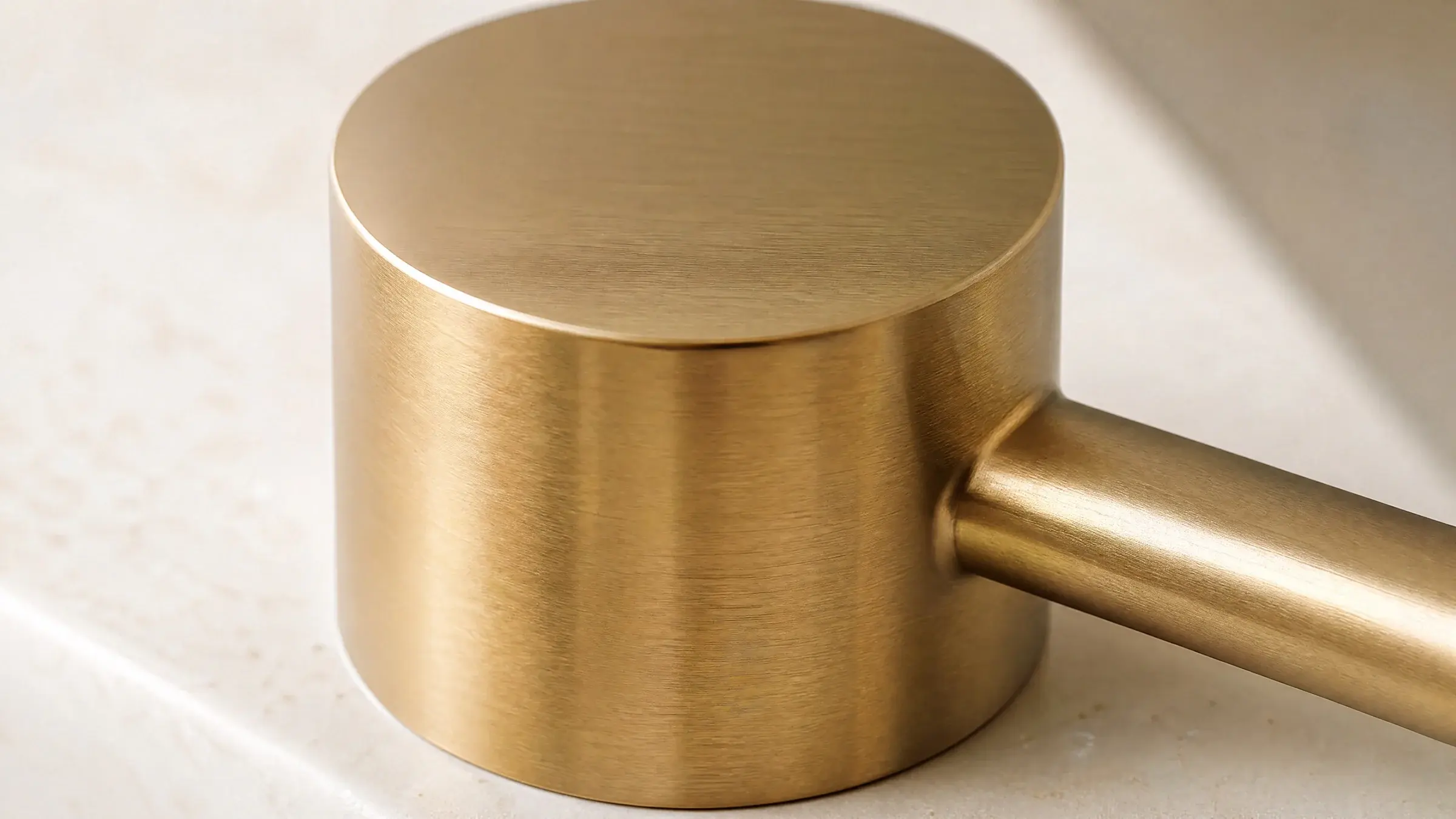
In short: H65 is the high-copper brass — a copper-zinc alloy with roughly 65% copper, balance zinc. Because copper holds that much zinc in solid solution, H65 is a clean single-phase α brass (one FCC phase, non-magnetic) with none of the harder, less ductile β phase that creeps in at higher zinc levels.[2] That uniform α structure is exactly what makes H65 the best deep-drawer in the common brass range — the classic cartridge / deep-drawn part material, taking deep draws and tight radii in the annealed condition without cracking. Its higher copper content gives it more ductility and a warmer gold colour than H62 brass, at the cost of a little more metal. It conducts moderately (~28% IACS — far below pure T2 copper), and like all brasses it can dezincify in aggressive chloride water and is susceptible to stress-corrosion cracking in ammonia, so it is chosen for formability and appearance rather than harsh-environment service.
What H65 Brass Is
H65 is a high-copper brass — a copper-zinc alloy with roughly 65% copper and the balance zinc, with only trace iron and lead. It belongs to the family known internationally as cartridge brass, the alloys prized above all for their cold-forming and deep-drawing behaviour.
In the Chinese GB system it is H65 (GB/T 5231) — the "H" denotes *huangtong* (黄铜, brass) and the number the nominal copper percentage. It corresponds closely to CuZn35 and to UNS C27000. Buyers searching *H65*, *CuZn35*, *cartridge brass*, or *C270* are looking for this alloy.
H65 sits in the brass branch of the copper family — the copper-zinc alloys — distinct from pure copper, the bronzes, and the cupronickels. Where pure T2 copper is chosen for conductivity and the B10 cupronickel for seawater service, the brasses are chosen for the combination of strength, machinability or formability, and an attractive finish at modest cost. Within the brasses, H65 sits at the high-copper, best-formability end; H62 trades some of that formability for lower cost.
The defining feature of H65 versus higher-zinc brasses is that its copper content is high enough to keep the structure single-phase α — and it is that clean, uniform α structure, not any special additive, that delivers the deep-drawing performance the grade is known for.[2]
Chemical Composition
Composition limits for H65 per GB/T 5231. Copper is the dominant element and is what holds the zinc in single-phase α solid solution; zinc is the principal alloying addition, strengthening the copper and lowering cost; iron and lead are held to trace levels.
| Element | Symbol | Content (wt%) | Role |
|---|---|---|---|
| Copper | Cu | 63.5–68 | Base and majority element — high enough (≈65%) to keep zinc fully in solid solution, so the structure stays single-phase α (FCC); also gives the warm gold colour |
| Zn | Zn | Balance | Principal alloying element — dissolves substitutionally in the copper FCC lattice, raising strength while keeping ductility; lowers cost versus pure copper |
| Iron | Fe | ≤ 0.1 | Trace residual — held low; can form hard particles that disrupt deep-draw surface quality if uncontrolled |
| Pb | Pb | ≤ 0.03 | Trace residual — kept very low here (this is a forming grade, not a free-machining leaded brass), since lead impairs cold formability |
Per GB/T 5231 (H65), ≈ CuZn35 / UNS C27000.
Crystal Structure: A Single-Phase α Brass
H65 is an alloy — a solid solution of zinc in copper — so it has no molecular formula. The correct description is by crystal structure and phase constitution.
Copper is face-centred cubic (FCC) and dissolves a large amount of zinc substitutionally on that lattice. Up to roughly a third zinc the alloy stays a single FCC phase called α; push the zinc higher and a second, harder body-centred-cubic phase (β) appears, which reduces cold formability. At ≈65% copper, H65 sits comfortably in the single-phase α field: every zinc atom substitutes for a copper atom on the same FCC lattice, with no β phase. The alloy is non-magnetic in all conditions.[2]
This matters for forming. H65's higher copper content keeps it cleanly in the α field with no β; a leaner brass nearer the phase boundary risks retaining some β, which embrittles deep draws. The Copper Development Association notes exactly this — a brass held at the higher-copper side of the boundary develops a pure α structure, whereas a slightly leaner composition can retain β — which is why H65's extra copper, relative to H62, buys measurably better deep-drawing behaviour.[2]
Because H65 is a single-phase α solid solution on the copper FCC lattice — and a high-copper one, so it is purer α with no β — its cold formability is intrinsic to the structure, not the product of any passive film. There is no chromium-rich passive layer and nothing resembling the Cr passivation of stainless steel, and no quench-and-temper martensite: H65 is strengthened only by solid-solution zinc and by cold work, and softened by annealing. The clean, uniform α grain structure is precisely what lets it take deep draws and tight bend radii without cracking — the reason higher-copper brass is the classic deep-drawing / cartridge material.[2]
Corrosion: Dezincification & Stress-Corrosion Cracking
H65 has good resistance to ordinary atmospheric and freshwater corrosion, which together with its appearance is why it is used for visible hardware and trim. But like every copper-zinc brass it has two characteristic vulnerabilities the designer must respect: dezincification and stress-corrosion cracking.
Dezincification. In aggressive waters — especially warm, stagnant, or chloride-rich water — brass can corrode selectively: the zinc dissolves out of the alloy and a weak, porous copper residue is left in place, sometimes plugged with redeposited copper, so the part keeps its shape but loses its strength. The accepted mechanism is that copper and zinc dissolve together and copper then redeposits as a porous layer; arsenic additions suppress the redeposition step in dezincification-resistant grades.[3]
Because H65 is a high-copper single-phase α brass, it is somewhat less prone to dezincification than higher-zinc or two-phase (α+β) brasses — selective zinc loss is generally more severe where zinc content is higher and where a β phase is present. That said, this is a difference of degree, not immunity: in genuinely aggressive chloride waters H65 can still dezincify, and where that risk is real the correct choice is an inhibited dezincification-resistant (DZR/CR) brass, not standard H65.[2][3]
Stress-corrosion cracking (season cracking). All α brasses, H65 included, are susceptible to stress-corrosion cracking in the presence of ammonia (and ammonium compounds) when residual tensile stress is present — the classic brass "season cracking" first observed in cold-worked cartridge brass. The brass–ammonia system is the textbook SCC couple, and copper and its alloys crack readily in ammoniacal solutions.[4][5] The practical defence is to stress-relieve (low-temperature anneal) cold-formed parts and to keep ammonia away from stressed brass in service — deep-drawn H65 parts in particular should be designed with a stress-relief step.
Electrical & Thermal Conductivity
Alloying copper with zinc lowers its conductivity: zinc atoms substituted into the FCC lattice scatter conduction electrons, so brass conducts well below pure copper. The chart places H65 in the copper family — from near-pure T2 copper at the IACS benchmark, through the brasses, down to the cupronickels.
At roughly 28% IACS, H65 conducts in the same band as other common brasses — well above the cupronickels but far below pure copper, the price of dissolving so much zinc into the lattice.[1] That is ample for terminals, connectors, and contacts where moderate conductivity is enough and formability matters more; where conductivity is the priority, T2 copper is the right choice. Higher copper content gives H65 a slight edge in conductivity over leaner brasses, since fewer zinc atoms are present to scatter electrons.
Mechanical & Physical Properties
H65's signature mechanical trait is high ductility in the annealed condition — its higher copper content gives it greater elongation than leaner brasses, the property underpinning its deep-drawing performance. Cold work then trades that ductility for substantial strength and hardness, so the same alloy spans a soft, deep-draw temper and a hard, spring temper.
| Tensile strength (MPa) | ≈320 |
| Yield strength (MPa) | ≈105 |
| Elongation (%) | ≈45 |
| Hardness | ≈55 HV |
| Density (g/cm³) | 8.47 |
| Elastic modulus (GPa) | 105 |
| Magnetic response | Non-magnetic |
| Tensile strength (MPa) | ≈490 |
| Yield strength (MPa) | ≈420 |
| Elongation (%) | ≈8 |
| Hardness | ≈145 HV |
| Density (g/cm³) | 8.47 |
| Elastic modulus (GPa) | 105 |
| Magnetic response | Non-magnetic |
In the soft (annealed) temper the high elongation lets H65 take deep draws and tight radii without cracking — the defining advantage of a high-copper single-phase α brass over leaner or two-phase grades. Being a single-phase solid solution with no hardening transformation, H65 cannot be quench-hardened the way martensitic steels are; its strength comes entirely from solid-solution zinc and the degree of cold work, and is reset by annealing. The figures above show the spread between the soft and hard tempers.
Key Characteristics
- Best deep-drawing in the common brass range. Clean single-phase α structure takes deep draws and tight radii without cracking — the classic cartridge / deep-drawn part material.
- Higher copper than H62 → more ductile, purer α. The extra copper keeps it firmly in the single-phase α field, so elongation and formability beat leaner brasses.
- Warm gold colour. A richer gold appearance than higher-zinc brasses, well suited to decorative and consumer-visible parts.
- Non-magnetic, single-phase FCC. A stable Cu-Zn α solid solution with no phase transformation — magnetically inert in all conditions.
- Moderate conductivity (~28% IACS). Enough for connectors and terminals; far below pure copper, the cost of the zinc.
- Two corrosion limits to design around. Somewhat less dezincification-prone than higher-zinc brasses but not immune in aggressive chloride water; SCC-susceptible in ammonia, so stress-relieve cold-formed parts.
How H65 Is Made
H65 is melted and cast to the controlled Cu-Zn composition, then hot- and cold-worked into sheet, strip, or coil — the feedstock for stamping and deep drawing. For a deep-draw grade the critical steps are rolling to gauge and a final anneal that delivers the soft, high-ductility temper the press needs; deep-drawn parts are then often stress-relieved to guard against season cracking.
The annealing schedule is what makes or breaks a deep-draw brass: too little and the strip cracks in the press, too much and the grain coarsens to an "orange-peel" surface. Holding H65 in the single-phase α field with controlled grain size is the metallurgical job; the post-draw stress-relief step then removes the residual tensile stress that would otherwise leave finished parts vulnerable to ammonia-driven SCC.[4]
H65 vs H62 vs T2 — Picking the Right Copper Alloy
All three are copper-base FCC alloys, but each is optimised for a different job. Among the brasses the choice between H65 and H62 comes down to formability and appearance versus cost; step outside the brasses to T2 when conductivity is the priority.
Applications by Industry
H65's pairing of best-in-class deep-drawing with a warm gold finish makes it the default brass wherever a part must be drawn or stamped to shape — and, often, look good doing it.
Deep-Drawn & Stamped Components
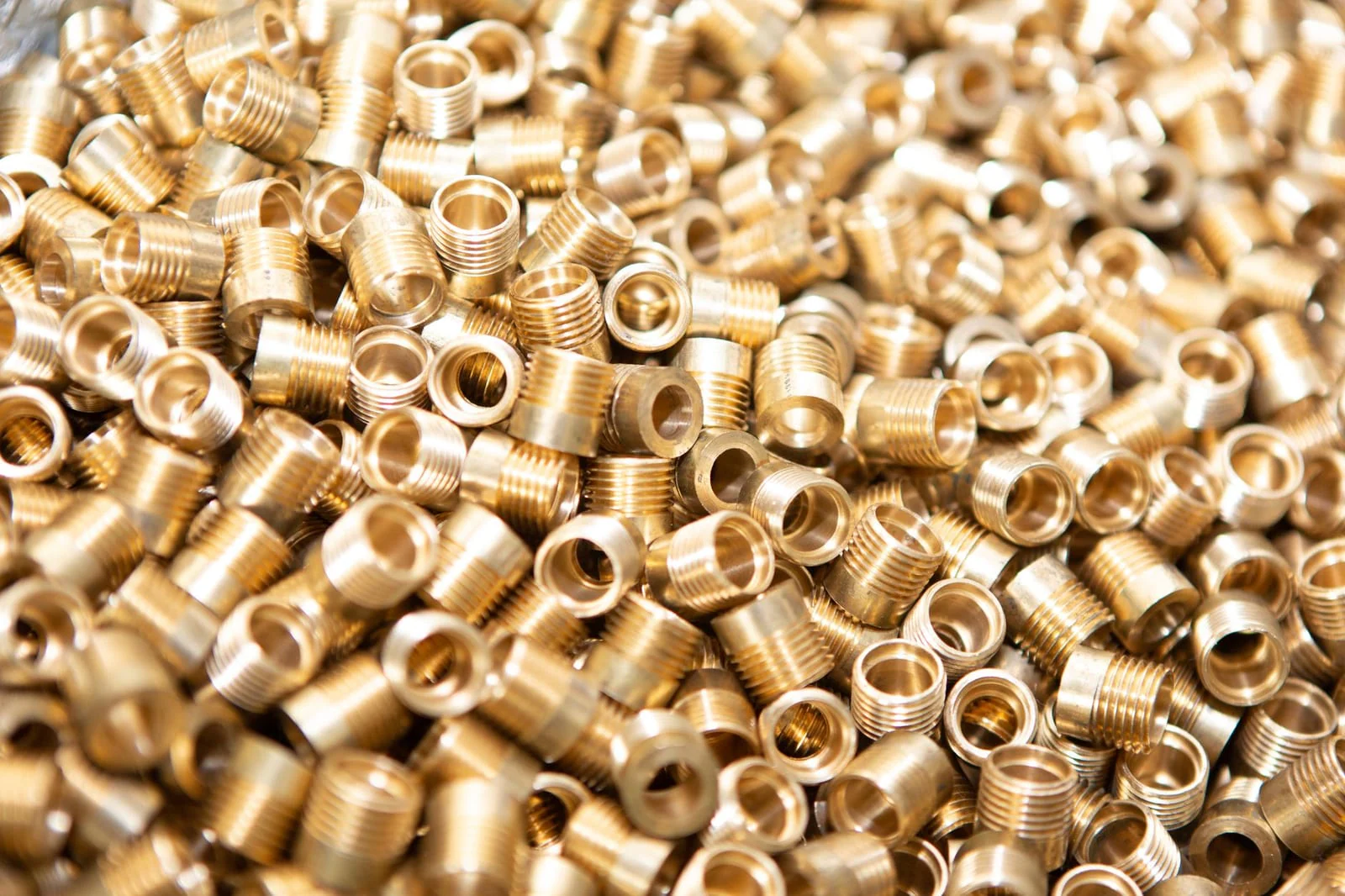
The primary application: cartridge cases, bullet jackets, lamp sockets, and other deep-drawn or stamped parts that demand the deepest draws and tightest radii without cracking — exactly what the clean single-phase α structure delivers.[2]
Decorative Trim & Hardware

Badges, trim, and decorative hardware where the warm gold colour matters, often with a polished or plated finish on the visible face.
Fasteners, Rivets & Turned Parts
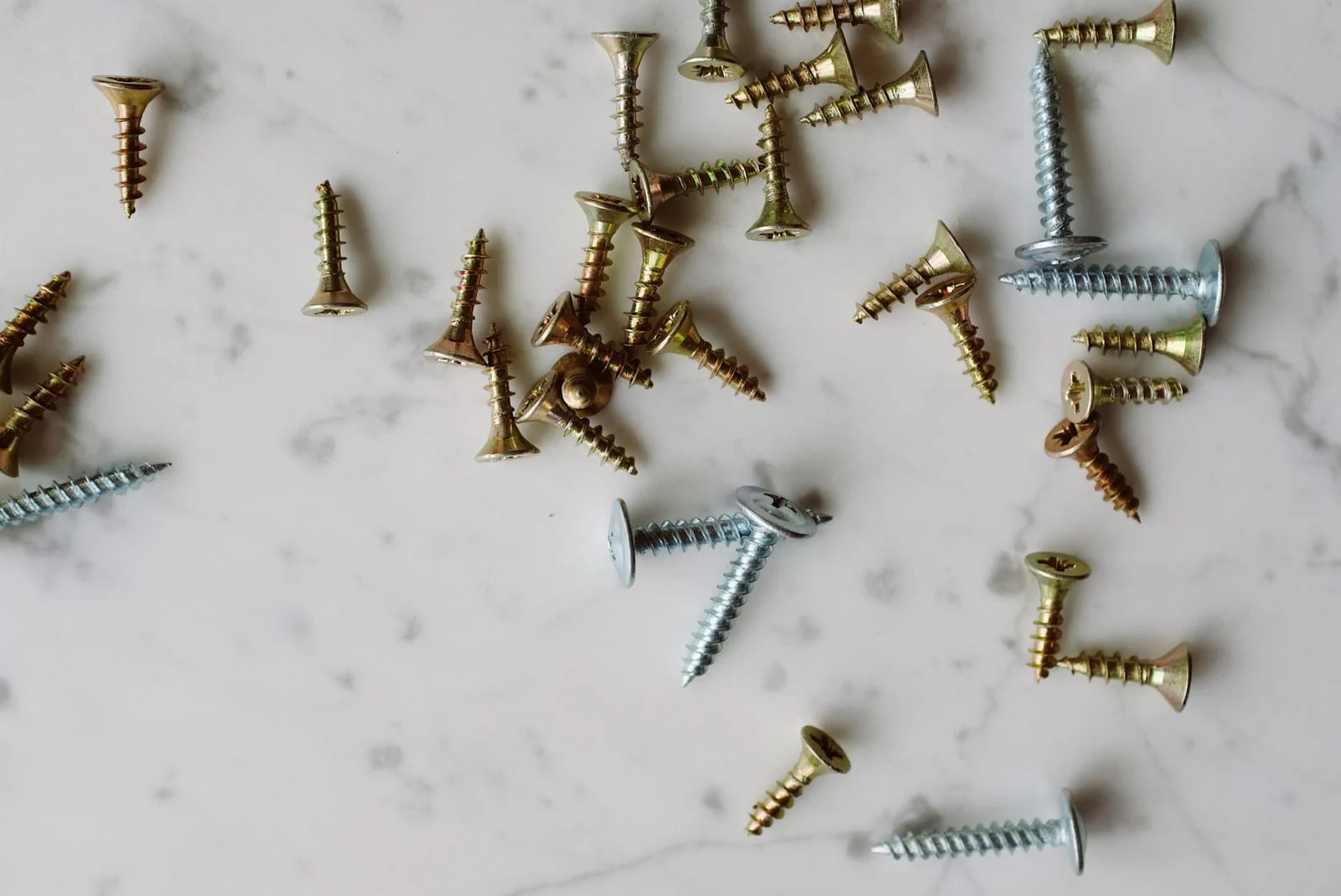
Rivets, small turned parts, and fasteners that benefit from the alloy's good cold formability and consistent surface.
Electrical Connectors & Terminals
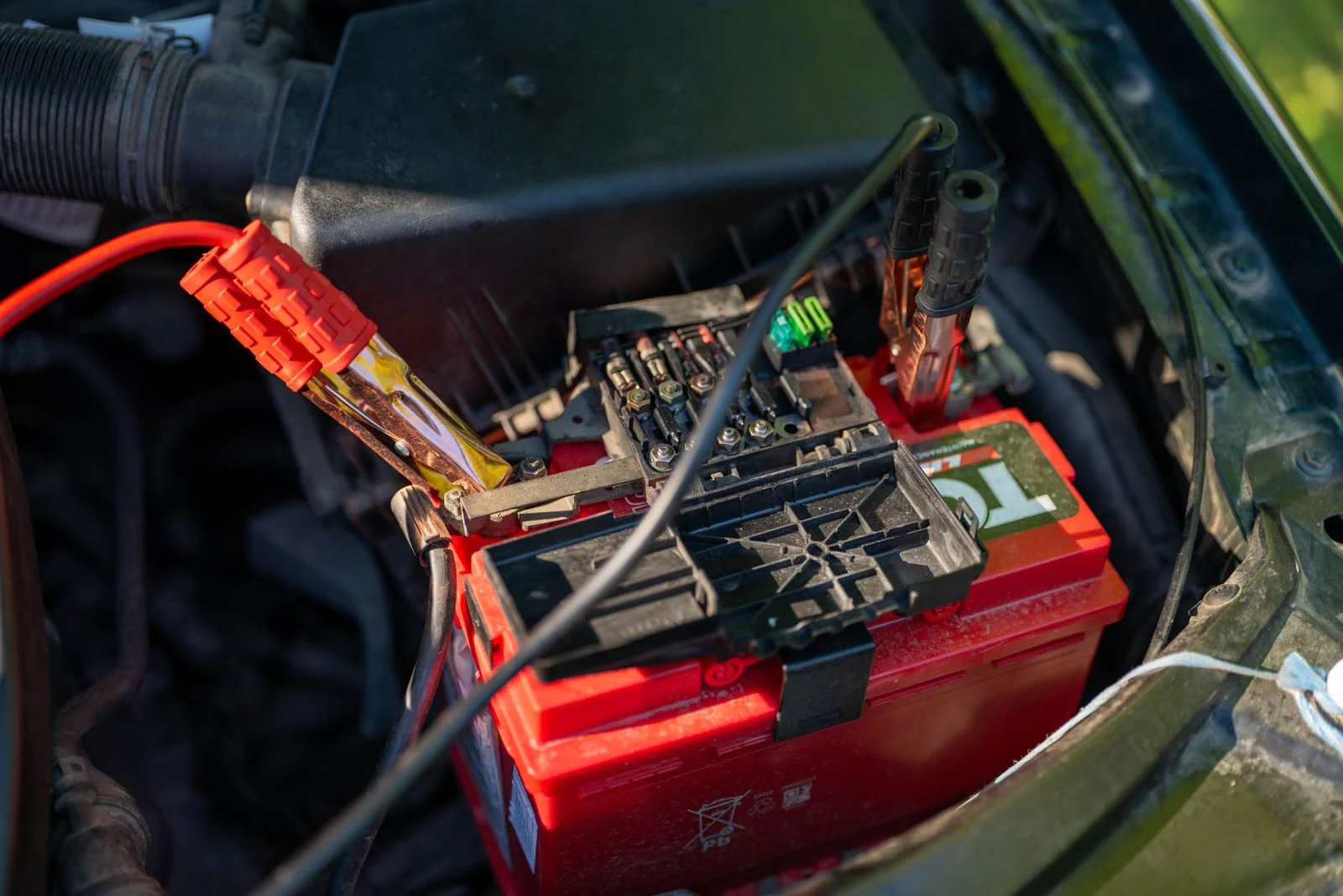
Connectors, terminals, and contacts where moderate conductivity is sufficient and the part is formed by stamping and bending — H65 carries the current well enough while taking the forming a pure-copper part could not.[1]
Forms & Finishes
Common product forms:SheetStripCoilTubeBarWire
Surface finishes:MillBright annealedPolishedPlated
Soft-temper strip and coil are the workhorse forms for H65, feeding stamping and deep-drawing presses; sheet, tube, bar, and wire serve fabricated, turned, and decorative parts. Polished and plated finishes are common where the gold face is visible.
References
- Effect of Cr on the Microstructure and Mechanical Properties of Cu-Ni-Si Alloys. Materials (MDPI), 2026. Conductivity expressed in %IACS; the effect of solid-solution elements on copper-alloy conductivity. pmc.ncbi.nlm.nih.gov/articles/PMC13075149
- Innovations: Introduction to Brasses (Part II). Copper Development Association (CDA). α-brass is FCC, β-brass BCC; higher copper favours a pure α structure with better ductility (good for deep drawing); DZR resistance comes from composition control plus heat treatment to single-phase α. copper.org/.../innovations/2000/01/brasses02
- The Mechanism of Dezincification and the Effect of Arsenic. I.. Lucey, British Corrosion Journal 1(1), 1965. Simultaneous Cu/Zn dissolution and porous Cu re-deposition; As suppresses cuprous-ion re-deposition. doi.org/10.1179/000705965798328254
- The mechanism of stress-corrosion cracking in the brass–ammonia system. Hoar & Booker, Corrosion Science 8(8), 1968. Classic mechanism of brass–ammonia stress corrosion cracking. doi.org/10.1016/s0010-938x(68)80073-3
- Corrosion Product Film-Induced Stress Facilitates Stress Corrosion Cracking. Scientific Reports 5, 2015. Copper and brass in ammonia solutions are classic SCC systems. pmc.ncbi.nlm.nih.gov/articles/PMC4464253