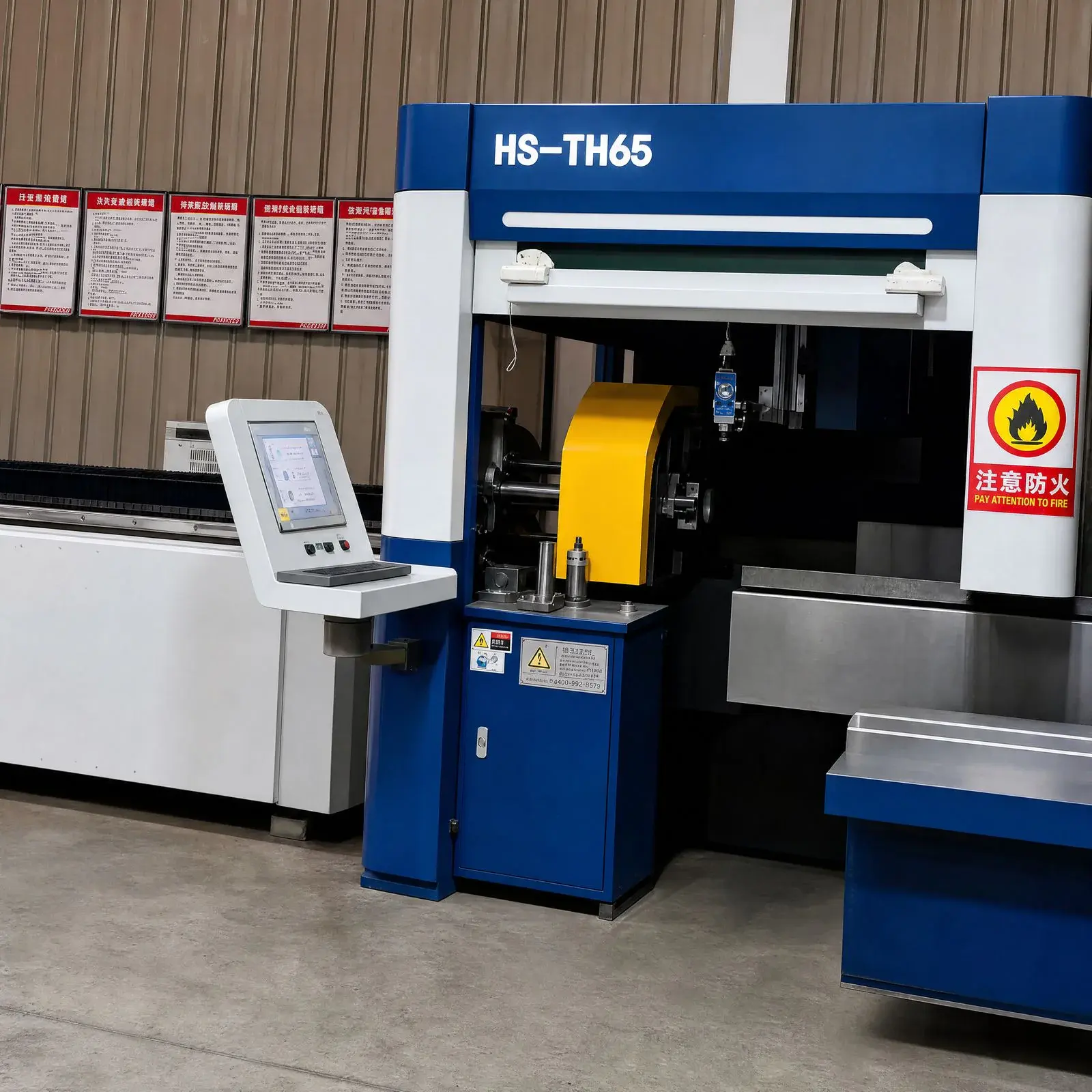
In short: laser tube cutting is continuous laser cutting of tube and profile rather than flat sheet. The tube is held in a chuck that rotates it about its axis while the cutting head travels along the length — the two motions are coordinated so the focused beam can trace any feature on the curved wall: square cut-offs, angled ends, holes, slots, bevels for weld preparation, and the saddle-shaped intersection (cope) profiles where one tube meets another. The cutting *mechanism* is the same as flat-sheet laser cutting — a focused beam melts or vaporises the metal and an assist-gas jet blows the melt clear, leaving a narrow kerf and a small heat-affected zone — but the *machine* and the *geometry* are built around a round, hollow, three-dimensional workpiece. The payoff is downstream: features that would otherwise need marking-out, sawing, drilling and grinding arrive ready to assemble and weld, which is why laser-cut tube is the backbone of welded frames, railings, furniture and machine structures.
What Laser Tube Cutting Is
Laser tube cutting is the continuous laser processing of tube and hollow profile — round, square and rectangular sections — as opposed to the flat-sheet work done on a sheet laser. A length of tube is loaded into the machine, gripped by a chuck, and then cut to length and machined with features along its whole length without ever being unclamped and re-set.
The defining idea is that the tube is treated as a rotating axis. Where a flat-sheet machine moves the beam over a stationary plate in two dimensions, a tube machine adds a third coordinated motion — rotation of the workpiece — so the beam can reach any point on the curved wall and trace features that wrap around the section. This is what lets a single setup produce a finished, weld-ready part rather than just a straight cut-off.
Buyers searching *laser tube cutting*, *tube laser*, *管材激光切割*, or *相贯线切割* (intersection / cope cutting) are looking for this process. It sits in the cutting family alongside flat-sheet laser cutting, and it is the natural front end for any product that is fabricated from welded tube.
The commercial reason to laser-cut tube rather than saw and drill it is work elimination downstream. A tube laser can cut a member to length, put a weld bevel on each end, pierce the bolt holes, and cut the saddle-shaped joint where it meets the next member — all in one operation, with no marking-out and no second machine. The cut parts then locate and weld together far faster and more accurately than sawn-and-drilled parts ever could.
How Tube Laser Cutting Works
At the point of cut the physics is identical to flat-sheet laser cutting: a focused laser beam delivers intense, concentrated energy to a tiny spot on the tube wall, heating it to melting or vaporisation in milliseconds, while a coaxial assist-gas jet blows the molten metal out of the bottom of the cut. The result is a narrow slot — the kerf — with clean walls and only a thin heat-affected zone (HAZ) beside it.
The assist gas does the mechanical work of clearing the melt and also sets the edge chemistry. Inert nitrogen shields the cut and produces a clean, oxide-free edge that needs no rework before welding or finishing; oxygen-assisted cutting adds an exothermic reaction that speeds thicker cuts at the cost of an oxidised edge. For stainless tube, nitrogen is the usual choice precisely because the cut face is left bright and weld-ready.[2]
What makes a tube machine different is motion control. The tube is held in one or more chucks that rotate it about its own axis, and the cutting head travels along the length of the tube (and tips to follow angled and bevelled cuts). The CNC continuously coordinates rotation with head travel so the focal spot stays on the moving, curved surface and traces the programmed contour — a square end, a slot, a hole, or a wrap-around intersection — exactly as a flat machine traces a contour on a plate.
The same coordinated motion handles non-round sections. For square and rectangular tube the rotation is no longer continuous — the controller indexes the section and adjusts head standoff and speed around the corners and along the flat faces, so the focus and gas flow stay correct as the wall geometry changes.
Tube vs Sheet: Why Cutting a Pipe Is Not Cutting a Plate
A flat-sheet laser sees a single, stationary, two-dimensional surface. A tube laser sees a curved, hollow, three-dimensional workpiece that is itself in motion — and that difference drives almost everything about the machine and the process.
A rotating axis, not a moving beam
On sheet, the workpiece is clamped flat and the beam does the travelling. On tube, the workpiece rotates while the head feeds along the length, and the two motions must stay in step. This is the single biggest difference: the part is an extra CNC axis, and programming a feature means describing how it wraps around the rotating section, not just where it sits on a flat plane.
Focusing on a curved surface
A plate keeps the cut zone at a constant distance from the focusing optics. A round wall does not: as the beam moves around the circumference, or across the flats and corners of a box section, the standoff between nozzle and surface changes. The machine continuously corrects head height and focal position so the beam stays sharp and the gas jet stays effective everywhere on the section — a control problem that simply does not exist on flat sheet.
A hollow part — collapse and back-wall strike
A tube is hollow, so two issues appear that a solid plate never raises. First, the cut edge of a thin wall can distort or collapse if heat input and support are not managed, especially on small-diameter or thin-wall tube. Second, the beam exits into the bore and must not damage the far wall. Tube machines manage both with appropriate support, controlled energy input and cutting strategy so the section keeps its shape and the opposite wall is left intact.
Edge quality and dross on the inside
On sheet, dross is shed downward into open space. On tube, melt expelled into the bore can cling to the inside of the wall as dross or burr. Correct assist-gas pressure and cutting parameters keep the cut face clean and minimise internal dross, so the tube ends arrive smooth and weld-ready rather than needing a deburring pass before assembly.
Copes, Bevels & Joints: Built for Welding
The strongest argument for a tube laser is not the cut-off — it is the joints. Because the beam can reach any point on the rotating wall, the machine can cut directly the features that turn a stick of tube into a fabricated assembly: the saddle where two tubes meet, the bevel that prepares an end for welding, and the locating features that let parts self-fixture.
Intersection / cope profiles
Where one tube meets another at an angle, the end must be cut to a saddle-shaped intersection (cope) profile so it sits flush against the mating surface. Traditionally this means marking out, notching and grinding each joint by hand. A tube laser computes the intersection curve and cuts it directly, so the member arrives with a perfectly mating end — no fitting, no gap to bridge with weld, and consistent joints from the first part to the last.
Weld bevels and preparation
By tipping the cutting head, the machine can put a bevel (weld preparation) on the cut end in the same pass that cuts it to length. An end that arrives pre-bevelled lets the welder lay a full-penetration weld without a separate grinding or machining step — the cut and the joint preparation become one operation.
Locating and self-fixturing features
The laser can also cut tabs, slots and matching holes so that mating parts interlock — a tab on one member dropping into a slot on the next. These self-fixturing features locate the assembly without jigs, hold it square while it is tacked, and dramatically cut the fit-up labour for a welded frame.
The value of laser-cut copes, bevels and locating features is realised downstream in welding — see TIG / argon-arc welding and laser welding for how these prepared joints are joined.
The Heat-Affected Zone
Laser cutting is a thermal process, so a band of metal beside the kerf is heated without being removed: the heat-affected zone (HAZ). Because the laser concentrates its energy into a very small spot and the cut is fast, the HAZ on a laser cut is narrow — much narrower than on slower thermal processes — which is one of the reasons laser-cut tube needs so little rework before welding.
The HAZ scales with the heat the cut puts in: studies of laser cutting show HAZ width grows with laser power and shrinks as cutting speed rises, while nitrogen assist gas keeps the cut face clean and oxide-free.[1] On tube the same rule applies — the parameters are tuned so each section and wall thickness is cut with the smallest heat input that still gives a clean through-cut, keeping the HAZ tight and the cut edge ready for welding.[2]
Precision, Tolerance & Cut Quality
A tube laser is repeatable: every part in a run is cut from the same CNC program, so length, feature position and joint profile are consistent from the first piece to the last. The narrow kerf and small HAZ mean the cut geometry is faithful to the drawing, and copes and bevels land where the model says they will.
Cut quality itself is judged the way all thermal cuts are: laser cutting is classified as a thermal cutting process, and the quality of a cut face is graded by criteria such as perpendicularity tolerance and surface roughness (Rz) under ISO 9013.[3] A nitrogen-assisted laser cut on stainless tube typically lands at the clean, oxide-free end of that scale — bright enough to weld or finish without an intermediate dressing step.
The capacity actually delivered on the shop floor — tube diameter range, maximum length and the section types handled — is set by the machine:
| Max outer diameter | 220 mm |
| Max length | 6000 mm |
| Tube sizes | OD 10–220 mm |
Materials & Size Range
Fiber laser cutting handles the full range of fabrication metals — stainless steel, carbon and mild steel, and aluminium among them — in tube and hollow-section form. For stainless tube in particular, nitrogen-assisted cutting leaves a bright, oxide-free edge that suits the architectural, food-grade and decorative work stainless is chosen for.
The geometric envelope — the smallest and largest tube diameters, the maximum length that can be loaded, and the round / square / rectangular sections supported — is fixed by the machine and listed in the capability table above. Round, square and rectangular profiles are all cut on the same machine; the controller adapts the motion to the section.
| Max outer diameter | 220 mm |
| Max length | 6000 mm |
| Tube sizes | OD 10–220 mm |
The Machine
Tube cutting at steelhui runs on a dedicated tube laser — separate from the flat-sheet machine — with chucks that grip and rotate the workpiece and a cutting head that travels the full length of the tube. The diameter range, maximum length and supported sections are listed below; round, square and rectangular profiles are all handled on this one machine.
| Max outer diameter | 220 mm |
| Max length | 6000 mm |
| Tube sizes | OD 10–220 mm |
Because the machine cuts copes, bevels and holes in the same setup as the cut-off, a single pass through it can replace a saw, a drill and a hand-grinding station — which is where the time and accuracy of laser-cut tube come from.
Applications by Industry
Laser tube cutting is the front end for anything built from welded tube. Wherever members must be cut to length, joined at angles and welded into a rigid structure, cutting the tube on a laser eliminates the marking-out, sawing, drilling and grinding that would otherwise precede every weld.
Welded Tube Structures & Frames
Machine bases, equipment frames and structural tube assemblies, where laser-cut copes and self-fixturing tabs let members locate and weld together square and fast — the classic case for a tube laser.
Machine & Equipment Frameworks
Sub-frames, supports and chassis for machinery and equipment, where pre-cut holes, slots and bevels mean the welded framework needs no secondary drilling or fitting before assembly.
Furniture & Architectural Metalwork
Tubular furniture, shelving and architectural elements in stainless and steel, where clean, oxide-free cut ends and precise mitres give a finished look straight off the machine.
Railings, Balustrades & Handrails
Railing and balustrade systems, where laser-cut intersection profiles let posts, rails and infill tubes meet flush and weld cleanly — consistent joints along a long run with no hand-fitting.
- An extensive review of the effects of laser cutting parameters on metal surface and kerf quality. Research on Engineering Structures & Materials (RESM), 2026. HAZ width scales with laser power and inversely with cutting speed; nitrogen assist gives a clean cut edge. jresm.org/article/resm2025-953ma0608rv
- Characterization of AISI 304 stainless steel based on laser cutting process optimization. Scientific Reports (Nature), 2025. Higher cutting speed lowers roughness and kerf width; focus position and assist gas control cut quality. nature.com/articles/s41598-025-24932-6
- ISO 9013:2017 — Thermal cutting — Classification of thermal cuts. International standard. Laser cutting is a thermal cutting process; cut-quality grading criteria = perpendicularity tolerance u and roughness Rz. ISO 9013:2017 (catalog)