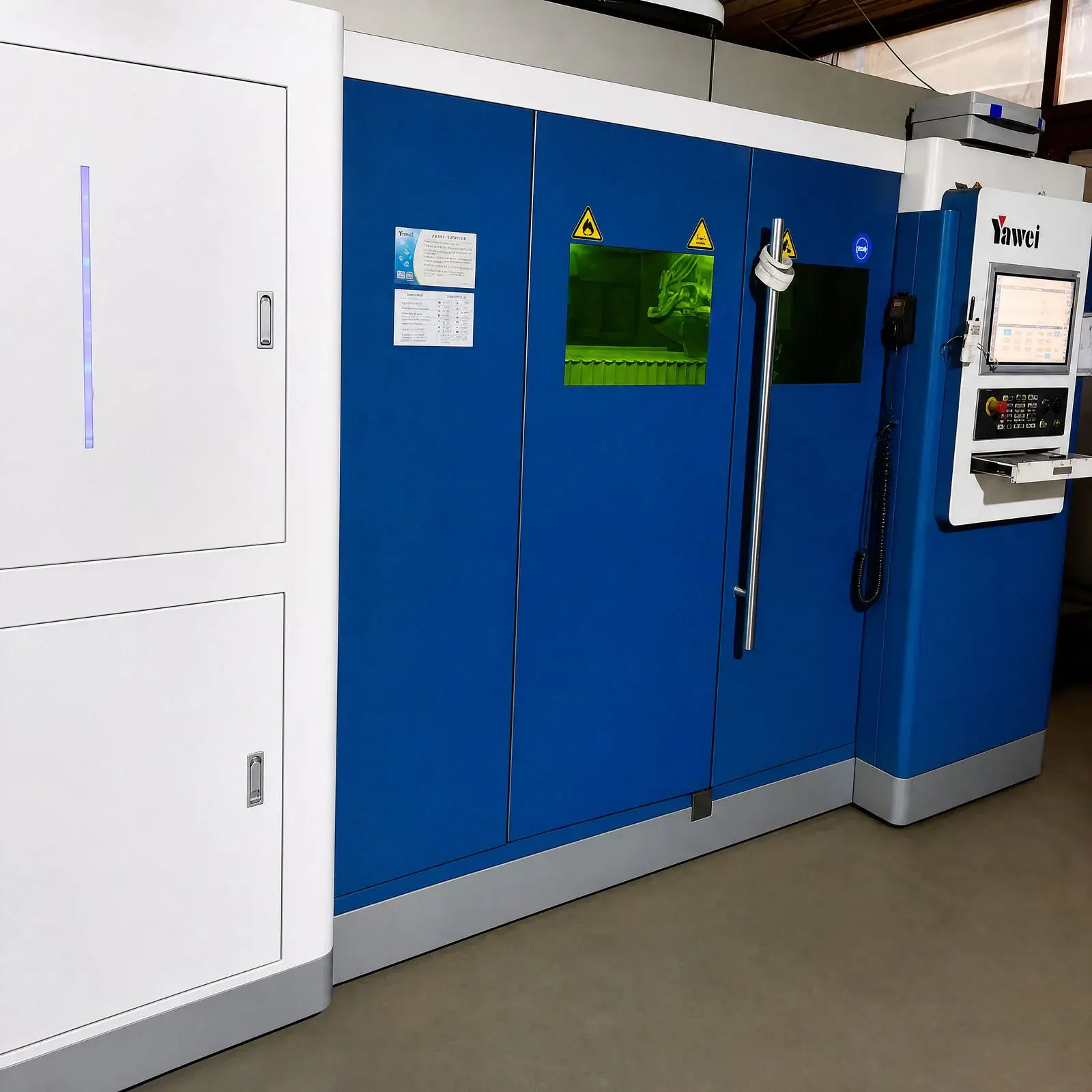
In short: fiber laser cutting focuses a high-power laser beam onto a tiny spot on the sheet, heating the metal until it melts (and partly vaporises); a coaxial assist gas then blows the molten material out of the bottom of the cut, leaving a narrow kerf. The single most important process choice for stainless steel is the assist gas: nitrogen gives a clean, bright, oxide-free edge (the default for stainless), while oxygen burns exothermically to cut thick carbon steel faster but leaves an oxidised edge. Because the energy is concentrated and the cut is fast, the heat-affected zone (HAZ) is very small — narrower at higher cutting speed and lower power.[1][2] Edge quality (squareness and roughness) is classified under [ISO 9013](#precision) for thermal cuts.[3] For stainless steel sheet, nitrogen-assisted fiber laser is the workhorse cutting route; where the part is too thick or the material reflective, plasma or waterjet take over.
What Fiber Laser Cutting Is
Laser cutting is a thermal cutting process: a laser beam is focused to a small, intense spot on the workpiece, the metal at that point is heated past melting, and a jet of assist gas flowing coaxially with the beam ejects the molten material to form a continuous cut. As the cutting head traverses the sheet under CNC control, the melt front travels with it and the result is a narrow slot — the kerf — that follows the programmed contour.
The fiber laser is the modern source for sheet-metal work: the beam is generated in a doped optical fiber and delivered to the cutting head through another fiber, at a near-infrared wavelength that metals absorb efficiently. Compared with the older CO₂ laser it couples energy into steel and stainless steel more effectively, runs at higher wall-plug efficiency, and has no moving mirrors in the beam path — which is why it dominates flat-sheet cutting today. It is the primary sheet-metal blanking route at steelhui, feeding downstream forming and welding with accurately profiled blanks.
Within the cutting family, the laser occupies the thin-to-medium, high-precision niche: it produces the cleanest, narrowest, most accurate cuts of the common processes, at the cost of an upper thickness limit and difficulty with highly reflective metals. Where the part exceeds that envelope, plasma or waterjet take over — a trade-off examined in the comparison section below.
How the Cut Is Formed: Beam, Melt, and Kerf
The cut is made by fusion (melt-and-blow) cutting. Focusing optics concentrate the beam to a spot a fraction of a millimetre across, raising the power density high enough to heat the metal past its melting point almost instantly. A high-pressure assist gas, delivered through a nozzle coaxial with the beam, then drives the molten metal downward and out of the bottom of the cut. Because melting and ejection happen continuously as the head moves, the beam carves a slot — the kerf — rather than vaporising a wide channel.
The kerf width is governed mainly by the focused spot size and the assist-gas dynamics; it is narrow — typically a fraction of a millimetre — which is one reason laser cutting wastes little material and holds tight contours. The kerf is not perfectly parallel-sided: a small taper (the top of the cut slightly wider than the bottom) is normal, and the cut wall carries fine vertical striations — the frozen record of the melt front sweeping down through the sheet. The depth and regularity of those striations, together with the squareness of the edge, are exactly the geometric features used to grade cut quality (see precision).
The dominant process variable is cutting speed. Slowing down pushes more energy into each millimetre of cut, which widens the melt zone and roughens the edge; speeding up reduces heat input, narrows the kerf, and lowers surface roughness — up to the point where the beam can no longer melt fully through and dross (re-solidified melt clinging to the underside) appears. Optimising a cut is largely a matter of balancing speed, power, focus position, and assist-gas pressure for the given material and thickness.[2]
Assist Gas: Nitrogen vs Oxygen
The assist gas does two jobs at once — it physically blows the melt out of the kerf, and it chemically determines what happens to the cut edge. Choosing between nitrogen and oxygen is the most consequential decision in setting up a cut, and the two behave in opposite ways.
Nitrogen — clean, bright cutting (the stainless default)
Nitrogen is an inert gas: it ejects the melt without taking part in the reaction, so the edge is left oxide-free, bright, and clean, ready for welding or finishing with no secondary cleaning. This is precisely what stainless steel needs — an oxidised edge would compromise both appearance and the corrosion resistance of the stainless surface — so nitrogen (often called "clean cutting" or "bright cutting") is the standard assist gas for stainless. The cost is that nitrogen contributes no heat of its own, so it is delivered at high pressure and high flow, and cutting speeds in thick section are lower than with oxygen. Nitrogen-assisted cutting is also associated with lower edge roughness and a narrower, cleaner heat-affected zone.[1]
Oxygen — exothermic cutting for thicker carbon steel
Oxygen reacts with the hot steel, and that oxidation reaction is exothermic — it releases additional heat that supplements the laser, letting the process cut thicker carbon steel faster than nitrogen could. The penalty is an oxidised edge (an oxide skin that usually must be removed before painting or welding) and, in the wrong window, more heat into the part. Oxygen cutting is therefore the route of choice for thick mild/carbon steel where edge oxidation is acceptable, and the wrong choice for bright stainless work.
Rule of thumb: nitrogen for stainless (and where a clean, weld-ready edge matters); oxygen for thicker carbon steel where speed matters more than a bright edge.
The Heat-Affected Zone (HAZ)
Any thermal cut leaves a thin band beside the kerf where the metal got hot enough to change its microstructure or hardness without melting — the heat-affected zone (HAZ). Because cutting is a heat input, comparative studies of thermal versus mechanical cutting show that thermal processes (laser, plasma) alter the edge hardness and structure within this band, whereas a cold mechanical process such as waterjet leaves essentially no HAZ.[4]
The defining advantage of the laser is that its HAZ is very small. The energy is delivered at high power density to a tiny spot and the cut is fast, so heat has little time to diffuse sideways into the surrounding metal before the head has moved on. The practical consequences are low thermal distortion of the blank and a cut edge whose properties stay close to those of the parent sheet — important for stainless steel, where minimising the heat-altered band helps preserve the corrosion performance of the edge.
Two process levers set the HAZ width. It grows with laser power (more energy deposited per unit length) and shrinks with cutting speed (less dwell time for heat to spread) — so to first order the HAZ width scales with power and inversely with speed.[1] This is the same trade-off that governs edge roughness: running fast and no hotter than necessary gives both a narrower HAZ and a cleaner edge, which is why nitrogen "bright cutting" of stainless is run at the highest speed that still cuts cleanly through.[2]
Precision, Tolerance & Edge Quality
Laser cutting is prized for dimensional accuracy and a clean, square edge — the reason it is the preferred blanking route where parts must fit and weld without rework. Two distinct things describe the quality of a cut: how closely the part matches its programmed dimensions (positional tolerance), and how good the cut face itself is (squareness and roughness).
Edge quality on a thermal cut is graded internationally under ISO 9013, the standard that classifies thermal cuts (laser among them) by geometric quality. Rather than a single pass/fail, it grades the cut against measurable features of the cut face — chiefly the perpendicularity / angularity tolerance (u), which captures how square the edge is to the surface, and the mean surface roughness (Rz) of the cut wall. Specifying a part to an ISO 9013 quality range puts a common, auditable language around "how good does the cut edge need to be."[3]
| Max thickness | 25 mm |
| Sheet size | 3000 × 1500 mm |
| Laser source | Fiber, 4 kW |
The specification figures above are the single source of truth for this cell. Achievable edge quality depends on material, thickness, and the speed/power/gas window chosen for the job.
Materials & Thickness Range
Fiber laser cutting handles the full run of flat sheet steelhui works in — stainless steel (the staple, cut bright under nitrogen) and carbon / mild steel (cut under nitrogen for a clean edge, or under oxygen when thickness and speed dominate). The near-infrared fiber wavelength couples efficiently into these metals, which is what makes the process fast and economical on steel and stainless.
| Max thickness | 25 mm |
| Sheet size | 3000 × 1500 mm |
| Laser source | Fiber, 4 kW |
The governing limit is sheet thickness: past the rated maximum the beam can no longer maintain a clean cut through the section, and the job moves to plasma or waterjet. Highly reflective and conductive metals (such as copper and aluminium alloys) are more demanding to cut than steel because they reflect more of the beam and conduct heat away quickly — feasible within limits on a fiber source, but outside the steel/stainless sweet spot this process is set up for. Within the rated envelope shown above, stainless and carbon-steel sheet are the materials this cell is built around.
Equipment at steelhui
Sheet cutting runs on a Bystronic fiber laser system on a flat-bed cutter sized for full-size sheet. The fiber source delivers the beam through optical fiber to the cutting head, with high-pressure assist-gas (nitrogen for bright stainless cuts, oxygen for thicker carbon steel) and CNC contour control. Exact source power, bed size, and maximum thickness are listed in the specification table.
| Max thickness | 25 mm |
| Sheet size | 3000 × 1500 mm |
| Laser source | Fiber, 4 kW |
The cutting cell is the front end of the fabrication flow: an incoming sheet is nested, cut to profiled blanks, and the blanks pass downstream to forming and welding. The sequence below traces a part from program to finished blank.
Laser vs Plasma vs Waterjet — Choosing the Cutting Process
The three workhorse profile-cutting processes split the field by thickness, edge quality, and heat. Laser wins on precision and edge quality in thin-to-medium sheet; plasma trades edge quality for speed and reach into thick conductive plate; waterjet is the cold, no-HAZ option that cuts anything but slowly. The cards summarise the trade-off.
Because laser and plasma are thermal processes they leave a heat-affected zone, while waterjet is mechanical and leaves none — the deciding factor when a part must keep parent-metal edge properties.[4] Cold-jet routes are also the benchmark for the lowest edge damage: studies of water-guided laser variants confirm that adding a cold medium markedly reduces roughness, burr, and thermal damage versus conventional dry laser cutting.[5] For most stainless and carbon-steel sheet within its thickness range, though, the dry fiber laser remains the fastest route to a clean, accurate, weld-ready blank.
Applications
Fiber laser cutting is the entry point for almost every fabricated stainless and steel part — wherever flat sheet must become an accurate, clean-edged blank ready for bending, rolling, or welding.
Sheet-metal blanks & enclosures
Profiled blanks, panels, brackets, and enclosure parts cut from stainless and steel sheet — the bread-and-butter feedstock for downstream press-brake bending and welding, where a tight, square cut edge means parts fit and weld with no rework.
Precision contours & cut-outs
Fine internal cut-outs, slots, and intricate outlines that exploit the narrow kerf and CNC accuracy — features that would be impractical to punch or saw and that benefit from the clean, oxide-free edge of nitrogen cutting.
Bright stainless work
Architectural, food-grade, and decorative stainless parts where a bright, oxide-free edge is required straight off the machine — the case nitrogen "clean cutting" is built for, preserving both appearance and edge corrosion resistance.
- An extensive review of the effects of laser cutting parameters on metal surface and kerf quality. Research on Engineering Structures & Materials (RESM), 2026. HAZ width scales with laser power and inversely with cutting speed; nitrogen assist gives low roughness and a narrow-HAZ clean cut. jresm.org/article/resm2025-953ma0608rv
- Characterization of AISI 304 stainless steel based on laser cutting process optimization. Scientific Reports (Nature), 2025. Higher cutting speed lowers roughness and kerf width and reduces heat input and thermal damage; focus position and assist gas control cut quality. nature.com/articles/s41598-025-24932-6
- ISO 9013:2017 — Thermal cutting — Classification of thermal cuts. International standard. Laser cutting is a thermal cutting process; cut-quality classes are graded by geometric criteria such as perpendicularity tolerance u and roughness Rz. ISO 9013:2017 (catalog)
- A comparative study of the thermal and mechanical cutting influence on the cut-edge hardness of structural steels. Int. J. Adv. Manuf. Technol. (Springer), 2023. Thermal cutting (laser/plasma) adds heat that alters edge hardness and microstructure (the HAZ); mechanical cutting (waterjet) causes no thermal effect. doi.org/10.1007/s00170-023-12937-2
- The Advancement of Waterjet-Guided Laser Cutting System for Enhanced Surface Quality in AISI 1020 Steel Sheets. Materials (MDPI), 2024. Waterjet-guided laser cutting significantly reduces roughness, burrs and thermal damage versus conventional laser — evidence that a cold-medium assist lowers thermal damage. pmc.ncbi.nlm.nih.gov/articles/PMC11277706