In short: TIG welding — formally gas tungsten arc welding (GTAW), also called argon arc welding — strikes an arc between a non-consumable tungsten electrode and the workpiece under a shield of inert argon gas, melting the base metal into a weld pool while filler wire is fed in independently by hand. Decoupling the heat source from the filler is what gives TIG its defining trait: precise, low-heat-input control with no spatter, a stable arc, and a clean, bright weld bead — ideal for stainless steel and thin-wall fabrication. The trade-off is speed: TIG is slower than MIG and lays down less metal than laser welding, so it earns its place on critical, high-quality joints rather than long production runs. For stainless work the discipline that separates a sound weld from a failed one is shielding — argon over the pool to stop oxidation, and back purging behind the joint to stop the root from oxidising (going black) and sensitising. This guide covers the GTAW arc and weld-pool physics, shielding and purging, defects and acceptance, heat-input and distortion control, and how TIG compares with laser and MIG.
What TIG / Argon Arc Welding Is
TIG welding — gas tungsten arc welding (GTAW) in the formal nomenclature, and *argon arc welding* in common shop usage — is a fusion-welding process in which an electric arc is struck between a non-consumable tungsten electrode and the workpiece. The arc melts the base metal to form a weld pool; an inert gas, almost always argon, flows from the torch to shield the molten metal from the atmosphere; and where extra metal is needed the welder feeds a filler wire into the pool by hand, separately from the arc.
That separation of arc from filler is the whole point. In MIG the wire *is* the electrode, so heat and metal arrive together and you trade control for speed. In TIG the tungsten only makes the heat, and the welder decides independently how much filler to add and where — which is why GTAW gives the operator the finest control of any common arc process and produces the cleanest welds.
At steelhui, TIG is the precision-welding station: it is reserved for critical assemblies and thin-wall stainless work where the weld must be sound, repeatable, and cosmetically clean — pressure-containing joints, fabricated stainless products, and tube work. The trade is deliberate: TIG is slower than MIG and deposits less than laser welding, so it is matched to the jobs where joint integrity, not throughput, is the deciding factor.
The GTAW Arc and the Weld Pool
Once the arc is established, a concentrated heat source sits over the joint and melts a small volume of base metal into a liquid weld pool. Unlike laser welding, which can drive a vapour keyhole deep into the metal, the TIG arc fuses primarily by conduction: heat enters at the surface and spreads downward, so the pool is a shallow, free-surface body of molten metal whose shape is governed by how heat and fluid move within it.
Modelling of stationary GTAW treats the pool as a coupled heat-transfer and fluid-flow problem with a deformable free surface, and shows that the liquid does not sit still — it circulates, and the direction of that circulation controls how deep the weld penetrates.[1] Several forces drive the flow, but for stainless steel the decisive one is usually Marangoni convection: a surface-tension gradient across the hot pool. Surface tension varies with temperature (and with trace surface-active elements such as sulphur), so the free surface pulls liquid from regions of low surface tension toward regions of high surface tension, setting up a convective loop.
The direction of that Marangoni loop is what matters. When flow runs inward and downward at the pool centre it carries hot metal into the depth and produces a deep, narrow weld; when it runs outward it spreads the pool wide and shallow. This is not a curiosity — it is the basis of the A-TIG variant, where a thin surface flux reverses the surface-tension gradient and the consequent change in convection direction can roughly double penetration for the same arc, letting thicker sections be joined in a single pass.[2] Understanding which way the pool is flowing is therefore central to getting predictable penetration on austenitic stainless steel.
Throughout, the argon shield blankets the pool and the hot tungsten, excluding oxygen and nitrogen. On stainless steel that protection is not optional cosmetics: a pool that contacts air oxidises instantly, picks up nitrogen, and forms a defective, discoloured bead. A stable arc, a quiet pool, and a clean inert atmosphere are the three conditions that together give TIG its characteristic bright, spatter-free weld.
Shielding & Back Purging
There are two gas-protection jobs in a stainless TIG weld, and skipping either ruins the joint. The torch shield protects the face — the visible weld pool and the tungsten — by flooding them with argon. The back purge protects the *root* — the underside of the weld that the torch shield never reaches.
Why the root must be purged
When stainless steel is heated to welding temperature with air on the back side, the root surface oxidises heavily — it turns blue-black, a condition welders call sugaring or root oxidation. That heat-tinted oxide is more than ugly: it is chromium-depleted, so the metal directly beneath it has lost the chromium that gives stainless its corrosion resistance. In the same temperature range the heat-affected metal can also sensitise — chromium carbides precipitate at grain boundaries and rob the adjacent metal of corrosion protection. A black, sugared root is therefore a corrosion liability, not a cosmetic one.
The fix is purging: argon is fed into the back side of the joint (inside a pipe, or into a dammed-off chamber behind a plate) to displace the air before and during welding, so the root solidifies under inert gas just as the face does. Done properly it leaves a bright, clean root with full corrosion resistance intact. This is why stainless TIG fabrication is slower and more disciplined than welding carbon steel — every closed joint needs a purge plan.
Root oxidation ("sugaring") on stainless is a corrosion-resistance defect, not just an appearance one: the heat-tinted layer is chromium-depleted. Back purging with argon is the standard control. Relevant base metals: 304 and 316 austenitic stainless.
Weld Defects & Quality Control
A weld is only as good as it is sound. The geometric imperfections that can occur in a fusion weld are classified internationally by ISO 6520-1, which sorts them into six numbered groups: cracks, cavities (including porosity), solid inclusions, lack of fusion and incomplete penetration, imperfections in shape (including undercut), and a final "other" group.[3]
Not all of these are equally dangerous. Porosity is gas trapped during solidification — argon shielding and a clean joint are the first defences against it. Lack of fusion and incomplete penetration leave a sharp internal notch that concentrates stress. Cracks are the most serious of all: a crack is a ready-made fracture initiation site, and unlike rounded porosity it does not blunt under load.[5]
Acceptance is judged against a quality level, not a personal opinion. ISO 5817 defines three quality levels — B (most stringent), C, and D — and a weld is specified and inspected to one of them. The principle that matters for critical work: certain imperfections, including cracks and lack of fusion, are not permitted at any quality level.[4]
Detection follows the defect. Surface imperfections — undercut, surface cracks, visible porosity, profile — are caught first by visual inspection, supplemented by dye-penetrant (PT) or magnetic-particle (MT) testing for fine surface cracks. Internal flaws such as buried porosity, inclusions, or lack of fusion require volumetric non-destructive testing — radiography (RT) or ultrasonic testing (UT) — to see inside the joint without cutting it open.[5] For steelhui the practical rule is that the inspection method is chosen to match both the defect type being guarded against and the quality level the part is built to.
Heat Input & Distortion Control
Every fusion weld is a localised heating-and-cooling cycle, and that cycle leaves two marks on the metal: a heat-affected zone (HAZ) beside the fusion line where the base metal was hot enough to change but not to melt, and distortion from the thermal expansion and contraction of the joint.
TIG's advantage here is controllable, relatively low heat input. Because the welder sets the current precisely and adds filler independently, the energy delivered per unit length of weld can be kept to what the joint actually needs — no more. Lower heat input means a narrower HAZ, less time spent in the sensitising range for austenitic stainless, and less shrinkage to fight afterwards.
Distortion control on thin-wall stainless is mostly technique and fixturing, not heat alone. The standard tools are tack welding to hold geometry, balanced or sequenced welding to let shrinkage forces cancel rather than accumulate, jigs and clamps to restrain the part while it cools, and limiting the heat per pass. On thin sections the priority is to put down a sound weld with the *least* energy that fully fuses the joint — which is exactly the regime TIG is built for, and why it suits thin-wall and precision work that MIG would distort.
TIG vs Laser Welding vs MIG — Choosing the Process
All three join metal by fusion, but they sit at different points on the quality-versus-speed curve. The choice comes down to what the joint must deliver: cleanest control and best finish, deepest narrowest weld at speed, or fastest fill on thicker structural work.
In practice the three are complementary, not rivals. steelhui uses laser welding for long stainless seams where speed and a deep, narrow, low-distortion weld matter, and reserves TIG for the critical joints — where independent filler control, the lowest practical heat input, and a clean purged root make the difference between a weld that passes and one that does not.
Precision & Tolerances
TIG is the precision-welding capability, and the controllable arc, hand-fed filler, and disciplined fixturing translate directly into a tight, repeatable result on critical assemblies. The figures below are the working envelope for this station.
| Max thickness | 20 mm |
| Tolerance | ±1 mm |
Holding tolerance on a weldment is as much about controlling distortion as about laying the bead — which is why the heat-input discipline and fixturing covered above are what actually deliver the dimensional result on a finished assembly.
Materials & Thickness Range
TIG at steelhui is built around stainless steel and thin-wall work. The independent filler control and low, steady heat input suit austenitic stainless particularly well — 304 and 316 — where a clean, purged, low-distortion weld preserves corrosion resistance through the joint.
| Max thickness | 20 mm |
| Tolerance | ±1 mm |
Thin-wall tube, sheet, and fabricated stainless products are the natural fit: thin sections punish excess heat with burn-through and distortion, and TIG's fine control is exactly the answer. Thicker sections are welded in multiple passes within the station's thickness envelope, with each pass kept to a controlled heat input.
Welding Equipment
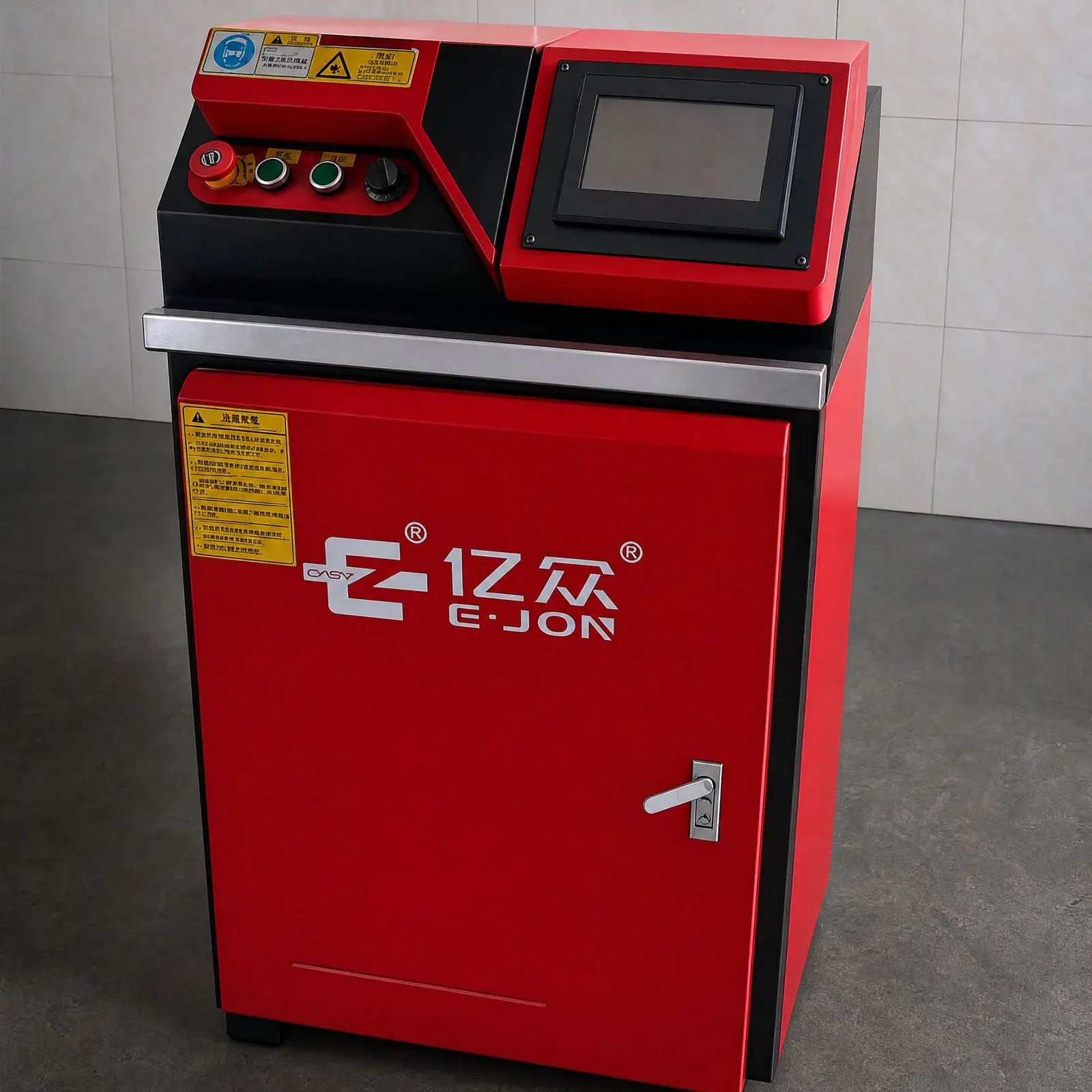
TIG welding here runs on a dedicated AC/DC inverter power source. AC/DC capability matters because polarity is chosen to suit the material; for stainless and other steels DC is used, and the precise, stable current control is what lets the welder hold the low, even heat input that clean stainless welds demand. Full machine specifications are listed below.
Applications by Sector
TIG earns its keep wherever a stainless or thin-wall joint has to be sound, clean, and corrosion-tight rather than merely fast to lay down.
Critical & Pressure-Containing Assemblies
Joints on pressure vessels, tanks, and load-bearing assemblies, where weld soundness is inspected to a defined quality level and defects such as cracks or lack of fusion are not tolerated. The fine arc control and inspectable, repeatable beads make TIG the process of record for these welds.
Fabricated Stainless-Steel Products
Stainless enclosures, frames, fittings, and finished products where the weld is visible and must stay corrosion-resistant. A purged, bright, spatter-free bead means little or no grinding and a surface that keeps its passive film intact.
Thin-Wall Tube & Pipe Work
Thin-wall stainless tube and pipe — hygienic, process, and hydraulic lines — where back purging protects the root and low heat input avoids burn-through and distortion on the thin section.
Repair & Precision Rework
Precise, localised welds for repair and rework on stainless components, where the ability to add exactly the right amount of filler in exactly the right place — with minimal heat spread — is decisive.
- Modeling of Melt Flow and Heat Transfer in Stationary Gas Tungsten Arc Welding. Crystals (MDPI), 2021. The GTAW weld pool is liquid metal with free-surface convection and heat transfer; the direction of Marangoni convection controls penetration depth. pmc.ncbi.nlm.nih.gov/articles/PMC8622748
- Mechanical Properties and Microstructure of TIG and ATIG Welded 316L Austenitic Stainless Steel. Materials (MDPI), 2021. TIG welding of austenitic stainless steel: argon shields the pool and Marangoni convection controls penetration; A-TIG reverses the convection direction to roughly double penetration. ncbi.nlm.nih.gov/pmc/articles/PMC8658163
- ISO 6520-1:2007 — Classification of geometric imperfections in metallic materials — Fusion welding. International standard. Six defect groups by code: cracks 100 / cavities 200 / solid inclusions 300 / lack of fusion & penetration 400 / shape defects incl. undercut 500 / miscellaneous 600. ISO 6520-1:2007 (catalog)
- ISO 5817:2023 — Welding — Quality levels for imperfections in fusion-welded joints. International standard. Three acceptance levels B/C/D; cracks and lack of fusion are not permitted at any level. ISO 5817:2023 (catalog)
- A Review of Non-Destructive Testing (NDT) Techniques for Defect Detection: Application to Fusion Welding. Materials (MDPI), 2022. Porosity = entrapped gas on solidification, lack of fusion = notch effect, cracks most critical; surface inspection is visual, internal by RT/UT/MT/PT. pmc.ncbi.nlm.nih.gov/articles/PMC9147555