In short: laser welding focuses a high-power beam to a power density high enough to vaporise the metal, not just melt it. The vapour recoil pressure pushes the molten pool aside and opens a slender vapour cavity — the keyhole — whose walls trap the beam through multiple reflections so the energy is absorbed deep inside the material rather than only at the surface.[1] The result is deep-penetration, high aspect-ratio welds: far narrower, with far lower heat input, less distortion and higher speed than conventional arc welding. For stainless steel that means tight, clean seams with a small heat-affected zone; weld quality is judged against international acceptance levels (ISO 5817 / ISO 6520-1). It is the precision route for stainless-steel sheet-metal, vessels and tubing — where the alternative, TIG, trades speed and distortion for lower equipment cost.
What Laser Welding Is
Laser welding joins metal by focusing a laser beam onto the joint, melting the material along the seam so it fuses on solidification. What sets it apart from older fusion processes is *how concentrated* the energy is: the beam is focused to a small spot at very high power density, so the heat is delivered to a tiny region rather than spread across a wide area.
That concentration is the whole story. It is what gives laser welding its signature combination — deep, narrow welds, low heat input, small heat-affected zone, little distortion, and high welding speed — and it is why laser welding has become a preferred route for precision stainless-steel fabrication, from sheet-metal enclosures to vessels and tubing.
Here the focus is on continuous laser welding of stainless steel — running a moving weld along a seam, rather than spot or pulsed tack welding. The reach of the process on the shop floor is set by material thickness and seam length; the figures are in the specifications below.
The Keyhole: How Deep-Penetration Laser Welding Works
At low power density a laser simply heats and melts the surface, and the heat conducts inward — *conduction-mode* welding, giving a shallow, wide, roughly semicircular weld. The defining mechanism of deep-penetration laser welding is different, and it is called the keyhole.
When the focused beam reaches a high enough power density, it does more than melt the metal — it vaporises it. The escaping metal vapour exerts a recoil pressure back on the molten pool, and that pressure pushes the melt aside to open a narrow, deep vapour-filled cavity directly under the beam: the keyhole.[1]
The keyhole is what makes the depth possible. Its walls act as a light trap: the beam reflects multiple times down the cavity, and at each reflection more energy is absorbed by the walls. So instead of energy being deposited only on the top surface, it is coupled into the body of the material along the full depth of the keyhole.[1] This is why laser welds reach a high depth-to-width (aspect) ratio — deep and slender — that conduction-mode welding and arc processes cannot match.
A pressure balance keeps the keyhole open during welding: the outward vapour pressure works against the surface tension and hydrostatic pressure of the surrounding melt that would otherwise collapse it. As the beam travels along the seam, the keyhole moves with it; molten metal flows around the cavity from front to back and solidifies behind it to form the weld bead.
Laser Welding vs Arc Welding
The practical difference between laser and conventional arc welding (TIG/GTAW, MIG/GMAW) follows directly from the keyhole. An arc spreads heat over a comparatively broad zone and melts from the surface down; the laser drives a concentrated, deep keyhole. That changes nearly every weld characteristic that matters to a fabricator.
- Lower heat input. Energy is concentrated and the weld is made fast, so far less total heat goes into the part than with an arc.
- Narrower weld and HAZ. The keyhole is slender, so both the fusion zone and the surrounding heat-affected zone are tight.
- Deeper penetration. Keyhole coupling gives a high aspect-ratio weld — deep relative to its width — often in a single pass where an arc would need several.
- Less distortion. Low heat input and a narrow weld mean less thermal expansion and contraction, so parts stay closer to shape.
- Higher speed. The concentrated energy lets the beam travel along the seam quickly, raising throughput.
None of this makes the arc processes obsolete — they cost far less to set up, tolerate wider fit-up gaps, and fill thick joints economically. The trade is clear: choose laser when narrow welds, low distortion and speed are worth the precision fit-up and equipment; choose TIG when weld quality at low cost matters most, and MIG when filling thicker joints fast.
Heat-Affected Zone & Distortion
Every fusion weld leaves a heat-affected zone (HAZ) — a band of base metal beside the fusion zone that did not melt but was heated enough to change its microstructure. With laser welding the low, concentrated heat input keeps that band narrow, which is one of the process’s biggest practical advantages on stainless steel.
Why a small HAZ matters for stainless steel: the less time the metal beside the weld spends hot, the less opportunity there is for the metallurgical changes that degrade corrosion resistance. A narrow, fast laser weld limits that exposure compared with a slower, hotter arc weld, helping preserve the corrosion performance that the stainless grade was chosen for in the first place.
Distortion is the other payoff. A weld shrinks as it cools, and a wide, hot weld pulls the part out of shape; the narrow laser weld with its low heat input puts far less thermal load into the workpiece, so panels stay flatter and assemblies hold their dimensions. For precision sheet-metal and thin-wall stainless work — where a warped panel is scrap — this low-distortion behaviour is often the deciding reason to weld with a laser.
Weld Defects & Quality Control
Fast, deep welding still has to be sound welding. Laser welds are assessed for the same families of imperfections as any fusion weld, and the international classification — ISO 6520-1 — groups geometric imperfections into six coded groups: cracks, cavities (including porosity), inclusions, lack of fusion / incomplete penetration, imperfect shape (such as undercut), and others.[2]
- Porosity. Gas trapped as the weld solidifies leaves voids; in stainless laser welds it is the imperfection to watch, and is countered with clean joints and proper shielding gas coverage.
- Lack of fusion / incomplete penetration. The metal does not fully fuse or the keyhole does not reach through — a notch-like defect that concentrates stress.[3]
- Cracking. The most dangerous family, since cracks are sharp stress raisers that can propagate; never acceptable in a quality weld.[3]
- Undercut and shape defects. Geometry imperfections at the weld toe or face that weaken the joint or fail visual inspection.
Shielding gas is part of getting this right. An inert shielding gas protects the molten pool and the hot, freshly welded stainless surface from the surrounding air — keeping oxygen and nitrogen out of the weld, suppressing porosity and oxidation, and influencing how the keyhole and plasma behave so the bead forms cleanly.
Acceptance is graded, not pass/fail by feel. Under ISO 5817 fusion welds are assigned quality levels B (stringent), C (intermediate) and D (moderate), with the limits on each imperfection tightening from D up to B; cracks and lack of fusion are not permitted at any level.[4] (Beam welds are covered by the companion standard ISO 13919.) The job is specified to a level, then verified: surface imperfections by visual inspection, and internal ones by non-destructive testing such as radiographic (RT) or ultrasonic (UT) methods.[3]
Weld quality levels and imperfection classes are specified per ISO 5817 / ISO 6520-1 (beam welds per ISO 13919) — graded acceptance criteria, not numeric tables reproduced here.
Precision & Capability
The working envelope for continuous laser welding here — the stainless-steel thickness it joins and the seam length it runs in a pass — is summarised below.
| Max thickness | 10 mm |
| Max seam length | 3 m |
Because the laser weld is narrow and non-contact, the practical limit is rarely the weld itself but the fit-up: the joint edges must be presented accurately and held in good contact, since a concentrated beam does not bridge gaps the way a filler-fed arc does. Within that envelope the process delivers repeatable, tight seams suited to precision stainless work.
Materials & Range
The process here is set up first and foremost for stainless steel. Austenitic stainless grades laser-weld well — their weldability, combined with the narrow weld and small HAZ the laser delivers, makes for clean joints that keep their corrosion resistance — which is why laser welding pairs naturally with precision stainless fabrication.
| Max thickness | 10 mm |
| Max seam length | 3 m |
The workhorse grade for this kind of work is 304 stainless steel; where higher corrosion resistance is needed the same process suits the molybdenum-bearing 316 family. The capability figures above (thickness and seam length) define what can be welded in a continuous pass.
Equipment
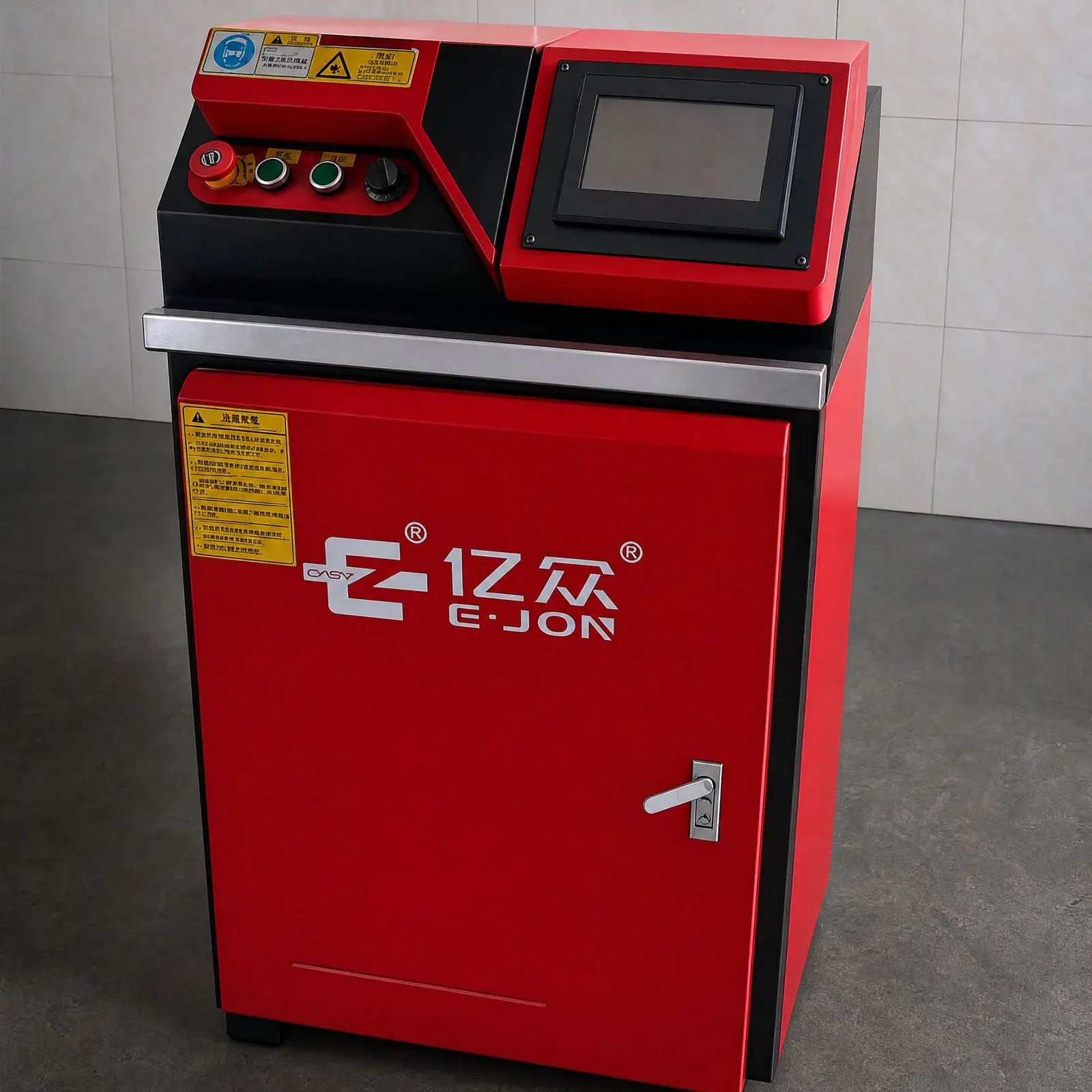
Laser welding is performed in house on Steelhui-owned laser-welding equipment by Steelhui welding personnel. The dedicated line supports continuous stainless-steel welding for precision fabricated parts and assemblies.
Machine model, laser power and working envelope are confirmed against the job requirement during quotation. For arc welding, see the related in-house TIG / Argon Arc Welding capability.
Related in-house welding capability:TIG / Argon Arc Welding
Applications
Laser welding earns its place wherever a stainless joint has to be tight, clean and dimensionally stable — its narrow, low-distortion weld is the differentiator over arc processes.
Precision Sheet-Metal & Enclosures
Stainless sheet-metal enclosures, panels and frames where a warped face or a wide, discoloured bead would be unacceptable. The low heat input keeps panels flat and the narrow seam keeps the joint discreet — well suited to visible, finished stainless products.
Stainless-Steel Products & Equipment
Fabricated stainless equipment — tanks, housings, food- and hygiene-grade assemblies — where preserving the corrosion resistance of the base metal through a small HAZ, and producing a clean weld that is easy to finish, both matter.
Tube & Pipe Joints
Welded stainless tube and pipe joints that need consistent, deep penetration and a narrow bead — the high aspect-ratio keyhole weld suits thin- to medium-wall tubular work.
- Heat transfer and fluid flow during keyhole mode laser welding of 304L stainless steel. J. Phys. D: Appl. Phys. 40(18), 2007. Evaporative recoil pressure opens a vapour cavity — the keyhole; multiple reflections off the cavity walls couple energy into bulk absorption, enabling high-aspect-ratio deep penetration. doi.org/10.1088/0022-3727/40/18/037
- ISO 6520-1:2007 — Classification of geometric imperfections in metallic materials — Fusion welding. International standard. Six defect groups by code: cracks 100 / cavities incl. porosity 200 / solid inclusions 300 / lack of fusion & penetration 400 / shape defects incl. undercut 500 / miscellaneous 600. ISO 6520-1:2007 (catalog)
- A Review of Non-Destructive Testing (NDT) Techniques for Defect Detection: Application to Fusion Welding. Materials (MDPI), 2022. Porosity = entrapped gas on solidification, lack of fusion = notch effect, cracks are the most critical; surface defects found visually, internal ones by RT/UT/MT/PT. pmc.ncbi.nlm.nih.gov/articles/PMC9147555
- ISO 5817:2023 — Welding — Quality levels for imperfections in fusion-welded joints. International standard. Three acceptance levels B (stringent) / C (intermediate) / D (moderate); cracks and lack of fusion are not permitted at any level. See also ISO 13919 for beam welding. ISO 5817:2023 (catalog)