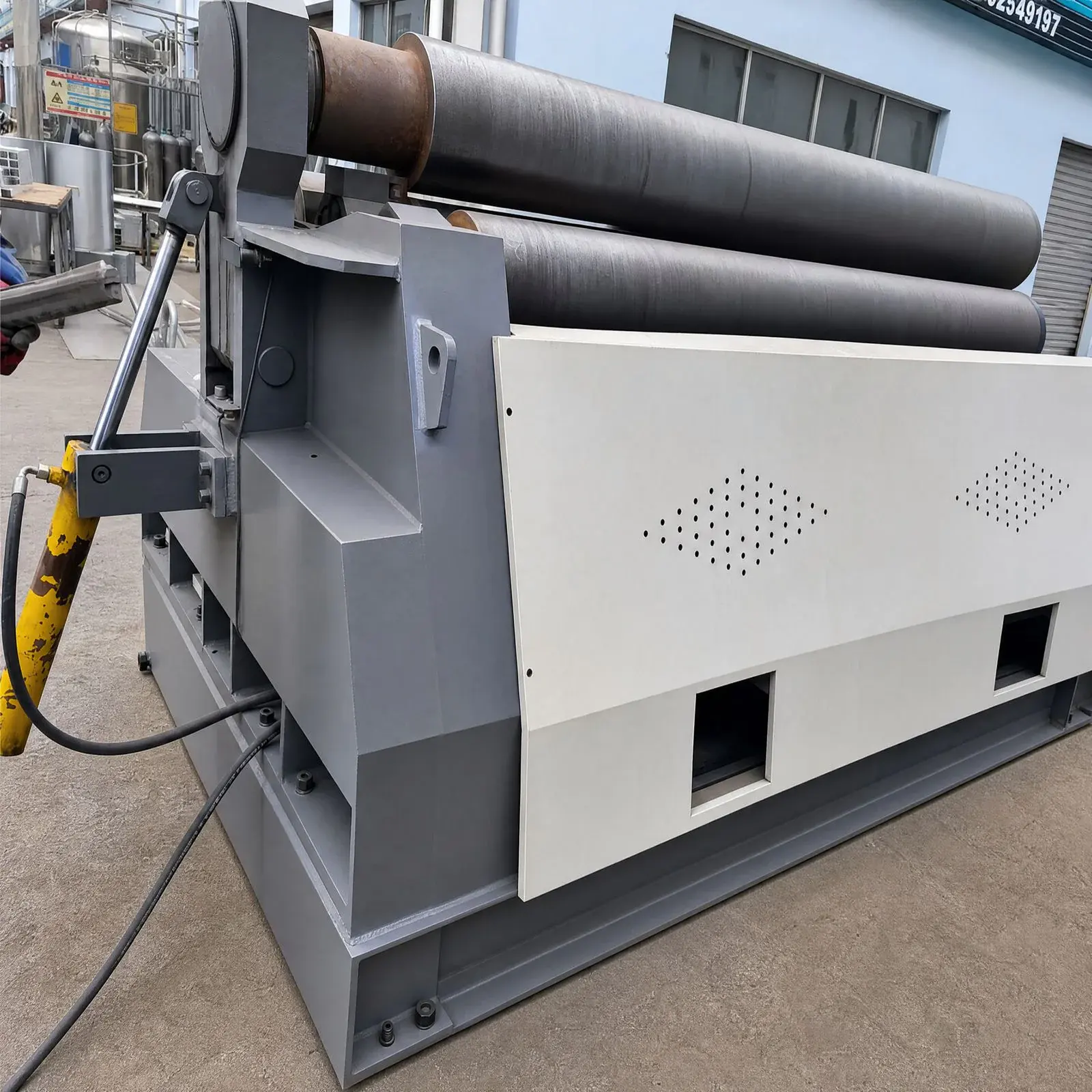
In short: plate rolling curves flat plate into a cylinder (or cone) by feeding it between rolls that bend it past its yield point into a permanent radius. The contrast that defines the station is three-roll versus four-roll geometry: a three-roll machine bends with two fixed lower rolls and one repositionable top roll, but cannot pre-bend the plate ends, so it leaves flat "leftover" tangents that must be dealt with separately. A four-roll machine adds a fourth roll so it can clamp the plate against the top roll and pre-bend each end first, then roll the body — giving smaller flat ends, better centring, and less cross-section distortion in one pass.[1] The second hard problem is springback: when the rolling load is released the plate elastically recovers and the radius opens up, so the rolls must be set to *over-bend* relative to the target — flexible roll-bending studies put the springback rate at roughly 5–15%, varying non-linearly with target radius, so the roll position is back-calculated from the finished radius, not the bent one.[3] This guide covers the four-roll bending principle, three-roll versus four-roll geometry, springback and compensation, minimum rollable radius and cone rolling, and how rolling pairs with press-brake bending.
What Plate Rolling Is
Plate rolling — also called roll bending or plate bending — is a forming process that turns flat plate into a curved shell: a cylinder, a cone, or a segment of either. The plate is fed between a set of large powered rolls; one or more rolls are offset from the line of the others, so the plate is forced to follow a curved path and takes a permanent radius as it passes through. Run the plate back and forth, adjusting the roll positions, and the curvature is progressively brought to the target until the two edges meet to form a closed cylinder ready for welding.
The mechanics are pure bending past the yield point. Across the plate thickness the outer fibers are stretched in tension and the inner fibers are squeezed in compression; somewhere between them sits a neutral layer that is neither, and the further a fiber lies from that neutral layer the more it is strained. When the imposed strain exceeds the elastic limit the deformation becomes permanent, and the plate keeps the curvature instead of springing flat again. Everything that makes rolling difficult — springback, minimum radius, end pre-bending — follows from this single fact that only the plastic part of the bend stays.
At steelhui, plate rolling is the cylinder-and-cone forming station. It is matched to press-brake bending, which makes sharp discrete folds: where the press brake creates a defined angle along a line, the roll bends a smooth continuous curve along the whole plate. The machine here is a four-roll plate roller, chosen for the end-to-end control that produces accurate shells with the least manual rework — the geometry advantage explained below.
The Four-Roll Bending Principle
A four-roll machine has a top roll, a bottom roll directly beneath it, and a side roll on each end. The top and bottom rolls form a pinch pair: they clamp the plate between them and drive it through by friction, so the plate is gripped and fed positively rather than just resting on the rolls. The two side rolls do the bending — each can be raised toward the top roll, and the higher a side roll is set, the tighter the curvature it imposes on the plate passing over it.
A typical sequence runs in three moves. First the leading edge is pre-bent: the plate is clamped in the pinch and the near side roll is raised to curve the short flat end that the rolls would otherwise leave straight. The plate is then rolled through the body, with the side rolls set to the radius that — after springback — gives the target, sweeping the full length into a continuous arc. Finally the plate is reversed and the trailing edge is pre-bent the same way, so both ends arrive at the seam already curved.
Because the plate is always pinched and aligned between the top and bottom rolls, it cannot skew or slip as it feeds, and both ends can be pre-bent without unloading and re-fixturing. That single-setup control is the whole reason a four-roll is preferred for accurate shells: the round comes off the machine with short flat tangents at the seam and a consistent radius around the circumference, ready to tack and weld.
The neutral layer is the reference for the bend. The finished radius the customer specifies is usually the inside or outside surface; the rolls work the material at the neutral layer, so the roll geometry is set relative to it and to the plate thickness — which is also why thicker plate needs a larger minimum radius (see below).
Three-Roll vs Four-Roll — The Geometry Difference
Both machines roll cylinders, but they differ in how the rolls are arranged and what that arrangement can do at the plate ends. A three-roll machine has two lower rolls fixed in position and a single top roll that moves up and down (or, in a pyramid layout, the reverse); curvature is set by how far the moving roll is pressed in. The plate is supported on the two lower rolls and bent by the central one.[1]
The limitation of the three-roll layout is the flat end. Where the plate sits on a lower roll, the short length of plate beyond the last contact point is never bent — it stays a straight tangent, the "leftover" flat that has to be removed, pre-bent on a press, or trimmed off afterward. A three-roll machine also has to manage plate alignment more actively, since the plate is not clamped the way a pinch pair clamps it.
The four-roll machine adds a dedicated supporting/side roll, and that extra roll is exactly what removes the flat-end problem. The plate is held in the top-bottom pinch while a side roll bends the end, so each edge is pre-bent in place and the leftover flat is small. The review literature on roll bending of curved profiles makes the same distinction generally: a third (or fourth) roll added to a two-roll arrangement is a repositionable roll whose offset sets the curvature, and the added roll improves control of the cross-section, reducing the distortion and the unbent end that a simpler layout leaves behind.[1]
The practical upshot for accurate shells: a four-roll gives smaller flat ends, better centring, and less cross-section distortion in a single setup, at the cost of a more complex, more expensive machine. For pressure-vessel and tank work — where the seam must close cleanly and out-of-round must be small — that single-setup four-roll control is why it is the layout of choice here.
Springback & Compensation
No bend stays exactly where it is rolled. When the rolling load is removed the elastic part of the deformation recovers, the curvature relaxes, and the radius opens up — the plate springs back toward flat. Only the plastic part of the bend is permanent, so the radius that comes off the machine is always larger (slacker) than the radius the rolls were set to. This is springback, and getting a part to the right radius means predicting it and rolling tighter than the target on purpose.
Modelling of precision four-roll bending treats this directly: on unloading the elastic recovery makes the curvature and bend angle spring back, and the amount depends on the material and the section — higher modulus, higher yield strength, thinner plate, and the friction conditions all shift how much the part relaxes. A control model therefore needs a springback compensation step that adjusts the commanded roll position so the post-unload radius lands on the target.[2]
How much springback to expect is not a single number. Flexible four-axis roll-bending studies on aluminium alloy report a springback rate of roughly 5–15%, and — importantly — show that the relationship between the target curvature radius, the pre-deformation, and the springback is non-linear: a tighter radius does not spring back by the same proportion as a slacker one.[3] Because of that non-linearity the practical method is to back-calculate the roll positions from the desired finished radius, applying a compensation that itself varies with the radius, rather than assuming a fixed over-bend everywhere.
Springback is governed by the material's elastic recovery (modulus and yield strength), the plate thickness, and friction. The same target radius on a stiffer or thinner plate needs a different roll setting — which is why the first ring of a new job is checked against a radius gauge and the rolls trimmed before the run.
Minimum Radius & Cone Rolling
There is a limit to how tight a plate can be rolled. The minimum rollable radius is the smallest curvature the plate will take without the outer fibers cracking or the section buckling, and it scales with the plate: the thicker the plate, the larger that minimum radius, because thicker material strains its outer fibers harder for a given radius. The material matters too — a stiffer, less ductile grade tolerates less outer-fiber strain than a soft, ductile one, so it cannot be rolled as tight.
In practice the minimum radius is read off the machine's capacity for a given thickness and grade, and a job that asks for a radius tighter than the plate will safely take has to be rethought — a thinner plate, a more ductile grade, or a segmented build rather than a single rolled ring. Conversely, very large-radius shells approach flat and are limited at the other end by the rolls' ability to impose any curvature at all on a near-straight plate.
A four-roll machine also rolls cones, not just cylinders. A cone is rolled by feeding the plate through at an angle so that one edge travels faster than the other — the rolls impose a tighter radius along the short (small-diameter) edge and a slacker radius along the long (large-diameter) edge, sweeping a conical surface instead of a cylindrical one. Cone rolling demands careful control of feed and roll position because the curvature varies continuously across the plate width, and the four-roll pinch — which keeps the plate aligned throughout — is what makes that controllable.
Precision & Tolerances
A rolled shell is judged on roundness (how close the ring is to a true circle, i.e. how small the out-of-round) and on the radius matching the specification once springback has settled out. Both follow from disciplined pre-bending and springback compensation rather than from a single pass — the round is brought in progressively and checked against a radius template before the seam is closed.
The figures below are the working envelope for this station — the thickness and width the machine handles, and the roll count that gives the end-to-end control. Holding tolerance on a shell is as much about controlling springback and out-of-round as about the roll setting alone, which is why the pre-bend and compensation discipline covered above is what actually delivers the dimensional result.
| Max thickness | 25 mm |
| Max width | 2500 mm |
| Rolls | 4-roll |
Materials & Thickness Range
Plate rolling at steelhui is built around stainless and carbon-steel plate within the station's thickness and width envelope. Thickness is the primary constraint: it sets both the maximum the rolls can drive past yield and the minimum radius the plate will safely take, so the capacity figures below define which shells can be rolled in a single ring versus built up from segments.
| Max thickness | 25 mm |
| Max width | 2500 mm |
| Rolls | 4-roll |
Within that envelope the grade governs the springback compensation and the minimum radius — a stiffer, higher-strength plate springs back more and tolerates a less tight radius than a soft, ductile one, so the roll positions are tuned to the actual plate, not assumed. Wider plate is rolled across the full roll width up to the machine's capacity, and longer-than-capacity cylinders are made by rolling and welding multiple rings together.
Rolling Equipment
Plate rolling here runs on a dedicated four-roll plate-rolling machine. The four-roll configuration is the reason the station can pre-bend both plate ends, keep the plate pinched and aligned through the body, and roll cones as well as cylinders — all in one setup, with the smaller flat ends and lower out-of-round that accurate shell work needs. Full machine specifications, including thickness and width capacity, are listed below.
Applications by Sector
Plate rolling earns its keep wherever flat plate has to become a round shell that closes cleanly and holds its shape — tanks, vessels, towers, and ducts.
Tanks & Storage Vessels
Cylindrical bodies for storage tanks and process vessels, where the rolled course must be round enough for the longitudinal seam to close without forcing and for stacked rings to align. The four-roll pre-bend keeps the seam tangents short so the weld prep is clean.
Pressure-Vessel Shells
Shell courses for pressure-containing equipment, where out-of-round is held tight and the radius matched to specification so the welded seam and the heads fit correctly. Controlled springback compensation is what lands the finished radius on target.
Wind-Tower & Structural Sections
Conical and cylindrical sections for wind-tower segments and similar large structural shells, rolled from heavy plate and built up ring by welded ring into the full tapered or straight column.
Ducting & Pipework
Large-diameter ducting, stacks, and fabricated pipe where plate is rolled into tube too large to draw or extrude. The continuous curve of a rolled cylinder gives a smooth bore and a single longitudinal seam.
- Advances and Trends in Forming Curved Extrusion Profiles. Materials (MDPI), 2021. Three-roll: two fixed bottom rolls plus one adjustable top roll to vary curvature; a four-roll machine adds a support roll, reducing section distortion and improving end pre-bending. pmc.ncbi.nlm.nih.gov/articles/PMC8037283
- Design and development of high precision four roll CNC roll bending machine and automatic control model. Scientific Reports (Nature), 2023. Elastic recovery on unloading causes springback in curvature and angle; springback depends on E, yield strength, thickness and friction, and requires a compensation model. pmc.ncbi.nlm.nih.gov/articles/PMC10415372
- Springback characteristics and influencing laws of four-axis flexible roll bending forming for aluminum alloy. PLOS ONE, 2024. Springback in flexible roll bending is about 5%–15%; radius and pre-deformation affect springback non-linearly, so roll positions are back-calculated from the target radius. pmc.ncbi.nlm.nih.gov/articles/PMC11349108